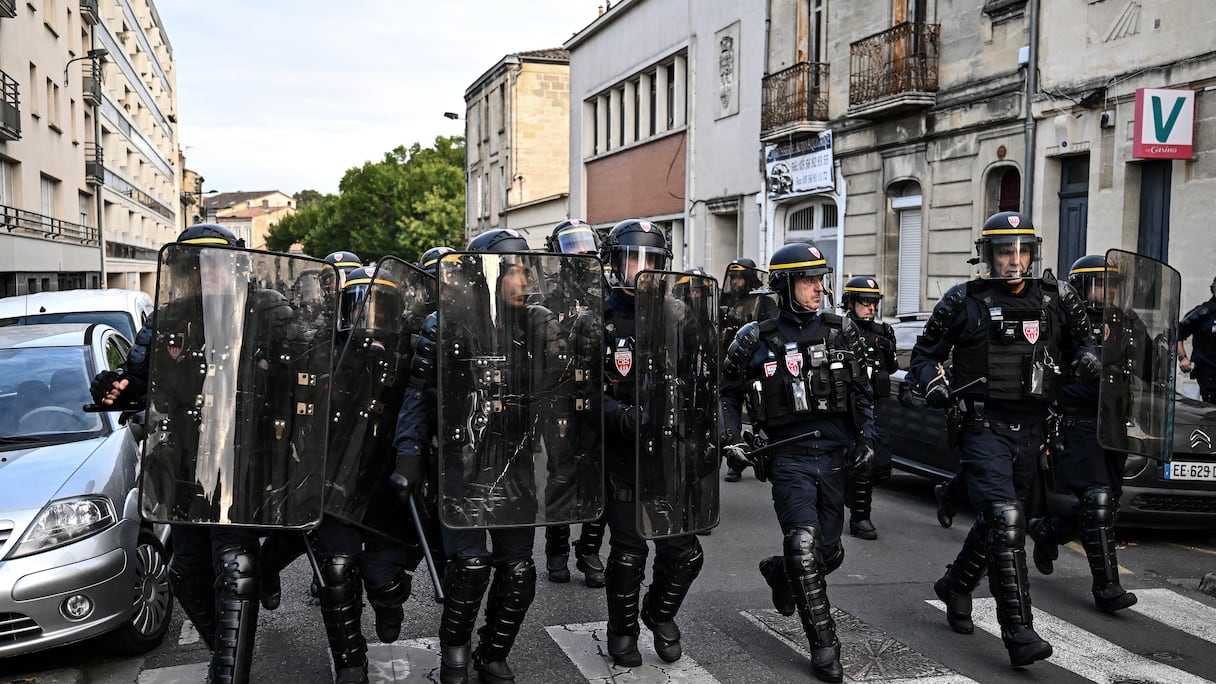
Since September 28, French high schools have been living to the rhythm of blockades—and batons. The figures would make more than a few of those “authoritarian regimes” routinely hauled over the coals on Paris television panels blush: 6,059 arrests in a matter of days. In the Paris region, 85% of those arrested are minors. Children handcuffed as they leave school, backpacks still on their shoulders. The authorities themselves acknowledge that 215 students have been injured.
Some will never fully recover. In Tours, a 16-year-old student struck in the head outside Balzac high school lost the sight in his right eye. In Lens, a 15-year-old boy had his hand blown off during a demonstration. In Argenteuil, a 16-year-old was hit in the eye by an LBD rubber bullet. In Saint-Ouen-l’Aumône, a 14-year-old was struck full in the face by a tear-gas grenade fired at close range. His jaw is now wired shut, he can no longer speak and has to eat through a straw. His family has filed a complaint for attempted murder.
The images leave little room for ambiguity. Three helmeted police officers facing a teenager. The first blow. The student kicks back. Then a grenade launcher is fired straight into his face, and his body crumples to the ground. The French Human Rights League speaks of a “broader drift away from the rule of law” and of “repression that shatters lives.”
What if it happened in Morocco?
Imagine for a moment that these figures, these injuries and these images came from Casablanca, Tangier or Rabat. It does not take much imagination: we know the drill. Red breaking-news banners would be running nonstop across France 24, BFMTV and Franceinfo. The “Maghreb experts” would be dragged out of bed at dawn. Every injured teenager would get a profile, a tearful mother, a lawyer and a live cross. An NGO would join by video link from Geneva. And on the 8 p.m. news, the verdict would come down: Morocco is an authoritarian country. The label would then be stamped onto every headline, every standfirst and every presenter’s follow-up question.
Then would come the usual suspect. As always, the spotlight would turn to the security apparatus headed by Abdellatif Hammouchi, pronounced guilty before the facts had even been established—and sometimes in place of evidence altogether. There would be calls for international investigations, conventions would be dusted off, and Rabat would be lectured about the gap between its words and its actions. And the 715 police officers and gendarmes injured, the figure French authorities are keen to highlight? In Morocco, they would merit, at best, half a sentence at the end of a report.
Paris: just another news brief
But this story carries a French passport, and suddenly everything changes, beginning with the vocabulary. “Repression” becomes “tensions on the fringes of the protests.” “Police brutality” becomes “public-order management.” A hand blown off? A “regrettable incident.” An eye lost? An “unfortunate consequence.” As for the word “authoritarian,” it vanishes from the lexicon with admirable speed. One could almost believe it exists only as an export product.
The tempo changes too. Solemn guests call on “all sides to act responsibly.” We are reminded—rightly—that hundreds of police officers have also been injured. And suddenly, these newsrooms rediscover virtues they have never thought worth extending to Morocco: context, the complexity of the situation on the ground, the need to wait for the investigation to run its course.
Scandal is something that happens to other people
Pascal wrote it centuries ago: “Truth on this side of the Pyrenees, error on the other.” For a certain section of the French press, the dividing line now runs through the Strait of Gibraltar.
Morocco knows this double standard by heart. Remember the Pegasus saga. Outlets such as France 24 uncritically relayed yet another Amnesty International report built around the testimony of a low-level figure presented under the pseudonym “Safir.” The same outlets became positively coy when confronted with the Predator Files, the 2023 investigation that revealed how French companies, including Nexa Technologies, had helped equip authoritarian regimes with spyware. Spyware becomes a state scandal when Rabat is suspected of using it; when it is made in France, it reverts to being just another export contract. There is always time to worry about the state of freedoms in Morocco. Never quite enough to scrutinize what happens in France with the same fervor.
No one is asking these newsrooms to flagellate themselves. Only to apply to France the standards they apply to Morocco. 6,059 arrests, hundreds of minors in handcuffs, more than 200 students injured, several maimed for life: surely that warrants a vocabulary at least as forceful as the one routinely deployed to describe public-order operations in Morocco. All it would take is a change of language. Perhaps next time… in Rabat or Casablanca.
