
The Tangier Observatory for Environmental Protection and Historic Monuments (OPEMH) raised the alarm on September 28 after reporting the presence of oriental hornets in “several areas of the North.” The observatory called for urgent field surveillance, a regional alert system and scientifically supervised control measures.
The Moroccan Interprofessional Federation of Beekeeping (FIMAP) has meanwhile formed an inspection and surveying commission to assess the extent of the hornet’s presence.
Speaking to Le360, OPEMH President Saïd Chakri said he fears the species could become invasive within one to two years. FIMAP said its commission is currently conducting field surveys to determine the degree of infestation.
What is the oriental hornet?
The oriental hornet is a member of the Vespidae family. It was described by Carl Linnaeus in 1771 and belongs to the Vespa genus, which includes 22 hornet species.
All species in the genus live in colonies organized around a queen, making them eusocial insects. The genus is found mainly in Asia and New Guinea, with two exceptions: the European hornet (Vespa crabro) and the oriental hornet. “Several types of hornets already live in Morocco,” Chakri said.
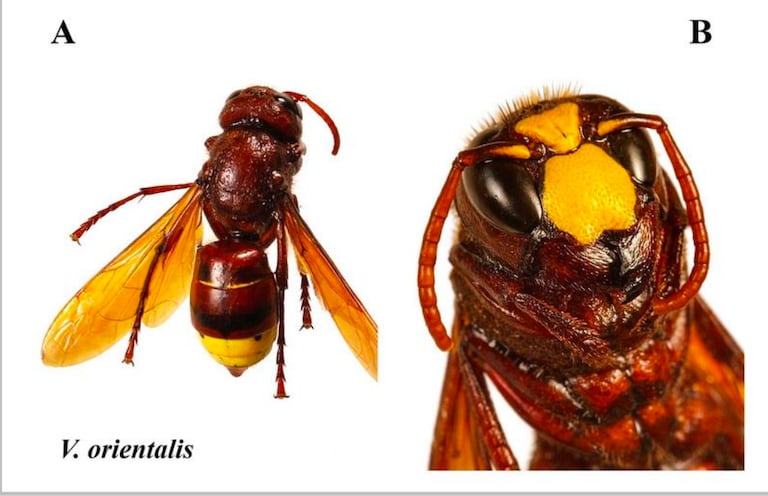
The oriental hornet is recognizable by its reddish, orange and yellow markings. Its native range covers western and central Asia, including Turkey, Iran, Pakistan, India, Nepal, China’s Xinjiang province, the Arabian Peninsula and the Middle East. Its range also extends into southeastern Europe, southern Italy, southern European Russia and parts of East Africa, from Egypt to Somalia.
The species has also been introduced into Europe. It has established populations in Spain and southeastern France and is believed to be in the process of establishing itself in Romania and northern Italy. Several countries have introduced control protocols and national eradication plans, according to Chakri.
The hornet generally nests underground, using abandoned rodent burrows or cracks in rocks, although it can also occupy buildings.
Adult hornets mainly feed on nectar, tree sap and honey, as well as ripe fruit in the fall. Females hunt other invertebrates to provide protein for their larvae. The insect is both a scavenger and predator. It preys on honeybees and other pollinators, although it can itself also play a role in pollination.
In many countries within its native range, the oriental hornet is among the main predators of honeybees. A beehive provides it with both protein, from adult bees, nymphs and larvae, and carbohydrates, from honey and nectar.
Its attacks on apiaries can be devastating, including in areas where it has been introduced, Chakri said.
The oriental hornet should not, however, be confused with the Asian hornet (Vespa velutina), also known as the yellow-legged hornet. The two are different species within the same genus and have different life cycles. Their control protocols are therefore also different, Chakri warned.
Read also : Casablanca steps up awareness campaign as summer heat drives rise in reptiles, scorpions and pests
A life cycle that helps the species spread
The oriental hornet’s life cycle follows the seasons.
Each spring, in March and April, a queen emerges from dormancy, searches for a suitable site and establishes a nest. She initially feeds the first larvae herself, using protein from bees.
“This is why it kills bees,” Chakri said.
The presence of a single hornet can be enough to paralyze a colony, he said. “As soon as bees see a hornet, they no longer dare to leave or search for nectar.” Stressed worker bees remain inside the hive, after which most colonies collapse on their own.
“The hive is doomed,” Chakri said.
The colony grows throughout the summer, with numbers increasing sharply in warm weather, which the hornet favors. Its population peaks around October, when about 400 workers can be present at the same time.
The hornet also differs from the honeybee in its ability to survive after stinging. A honeybee injects its stinger and dies shortly afterward, while the hornet survives. It is more resilient, making eradication difficult.
The nest declines rapidly after males and future queens appear. October and November are the reproductive period. Gardens are then mainly occupied by males and queens. The males die, while worker hornets die during the winter. Fertilized females seek shelter and spend the cold season dormant.
“The queens are therefore the greatest danger right now because they are the future nests,” Chakri warned.
A nest lasts only one year. If a nest exists today, new nests will appear the following spring, although not necessarily in the same location because each nest depends on an individual queen. Once the queen disappears, the nest disappears as well. There is no regeneration of the same nest.
This life cycle also helps explain how the species travels.
Fertilized queens spend the winter in sheltered locations, often inside materials or containers transported by humans over long distances. They can therefore spread without being detected. A queen can carry eggs, sometimes numbering in the hundreds, and only a few queens are enough to establish a population when conditions are favorable.
In practice, the species is spread mainly through the movement of goods, with females responsible for establishing new populations.
Why officials want stronger monitoring
The OPEMH said it is following recent reports “with interest and concern,” particularly observations of the insect in Tangier, Tetouan, M’diq and Fnideq.
The observatory is also referring to a scientific study published in 2026 that documented the establishment of two hornet species in northern Morocco. The researchers said surveillance needs to be strengthened to map their distribution and assess their potential effects on beekeeping, ecosystems and public health.
Beekeepers are not the only people potentially exposed. According to studies cited by the observatory, the species can establish nests in cracks, cavities and human structures, including near urban areas. Multiple stings can pose a health risk.
Read also : Inside Morocco’s plan to detect and contain diphtheria outbreaks
The observatory has nevertheless urged caution. Recent reports from several neighborhoods in Tangier should be treated as an early warning rather than proof of the full extent or geographical route of the species’ spread.
Determining that requires an organized field inventory of nests and individual hornets, precise mapping of each observation, scientific confirmation of the species identity in collected samples, and monitoring of population density and distribution.
The OPEMH has put forward five requests to authorities.
First, it is calling for urgent, coordinated field surveillance in Tangier and elsewhere in the North. The operation should define the distribution range of Vespa orientalis and produce an initial map of infestation sites and nests, with a focus on four areas: apiaries, residential zones, schools and sensitive natural areas.
Second, it wants a regional surveillance and early-warning mechanism bringing together relevant government services, local authorities, scientists, universities, beekeeping professionals and associations. The mechanism would collect reports, verify them scientifically and monitor changes in the species’ spread.
Third, the observatory is calling for an integrated management program based on scientific identification of nests, assessment of the level of risk and intervention by professionals to destroy nests when necessary.
The OPEMH opposes indiscriminate control measures, which it says could harm native insects and pollinators. It says the scientific literature supports an integrated approach.
The fourth request concerns beekeepers. The observatory wants them supported and surveillance activated in apiaries to identify predation pressure and possible losses. It is also calling for hive-protection protocols and systematic data collection to measure the phenomenon’s actual economic and environmental impact.
The fifth focuses on public awareness without creating panic. The observatory is urging people not to approach nests or attempt to burn or remove them themselves. It also wants a clear channel for reporting hornet sightings and nests so that the relevant services can intervene.
The observatory’s position is that early action should be based on scientific evidence. Rapid detection, identification of breeding sites and organized intervention would be more effective than waiting for the species’ range to expand, pressure on apiaries to increase or dense colonies to appear in urban areas.
The OPEMH has also invited Abdelmalek Essaâdi University, specialized scientific institutions and beekeeping professionals to participate in a regional program to monitor the species, track its spread and assess its potential environmental, economic and health effects.
FIMAP launches field survey
FIMAP said its own commission is conducting field surveys and identification work. The commission includes FIMAP, the National Office for Food Safety (ONSSA) and the agriculture ministry’s external services.
Read also : Older, more urban and slower-growing: What Morocco could look like by 2060
Initial findings remain limited, according to the federation. The oriental hornet has been identified in northern Morocco, but its prevalence and intensity remain unknown. An assessment is planned.
In Casablanca, confirmation and further details are still pending. FIMAP said there is currently no solid evidence to establish the situation there.
The timing is a concern. During their initial field surveys, OPEMH members found numerous queens. The presence of queens points to the possibility of future nests and, therefore, wider expansion.
Chakri said the coming years could be more difficult, although he currently considers the situation “not very serious.”
Like other introduced species, the oriental hornet goes through several stages of establishment. Morocco is currently, in his view, at the introduction stage. He believes the species could enter the invasive-species stage next year or the year after, meaning it would become permanently established and spread and reproduce on a much larger scale.
Potential impact on honey and fruit production
According to Chakri, the first economic impact would be on honey production.
He fears production problems could worsen an already existing decline linked to climate change. The hornet, he said, could accelerate that decline, with people who sell honey likely to be heavily affected.
The risk also extends to fruit orchards. Bees provide most of the pollination for certain fruits. Apple trees are one example, with bees serving as their main pollinators.
Chakri pointed to colony-collapse syndrome observed in Europe and the United States, which has already reduced apple yields. He also described the issue as a biodiversity concern.
He nevertheless urged the public not to panic.
“First of all, we must not frighten people by talking about the risk of attacks,” he said, stressing that the hornet only attacks when its nest is disturbed.
Read also : Moroccan poultry producers sell below cost as prices plunge
Chakri said he had surveyed Tangier and found hornets in most gardens, schools and natural areas he visited.
“We have never heard of a hornet attacking a child,” he said. “So that is not the issue.”
What a scientific study found in northern Morocco
The OPEMH is also citing a recent scientific study titled “First records of the genus Vespa Linnaeus, 1758 (Hymenoptera: Vespidae) in Morocco,” published in the Revista gaditana de Entomología, Volume XVII, No. 1, in 2026.
The study was co-authored by Ouafaa Driauach of Abdelmalek Essaâdi University in Tetouan and Leopoldo Castro, among others.
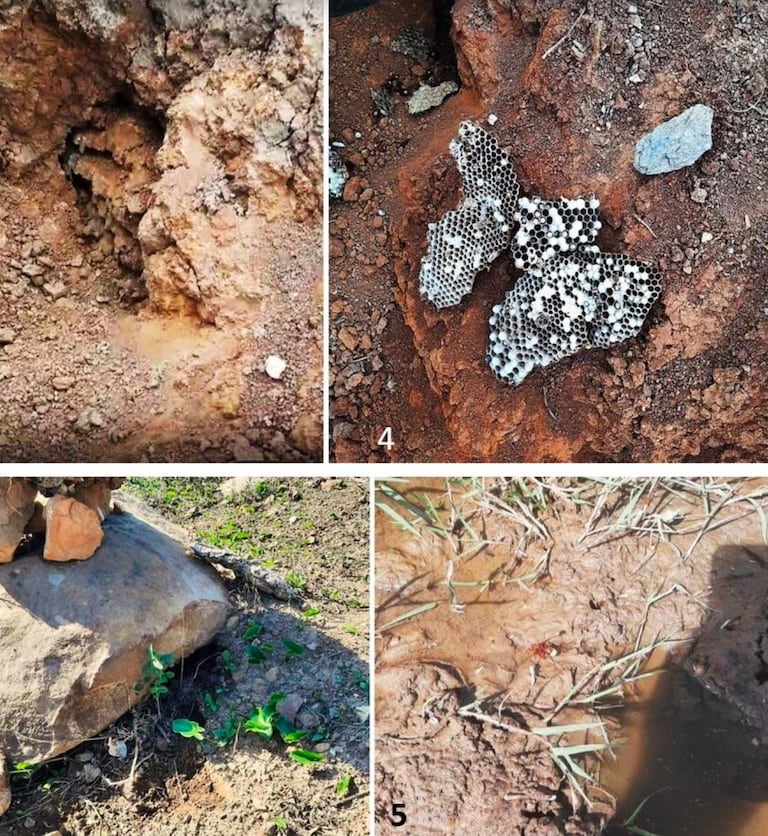
Researchers began their work after receiving complaints from beekeepers in 2025. They conducted surveys from October 1 to November 29 at eight sites in northern Morocco, mainly in the Rif, collecting 201 specimens from destroyed nests.
The oriental hornet was recorded at six coastal sites between seven and 53 meters above sea level, stretching from Tetouan to Fnideq. Researchers counted 80 nests and collected 166 specimens.
Fnideq and Mallalyene each accounted for 30 nests.
At Cabo Negro, two sites contained 12 nests. Samples from those nests included 47 gynes, or future queens.
All the oriental hornet nests were found in open terrain, either in the ground or beneath rocks.
The European hornet was found only in Bouhachem Natural Park, at elevations above 600 meters. The four nests recorded there contained 35 specimens and were all located inside cork-oak cavities.
The European hornet forms smaller colonies and generally causes limited damage to apiaries. The study did not measure any actual damage caused by either species in Morocco.
The only previous record of the genus dates back to the 1930s, when an oriental hornet specimen was intercepted at the port of Casablanca, according to Rungs (1936). The researchers now consider accidental maritime transport to be the most likely explanation.
The oriental hornet was first photographed in Morocco in 2023 and was widespread by 2025. The researchers believe it probably originated in Spain’s province of Cadiz.
The study concludes that both the oriental and European hornet have become established in Morocco, while stressing that their actual range remains unknown.
The authors are calling for stronger surveillance to determine the species’ impact on beekeeping, ecosystems and public health.
