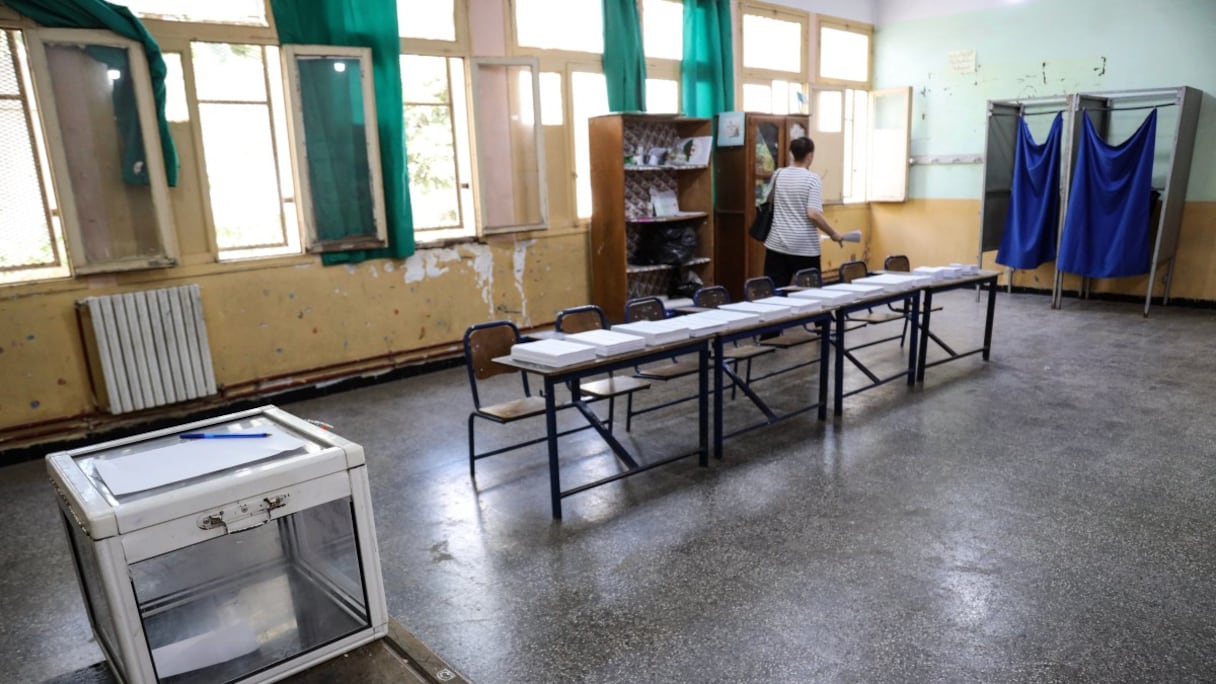
It is an immutable law of Algiers’ political physics: the wider the gap between the regime and the people, and the emptier the ballot boxes become, the louder the regime’s conspiratorial delirium grows.
Confronted with the historic rout of the June 2026 legislative elections, the military junta has found no better way to conceal its own bankruptcy than to revive its oldest and most threadbare formula: inventing an external threat and obsessively pointing the finger at its favorite scapegoat—Morocco.
In this latest low-budget political production, the Algerian authorities are desperately trying to erase the memory of an election shunned by the overwhelming majority of citizens by conjuring the specter of a subversive Moroccan-Kabyle alliance. It is a crude diversionary tactic that no longer deceives anyone.
Indeed, the Algiers regime’s latest invention borders on the absurd. On Monday, July 13, 2026, the Ministry of National Defense (MDN) issued a statement solemnly announcing the dismantling of a “criminal group” in the wilaya of Tizi-Ouzou, the capital of Kabylie.
The target? Six members of the entirely peaceful Movement for the Self-Determination of Kabylie (MAK), designated as a terrorist organization by the junta—including four Moroccan nationals.
According to official propaganda, “as part of field operations conducted to ensure citizens’ security and thanks to the optimal use of intelligence, the Army Security Directorate in the wilaya of Tizi-Ouzou dismantled a criminal group composed of six individuals belonging to the terrorist MAK movement [...], four of whom are Moroccan nationals residing illegally in Algeria.”
The absurdity reaches its peak when the MDN claims, without batting an eye, that the six individuals were “active in the region during the legislative elections with the aim of disrupting the proper conduct of the vote and preventing citizens from casting their ballots.”
A clumsy piece of political theater that the regime is attempting to present as evidence of its strength.
“This operation demonstrates the vigilance of the various security services and their ability to thwart criminal plots by arresting all members of this subversive group, which sought to undermine the country’s security and stability,” the statement reads.
One is almost tempted to applaud the performance. But attributing the mass boycott of an entire country—and an entire region—to the actions of four undocumented Moroccans belongs in the script of a hastily written B-movie produced by security services completely detached from reality.
The reality this state-sponsored lie is desperately trying to conceal is devastating for the authorities: Algerians have definitively divorced their rulers.
Officially, nationwide turnout stood at a meager 20%. Under a regime that has perfected the art of manipulating statistics, the truth is even bleaker. To obtain figures that are even remotely credible in Algeria, official statistics generally need to be divided by four.
In any event, this was the lowest voter turnout in Algeria’s history.
Abstention as a declaration of independence
The renowned French historian and Africanist Bernard Lugan perfectly captured this fracture in his July 14, 2026, column published by Le360:
“What is unfolding in Algeria is indeed a silent Hirak, with 80% of Algerians demonstrating, election after election, that in their eyes the “System” is illegitimate."
The mass rejection of the ballot box in July 2026 directly echoes Abdelmadjid Tebboune’s surreal reelection in September 2024, when he awarded himself a Soviet-style 94.65% of the vote, against the backdrop of turnout that also struggled—and only very hypothetically—to approach 20%.
The people’s message is unequivocal. This regime has no legitimacy.
While deserted polling stations became the norm across Algeria, it was in Kabylie that the regime suffered its most humiliating rebuke. Officially placed at 15%, actual turnout there was, in truth, close to nonexistent.
Asked about this masquerade, Aksel Bellabbaci, adviser to the president of the MAK and one of the movement’s leading figures, offered a forceful assessment.
“This is yet another resounding slap in the face for the regime. Officially, they claim 15% turnout in Kabylie, but we all know that figure has been outrageously inflated. In reality, participation did not even reach 1%,” he told us.
To illustrate this grotesque fraud, Bellabbaci points to glaring evidence widely shared on social media.
“At the close of voting in one polling station in Tizi-Ouzou, the count revealed that only 13 ballots had been cast, two of them invalid. That left just 11 valid votes, while the list of candidates contained more than 30 names. There were three times fewer voters than candidates themselves. That illustrates the scale of Algeria’s tragedy,” he said.
The regime had nevertheless thrown everything it had into the campaign, going so far as to dispatch Abdelmadjid Tebboune on a propaganda visit to Kabylie in an attempt to win over the population. It proved to be an exercise in futility.
“That staged visit achieved absolutely nothing. The Kabyle people, now forced to live in what has become a genuine open-air prison, chose to express themselves through deafening silence. The systematic and overwhelming boycott of every election by the Kabyles is proof that they do not identify with Algiers’ delusions,” Bellabbaci said.
More than a simple refusal to vote, this historic abstention amounts to a genuine declaration of independence by the Kabyle people, who refuse to legitimize the regime in Algiers.
“Since Tebboune came to power, this is the fifth time the Kabyle people have spoken by massively boycotting the ballot box. For us, each of these boycotted elections is a referendum on self-determination, and this regime has no legitimacy among us,” Bellabbaci stressed.
A call for caution
Against this backdrop of deepening institutional decay, blaming the MAK and Morocco has become a matter of political survival for Algiers’ generals.
The regime’s paranoia is no longer confined to propaganda. It now places human lives at risk.
Not content with transforming the reality of the ballot box into a cheap espionage thriller, the media mouthpieces of the Algiers regime have crossed yet another line.
In the wake of the Ministry of National Defense’s statement, the junta’s propaganda outlets have openly turned their sights on the Moroccan community.
To justify what amounts to an incitement to hatred and a xenophobic witch hunt, the regime’s propagandists have begun brandishing the utterly fantastical figure of “one million illegal Moroccans” supposedly living in Algeria.
A statistical fantasy designed to instill fear in an already impoverished public by portraying a small community of modest migrant workers as alleged “sleeper cells” serving a mythical “Moroccan-Zionist alliance.”
Worse still, in rhetoric that defies belief, the regime’s attack dogs now invoke the methods used by Mossad to infiltrate Iran as justification for calling for a sweeping purge of Algerian territory.
With extraordinary indecency, Algiers’ propaganda machine has even resurrected—indeed, celebrated—one of the darkest and most inhumane episodes in Algerian history: the criminal expulsion, on the day of Eid in December 1975, by Houari Boumediene of 350,000 Moroccan civilians torn from their families in retaliation for the Green March.
To hold up that human tragedy today as a “model of surgical firmness” and threaten to repeat such an atrocity proves one thing: confronted with its own political and moral bankruptcy, the Algiers regime is prepared to reactivate its worst instincts of state terror and sacrifice human lives to ensure its own survival.
Faced with this dangerous escalation and the junta’s frantic search for foreign scapegoats, Aksel Bellabbaci issues a solemn and anxious appeal to Moroccan nationals.
“This is a difficult but necessary appeal that I am making to our Moroccan brothers and sisters: for their own safety, they should leave Kabylie and Algeria as quickly as possible. Faced with a cornered regime prepared to sacrifice innocent people for purely political ends, they unfortunately risk both their freedom and their lives. We hope that one day the situation will change and that we will once again be able to welcome them as brothers in a free Kabylie. But for now, the utmost caution is required,” he pleaded.
The supposed “arrest of Moroccan MAK terrorists” is merely the latest symptom of an Algerian regime in an advanced state of decay.
Incapable of offering its young people even the slightest economic prospect, rejected by the overwhelming majority of its own population, and terrified by Kabylia’s democratic aspirations, the military regime in Algiers now survives only through force, falsehoods, and an obsessive hostility toward Morocco.
But by relentlessly invoking imaginary conspiracies to conceal its very real failures, the regime has earned nothing but the contempt of its neighbors and the icy silence of its own people.
A silence that, beyond any doubt, carries within it the seeds of the system’s inevitable collapse.
