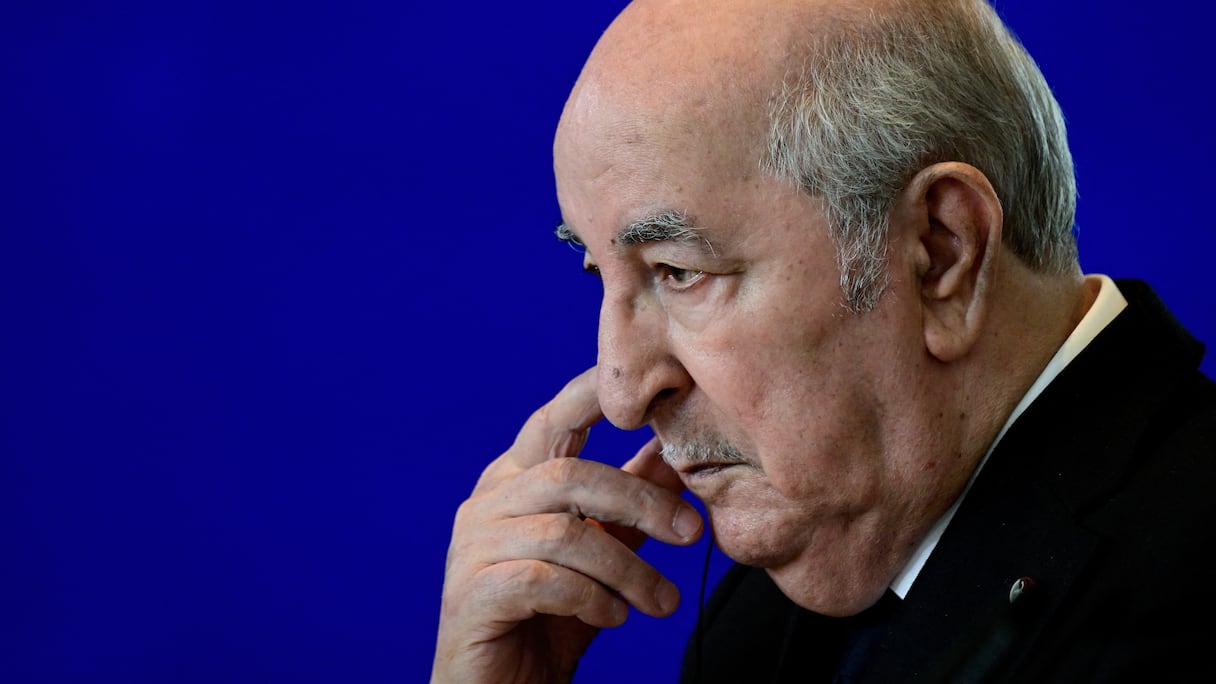
The threat was made before judges on November 15, at the opening of the judicial year. At 16 minutes and 50 seconds into the official video of his speech, the Algerian president promises, if necessary, to go “right to the source where [the drugs] are manufactured,” invoking “self-defense.” It would be a mistake to dismiss this as a mere rhetorical outburst. It is the latest episode in a long series. Since taking office at El Mouradia, Tebboune has relentlessly raised the military stakes, in words, budgets and legislation.
Let us begin with the money, which does not lie. In 2019, the year of his election, Algeria spent $10.3 billion on its military, according to the Stockholm International Peace Research Institute (SIPRI). By 2025, that expenditure had reached $25.4 billion, an increase of 11% year on year, according to the institute’s latest report. Algeria is described as “by far” Africa’s biggest military spender, devoting 8.8% of its GDP and a quarter of all government expenditure to the armed forces, the second-highest proportion in the world after Ukraine, a country at war. For 2027, the Ministry of Defense has been allocated a further 3.12 trillion dinars, according to Algérie Eco. In six years, military spending has increased almost two and a half times. Meanwhile, Algerians queue for potatoes, cooking oil and milk.
The regime cannot afford to fill the shelves. It can afford to fill the arsenals.
Tebboune likes to make those billions count. In June 2021, in an interview with Le Point conducted by Kamel Daoud, he declared, “Morocco has always been the aggressor. We will retaliate if we are attacked. But I doubt Morocco would attempt it, given the balance of power,” while boasting of an army that was “just as modern and just as professional,” as Le360 reported. Tebboune talks about the balance of power the way a poker player talks about his hand. But he would still have to show his cards.
Read also : Is Tebboune going to attack Morocco?
He tried. On July 5, 2022, to mark the 60th anniversary of independence, the regime staged Algeria’s first major military parade in more than three decades. It was meant to be a show of strength directed westwards. Above all, it revealed what was missing. The specialist website Mena Défense, which is close to the military, noted the absence of the Iskander missiles, drones and latest-generation armoured vehicles whose acquisition had been trumpeted by regime propaganda, as Le360 reported. In their place were trucks from another era and a carefully selected audience. The parade was supposed to impress the neighbor. Instead, it embarrassed the military high command. It has never been repeated.
The warmonger had already revealed himself a few months earlier. On November 1, 2021, three Algerian truck drivers were killed near Bir Lahlou, in the buffer zone of Western Sahara. The Algerian presidency immediately issued an incendiary statement accusing Morocco of a “barbaric bombing” and promising, “Their murder will not go unpunished.” Five years later, impunity is alive and well. In the meantime, Major General Mohamed Kaidi, head of the General Staff’s Operations and Training Department, was removed from his post. According to the website Algérie Part, he had expressed disagreement over the handling of the truck incident and the response to be taken against Morocco. The president promised retaliation. Those who know what war entails preferred to forget about it.
The list of bluster does not end there. On December 29, 2022, in an interview with Le Figaro, Tebboune declared, referring to the severing of diplomatic relations with Morocco in August 2021: “We broke off relations to avoid going to war.” A head of state who presents a diplomatic rupture with his neighbor as the alternative to armed conflict reveals at least one thing: the idea of war is familiar to him. In August 2024, in the middle of his presidential campaign, he promised in Constantine, referring to Gaza, “The army will be ready as soon as the borders are opened.” The US ambassador subsequently visited the Ministry of Foreign Affairs to seek an explanation, and Algerian diplomacy was forced to reaffirm its commitment to “peaceful solutions.”
On the night of March 31 to April 1, 2025, the Algerian army shot down a Malian drone near Tinzaouatène. Bamako maintains that the wreckage was found 9.5 kilometers inside Mali. Mali, Niger and Burkina Faso recalled their ambassadors from Algiers and denounced yet “another provocation by the Algerian regime.” A year and a half later, Algiers is sending troops to Niger, one of the three countries that had accused it of aggression. Consistency is not the El Mouradia strategist’s strong suit.
In the absence of a war, Tebboune has laid the legal groundwork. The 2020 constitutional revision introduced Article 91, allowing the president to deploy army units beyond Algeria’s borders with the approval of two-thirds of both chambers of parliament. It was invoked for the first time on October 25, 2026: convened in an extraordinary session, Parliament approved the deployment of a detachment to Niger, officially to protect Sonatrach’s investments. On June 16, 2025, the National Assembly unanimously adopted a law on “general mobilization,” provided for under Article 99 of the Constitution. Those who deliberately start forest fires now face the death penalty. And on November 15, the president promised to reopen the Tanezrouft penal colony and carry out death sentences. The arsenal is complete.
Why such zeal? A man familiar with the inner workings of the regime has an answer. On October 24, speaking on Flash News TV, YouTuber Saïd Bensedira described the sequence: military engagement in Niger, a state of emergency, general mobilization, suspension of the Constitution, a freeze on presidential elections and the extension of Tebboune’s term until the end of the war. He summed it up in these words: “Tebboune will declare a state of war, but he will not be able to announce its end,” as Le360 reported. The scenario is no legal fantasy. Algeria’s Constitution does indeed provide that, in a state of war, the Constitution is suspended, the president assumes all powers and his term, should it expire, is extended until the conflict ends. Tebboune’s current term expires in 2029.
Others are voicing their concerns openly. On August 20, in a column published by Le360 under the headline “Is Tebboune going to attack Morocco?”, Boualem Sansal, who spent a year in the regime’s prisons, offered a chilling assessment: “War speeches are multiplying. Military exercises are multiplying at a frantic pace. A war economy and a system of mass regimentation are being put in place.” He concluded: “All that is missing is a small provocation to ignite the conflict.” The writer described the president as “unpredictable, as Gaddafi was,” challenged him directly (“Where are you taking Algeria, Mr. Tebboune?”), and also addressed the chief of staff: “How far, Mr. Chengriha, will the People’s National Army allow itself to be instrumentalized?” On November 4, in Fez, he drove the point home before students: “Stop waging war on everyone,” and “if we continue like this, we will end up fighting one another.” Three months after his column, Tebboune is promising to strike at the “source.” He is now manufacturing the small provocation himself.
The driving force behind this headlong rush had been identified early on. As far back as 2021, in his book The Prophet and the Pandemic, political scientist Gilles Kepel expressed concern about the Algerian army’s disproportionate weight: “With 28% of the budget and 6% of GDP, it ranks second in the world in relative terms,” he wrote, adding that it “constitutes the backbone of the rentier system,” as Le360 noted.
Read also : Troops abroad, mass mobilization, state of war: Algeria’s temptation to invoke emergency powers
Tebboune has made that army his real program of government. He owes it his presidency: he was elected in December 2019 in a vote demanded by the then chief of staff, Ahmed Gaïd Salah, and rejected by the Hirak protest movement. Since then, he has been repaying his debt in billions, emergency laws and bellicose speeches. He flatters the generals, stages their parades, embraces their conspiracy theories and repeats their threats. He has antagonized Rabat, Paris, Abu Dhabi, Bamako and even Niamey before reconciling with the latter by sending soldiers there. A president whose foreign policy consists of little more than quarrels is not practicing diplomacy. He is preparing for war.
The threat to strike at the “source” of drugs is no isolated outburst. It is another component in a mechanism that Tebboune has been methodically assembling since 2019, with each cog serving a purpose. First step: identify the enemy. Morocco has been accused of “hostile acts” since the diplomatic rupture of August 2021, the Kabylie wildfires have been blamed on it, and drugs are now, in his words, “a war declared against Algeria.” These words are not chosen at random. A war “declared” by the other side constitutes aggression. And invoking “self-defense” means adopting the language of Article 51 of the United Nations Charter, the language states use to justify an armed response. Second step: forge the instruments. Article 91 allows the army to be deployed abroad, and it has been tested in Niger. The general mobilization law allows the entire country to be requisitioned. The death penalty and the Tanezrouft penal colony provide the means to silence those who refuse to fall into line. Third step: pay for it. A quarter of public expenditure already goes to the military. Fourth step, for which everything else is preparation: the Constitution allows the president to declare war in the event of actual or imminent aggression. A state of war then suspends the Constitution, grants him all powers and extends his term until the conflict ends. Every declaration by Tebboune brings Algeria a little closer to that threshold, and all it would take to cross it is an incident.
Tebboune has little left to show Algerians: queues for potatoes, a dinar worth almost half as much on the black market as at the official exchange rate, and an isolated country. He has one costume left, that of a wartime leader, and he never takes it off. His term ends in 2029. He has just three years left to turn rhetoric into a state of emergency, and he already has everything he needs to do so: a designated enemy, a drafted casus belli, laws passed and funding released. Tebboune would not be the first leader to seek in war what the ballot box can no longer guarantee him. So far, his battles have been fought at political rallies, in official statements and on state television. But a man who has nothing left but war to save his presidency will sooner or later be tempted to act. The day he takes that step, he will discover that the “balance of power” he has been boasting about since 2021 is measured on the battlefield, not in newspapers.
