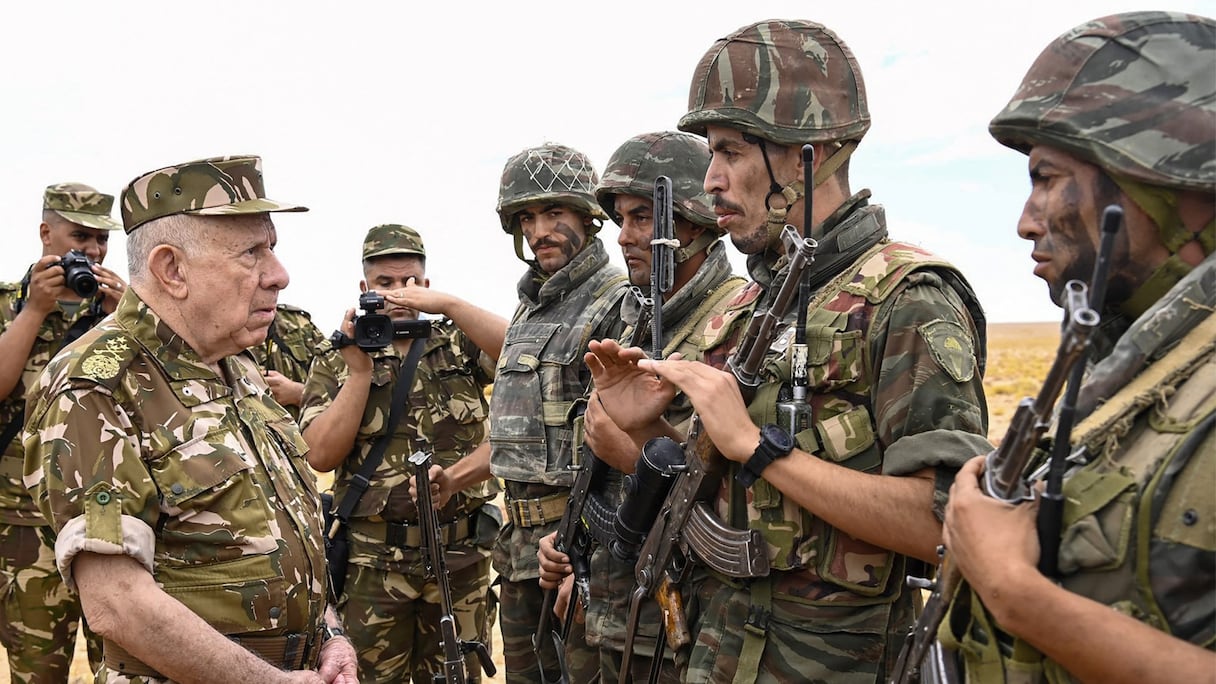
El Djeich is no ordinary magazine. Founded in 1963, the publication of the People’s National Army (ANP) lists Army General Saïd Chengriha, chief of staff, as its “general supervisor,” while its publication director is the head of information and communication at the Ministry of Defense. What appears in its pages is not a columnist’s passing opinion: it is the doctrine of the military high command. Issue 760, dated November 2026, runs to 92 pages. The word “disinformation” appears 17 times, “plot” 12 times, “sabotage” and “saboteurs” 11 times, and “hybrid warfare” 10 times. The vocabulary of a fortress under siege.
It begins with the editorial. Ostensibly intended to commemorate the 72nd anniversary of November 1, 1954, it spends little time dwelling on the heroes of the Revolution. Instead, it swiftly turns to the enemy of today. Algeria, it claims, faces “attempts” targeting “its security, stability and unity,” “hybrid wars,” “campaigns of disinformation, propaganda and manipulation,” “odious campaigns of sabotage” and even “drug trafficking,” allegedly used “to undermine our society.” Drugs are no longer a scourge: they are a weapon aimed at Algeria.
Then comes the list of culprits, resembling a police inventory: “Algeria’s enemies, their henchmen, their zealous servants, their media mouthpieces, the saboteurs who have sold their souls for a pittance, masters of treachery, perfidy and servility.” Who are they? The editorial carefully avoids saying. It does, however, provide a criterion for identifying them: the “achievements” of the “New Algeria,” it declares, “can only be denied by vindictive minds blinded by their hatred and resentment towards our country.” The reasoning is simple.
To question the regime’s record is to hate Algeria. Anyone queuing for a sack of potatoes, a liter of cooking oil or a vial of anesthetic at the dentist’s and who dares complain, therefore, joins the ranks of traitors. Shortages, meanwhile, have become the regime’s only constant, as Le360 recently pointed out.
Read also : Niger: Algeria’s army moves into a former French military base
The editorial draws its conclusion: “today’s battle is, above all, a battle for consciousness.” An army that declares war on the consciousness of its own people is no longer protecting borders: it is policing minds.
The chief of staff goes further. In his November 1 order of the day, reproduced in the magazine, Saïd Chengriha asserts that it has been “established, supported by irrefutable evidence,” that the summer wildfires “were not merely a passing natural disaster but another episode in a series of malicious and criminal plots orchestrated by the enemies of our country, with the aim of obstructing its development and exhausting its resources.” Irrefutable evidence, then. Yet nobody has seen it. The documentary broadcast by state television, to which the magazine devotes two pages, offers nothing beyond the “confessions” of three Algerians arrested in Constantine and Guelma, and references to instigators described as “parties known for their hostility towards Algeria.” In reality, the film pointed to an opposition figure living abroad, as Le360 reported. Drought, heat, neglected forests and the lack of aerial firefighting resources simply do not exist. Only the plot exists.
Along the way, the magazine makes a revealing admission. In a feature on “comprehensive resilience,” it notes that threats now arise in a context “where the distinction between enemy and friend was once more obvious.” The military high command, then, no longer knows who the enemy is. This is the very definition of paranoia: when friend and foe become indistinguishable, everyone becomes a suspect.
To justify this state of siege, El Djeich invokes the war of liberation. A feature entitled “Between Yesterday and Today: Perfidious Plots — Algeria Stands United” states it plainly: “Just as the National Liberation Army fought colonialism to wrest our independence, Algeria today continues the struggle against renewed threats.” The tactic is as old as the regime itself.
Sixty-four years after independence, it reenacts 1954 to avoid having to account for 2026. Today’s critic takes the place of yesterday’s collaborator.
Read also : Troops abroad, mass mobilization, state of war: Algeria’s temptation to invoke emergency powers
A war for “consciousness” requires soldiers of information. On October 25, at the National Army Circle in Béni Messous, Army General Chengriha chaired a seminar entitled “National Media and Hybrid Wars… Confronting Challenges and Rising to the Occasion." Addressing media executives and academics, he called on press officials to “deconstruct tendentious disinformation” and “develop a solid national narrative.” In a normal country, the press reports on what the army does. In Algeria, the army dictates to the press the narrative it must follow.
The enemies remain unnamed throughout almost the entire issue. Morocco, however, appears wherever crime is discussed. The magazine claims that in 2025, “thirty-five tonnes of processed kif” were intercepted “along the borders with Morocco,” and that these seizures “thwarted criminal plans and plots aimed at undermining the country’s stability and cohesion.” Yet those same pages report that the police alone seized 352 kilograms of cocaine this summer, a drug that does not grow in the Rif. The magazine also repeats, as established fact, the case of “61 Moroccan nationals” allegedly belonging to “criminal networks of a subversive nature,” announced on October 11 by Algerian police without any trial or publicly available evidence. The case was so flimsy that the Algerian press had to illustrate it with AI-generated images, as Le360 demonstrated.
A month later, the army magazine sets the allegation in stone.
Then comes the ritual: the “Sahrawi Cause” section, which El Djeich publishes in every issue, as though the Sahara were a province of the ANP. Morocco is described as an “occupying power.” The vote in the UN Fourth Committee is presented as a slap in Rabat’s face, even though Morocco itself voted in favor of the text. The magazine also reproduces at length the statement in which Algiers “regrets” the end of MINURSO, without a word about the veto that brought it about—a veto Algerian diplomacy had itself been calling for, as Le360 noted.
Palestine is no exception. The page devoted to the International Day of Solidarity with the Palestinian People ends with the Sahara, linking “the Palestinian and Sahrawi causes.” Nothing new here: in Algiers, the Palestinian cause has always served merely to establish an analogy and provide a foil for the “Sahrawi cause.” Gaza supplies the backdrop; Tindouf remains the subject.
A regime that can no longer promise bread promises an enemy. It needs plots to explain the fires, saboteurs to explain the shortages, traitors to explain the anger. El Djeich supplies them on every page. An army that devotes its magazine to hunting faceless enemies and dictating its narrative to the press is not preparing to defend Algeria. It is preparing to keep Algeria under its control.
