It was only a matter of time. On October 11, Algeria’s General Directorate of National Security announced that it had dismantled an “extremely dangerous” “Moroccan international criminal network” of 61 people who were preparing to carry out “acts of sabotage.”
As Le360 pointed out the very next day, the statement read like a cheap thriller: suspects who flew into Tunis, slipped into Algeria illegally through the rugged trails and forests of El Kala, then crossed the entire country to reach Oran. No arrest date, just “early October.” No targets. No plan. Not a single weapon. The evidence? Moroccan passports and a few banknotes in dirhams and euros. Even AFP dryly noted that police “gave no details about the actions” supposedly being planned.
Men filmed from behind, passports spread across a table
All that remained was to put a face to this conspiracy. That is where the script went off the rails.
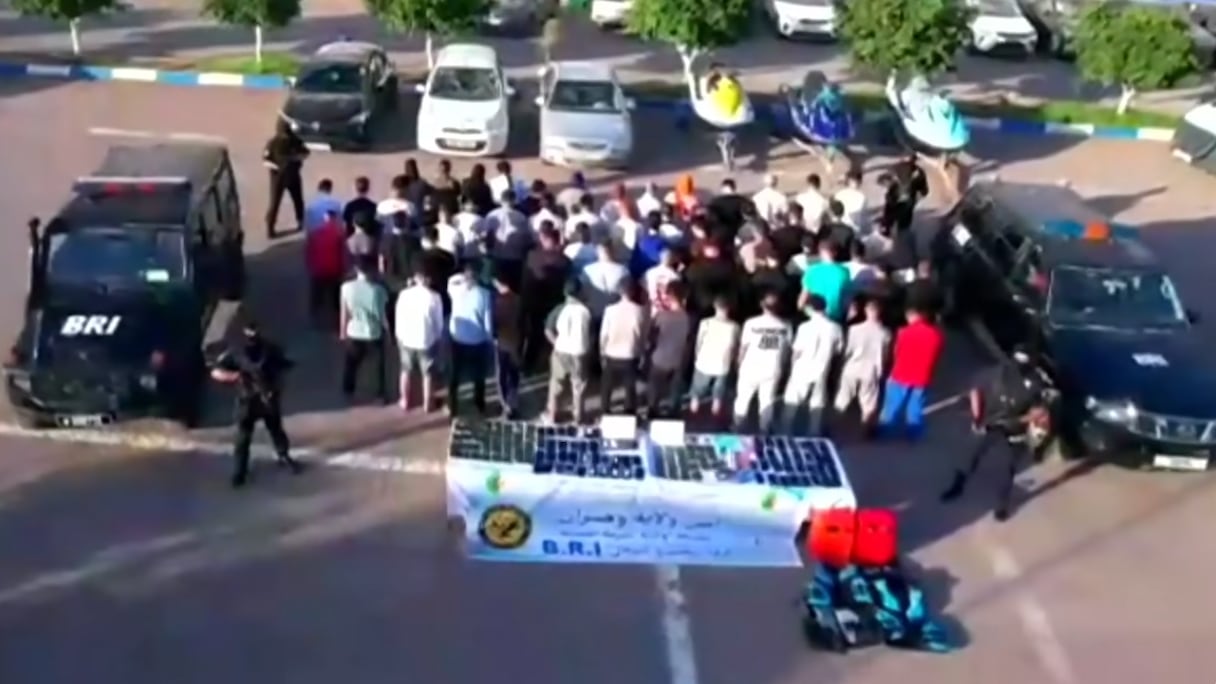
Algeria’s state news agency, APS, first published a photograph showing dozens of men from behind, surrounded by officers from the Research and Intervention Brigade, with a table covered in passports and phones in front of them. State television followed with just over a minute of more of the same.
Read also : Algeria’s army in disarray after seven years of purges under Tebboune and Chengriha
Those images appear to be authentic, France 24 noted. But, the broadcaster added, they reproduce a “staging regularly used” by Algerian authorities to congratulate themselves on their security crackdowns. Sixty-one backs and a table full of passports: behold the evidence of an international sabotage network.
Then came the other images, the ones that supposedly revealed more. Dozens of men kneeling, heads bowed, hands tied behind their backs, surrounded by special forces. Another shot from a different angle, with the table, passports, phones and cash.
According to an RFI investigation featured in France 24’s Info or Intox, these images were generated by artificial intelligence, as Google’s SynthID detection tool showed. And they did not merely circulate on social media. Two Algerian national newspapers, L’Écho d’Algérie and La Nouvelle République, published them to illustrate the case, without so much as a caption.
Let that sink in. The official story was so threadbare that the people tasked with spreading it had to dress it up. You do not manufacture fake photographs to support a solid case. You manufacture them when the real thing shows nothing.
Read also : Nine years on, Algeria is still printing money
Dahdouhism: a user’s guide
None of this is new. Algerians even have a word for this kind of production: Dahdouhism. It takes its name from Abou Dahdouh, the “repentant terrorist” paraded on state television in June 2021, just days before an election shunned by voters, to confess to a supposed conspiracy by the MAK and Rachad movements against the Hirak protest movement.
Sentenced to 20 years in prison, he was acquitted in 2024. The script was recycled in August 2024, on the eve of the presidential election, with the “revelations” of another terrorist allegedly tasked with sabotaging Tebboune’s re-election. Then again in July 2026, after parliamentary elections with an official turnout of 20.79%, this time featuring six supposed “MAK members,” four of them Moroccan, whose “confessions” were broadcast a month later.
The 61 men in Oran are the latest installment in the same series, with a bigger cast and a smaller special-effects budget. The ingredients never change: a foreign enemy, preferably Moroccan; a conspiracy with no details; a televised spectacle; and timing that is always just right.
As Le360 has noted, the UN Security Council is due to take up the Sahara issue in the coming weeks. The next episode has already been written: blurred faces, rehearsed lines and Morocco cast as the mastermind.
Migrants rather than saboteurs?
An official source in Rabat, speaking to Jeune Afrique, called the case a fabrication. According to the source, those arrested were migrants simply trying to reach Europe, recast as a commando unit to serve the regime’s communications strategy.
Read also : Algeria: Humiliated by mass legislative election boycott, regime hides behind “Dahdouhism”
The theory has one advantage: it fits every detail in the official statement. The route through Tunisia, the mountain trails, the passports, the euros in their pockets and the complete absence of weapons. It also has one fatal flaw in Algiers’ eyes: it serves no political purpose.
The most troubling issue remains the fate of these 61 people, detained on the strength of a story that the regime’s own press had to doctor. They are entitled to a lawyer, a fair trial and consular protection from their country. Those rights do not depend on the quality of the script or the special effects.
The Algerian regime wanted a war movie. What it produced was a cheap TV drama, so flimsy that even its own newspapers apparently found it too weak to show without a little digital enhancement.
