The Algerian regime has yet to recover from the slap in the face it received in the July 2 legislative elections. That day, 80% of Algerian voters, according to official figures—but 95% in reality—boycotted the polls. This mass rejection has become chronic since 2019: every election held during Abdelmadjid Tebboune’s two terms has been marked by ever-declining turnout. July’s elections hit a historic low, with an official turnout of 21%, described by some observers as a world record for abstention in a legislative election.
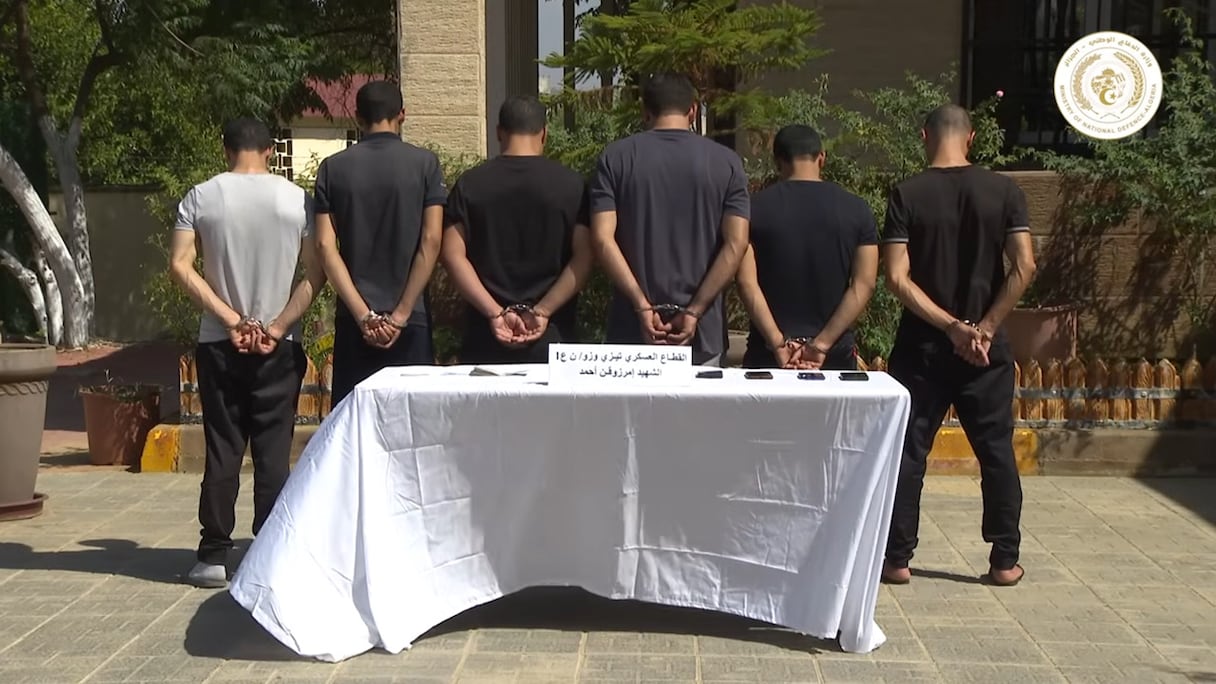
Humiliated by a result that reflects a deficit of legitimacy, if not its total absence, the authorities resorted to their usual diversionary tactics, concocting a scenario of staggering mediocrity. Last Tuesday, the Ministry of National Defense released a video of stage-managed confessions by a «criminal group» allegedly comprising two Algerians and four supposed Moroccans. These individuals are said to have incited millions of Kabyle voters to abstain.
Had this involved nothing more than Algerians campaigning for a boycott, the maneuver would have outraged no one. But the addition of four Moroccan nationals is intended to revive the theory of a «foreign agenda»—the worn-out crutch of a regime incapable of facing reality. Against a backdrop of funereal music and opening graphics alternating between keyboards, computer screens and social-media logos, one member of the alleged group declares straight away: «We received instructions from MAK leaders, headed by Ferhat Mehenni, aimed at preventing voters from casting their ballots.»
The five other extras in this staged production take turns speaking of MAK «cells» in Morocco, as well as trips to Europe to receive money and instructions. Some «admit» they were wrong to place themselves at the service of a supposed «foreign agenda» targeting Algeria, while one of them appeals to «Kabyle youth», urging them to turn away from it. The video finally ends with the word «Makhzen», uttered in a decrescendo by the designated commentator. The ploy is so crude that it takes no finely tuned ear to detect that the accent of the four supposed Moroccans, as well as their speech patterns, are quite simply those of Algerian Darija.
The video comes one month after a ministry statement issued on July 13, 2026, claiming that: «as part of ongoing efforts on the ground [...] the army’s central security services dismantled, in the wilaya of Tizi Ouzou [...] a criminal group composed of six individuals belonging to the terrorist MAK movement, including four Moroccan nationals residing illegally in Algeria, who were active in the region during the legislative election period [...] with the aim of disrupting the smooth conduct of this electoral event.»
Yet this regime lie—which took 30 days to produce in the form of a short video—is all the more blatant given that it is common knowledge that Kabylia has effectively stopped voting since 2019. It is the only region in the world where, across two presidential elections, two legislative elections and a constitutional referendum, several polling stations recorded zero ballots cast. That is why, at every electoral juncture and in the face of the mass boycott championed by the Hirak, the authorities systematically resort to «Dahdouhism» to conceal their illegitimacy and the vox populi’s constant rejection of them.
This strategy began with the first legislative elections of the Tebboune era, in June 2021, which ended with an anemic turnout of 23%. A few days before the vote, as the Hirak resumed its demonstrations across major cities following the Covid hiatus, a certain Ahcène Zerkane, alias Abou Dahdouh, was paraded on state television.
Presented as a terrorist active since 1994, he claimed to have repented after attempting to infiltrate the popular movement and steer it toward armed struggle. According to his «confessions», the mission had been commissioned by the MAK and Rachad. Purportedly arrested on December 18, 2020, in a militant hideout near Jijel, Abou Dahdouh was sentenced in September 2021 to 20 years in prison before being acquitted in November 2024.
Since 2021 and the end of the demonstrations, Abou Dahdouh has become the symbol of the regime’s fabrications. The term «Dahdouhism» has thus become embedded in everyday Algerian parlance as a way of ridiculing a hated regime, referring not only to the false confessions of fake «terrorists», but also to the full range of statements made by Abdelmadjid Tebboune and Chief of Staff Saïd Chengriha.
Exactly two years ago, on August 14, 2024, Algiers aired another episode of this same machinery, just hours before campaigning began for the snap presidential election. State television then presented the purported «revelations of a terrorist» tasked with carrying out a MAK plan to sabotage Tebboune’s reelection. If the Algerian regime imagines that such pitiful scenarios will suffice to contain the electorate’s revolt and Kabylia’s irreversible independence, then it is definitively deaf and blind.