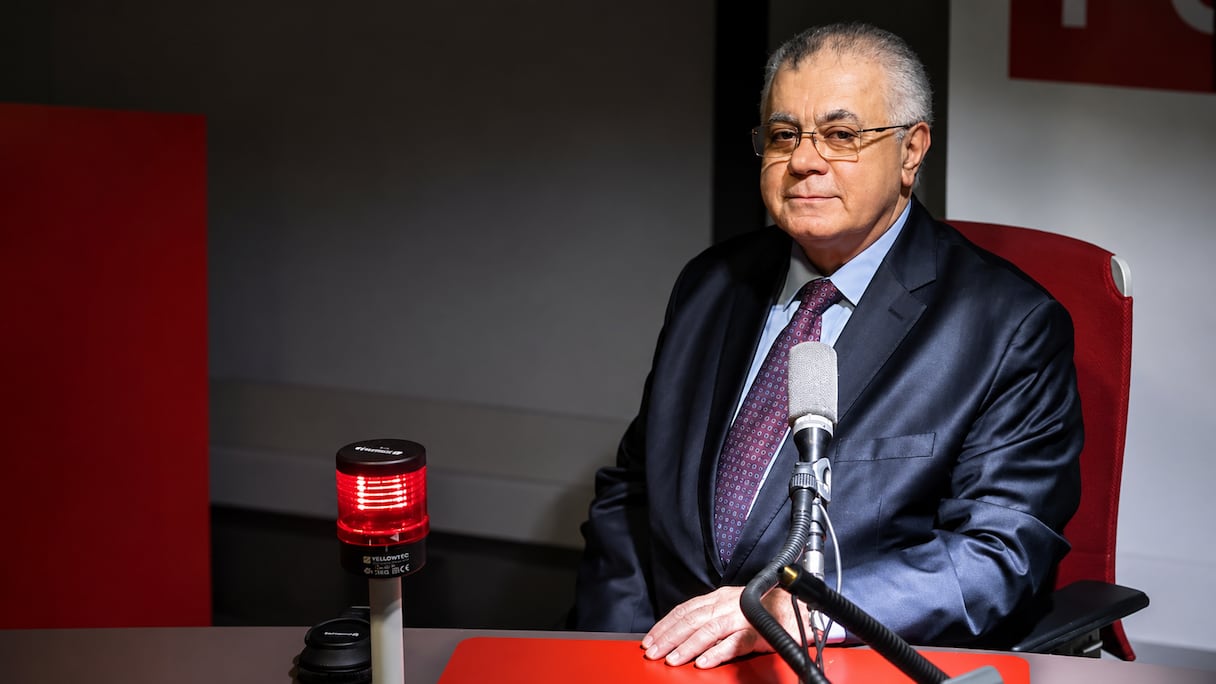
Born in Tehran and having moved to France to pursue higher education, Matthieu Ghadiri belongs to that generation of Iranians whose lives were upended by the Islamic Revolution of 1979. His trajectory took a decisive turn in the mid-1980s, when the Direction de la surveillance du territoire, the former DST, tasked him with infiltrating the intelligence services of the Islamic Republic. To attract their attention, he constructed a cover as a young Franco-Iranian destined for a career at the bar, active in the Socialist Party and familiar with Middle Eastern affairs.
That clandestine experience, followed by a long career in the National Police, allowed him to observe from within the recruitment methods, influence networks and transformations of the Iranian apparatus. Now retired after forty years of service and a recipient of the National Police Medal, he returns in this second installment to a lesser-known chapter of that history: the ties forged between Tehran and Algiers.
How did the two intelligence apparatuses grow closer? What interests drove their cooperation? How far do their strategies converge, and where does their mutual distrust begin? Matthieu Ghadiri now offers his testimony and analysis.
Le360: What objectives was France pursuing when it asked you to infiltrate the intelligence services of the Islamic Republic?
Matthieu Ghadiri: We had three objectives. The first was to understand how the Iranian Ministry of Intelligence operated. The second was to identify its objectives in Europe, and particularly in France. The third was to identify its active or dormant agents on French soil, and it was within this framework that Algeria’s role vis-à-vis the Iranian services would be revealed.
At the time, France was the first Western country to successfully carry out an infiltration at this level within the Iranian intelligence services. The French authorities still knew very little about the organization of the Iranian Ministry of Intelligence, created after Ayatollah Khomeini came to power, its recruitment methods and its chain of command.
After the Revolution, Yasser Arafat had been one of the first leaders to travel to Iran. He had offered Khomeini his help in building an intelligence service for the new authorities, with the support of the Syrian services. Khomeini, who did not much like Yasser Arafat—he said he was a bad Muslim and did not consider him sufficiently anti-Western—refused and instead chose to approach the Soviets directly. The Soviet services therefore contributed to the initial training of the Iranian apparatus. The latter then sought to recruit agents in Western countries, particularly in France. My role was to arouse their interest and induce them to approach me.
How did you attract the attention of Iranian recruiters?
I had to construct what we call, internally, a legend—that is, a credible, coherent identity sufficiently attractive for the opposing intelligence services to want to recruit me. My cover, which I can reveal today, was the following: I had completed my studies and was preparing for the certificat d’aptitude à la profession d’avocat, the CAPA, the professional qualification required to practice law in France. I secured a position at a law firm. At the same time, I was politically active in the Socialist Party.
I gradually took on responsibilities relating to Middle Eastern affairs, eventually joining the team responsible for the region at the party’s headquarters on rue de Solférino.
For the Iranian services, the profile was extremely attractive: a young Franco-Iranian, future lawyer, integrated into French society, active in the Socialist Party and working on Middle Eastern affairs. They thought they were recruiting someone who could penetrate French political circles over the long term. That is how they approached me. The Iranian services were seeking to recruit two categories of people in France. The first consisted of operational agents capable of gathering intelligence or helping prepare certain operations. The second, a very important category to which I belonged, consisted of agents of influence. These agents were expected to open doors, provide analyses and defend Iranian positions without appearing to be official representatives of Tehran.
What was one of the first missions the Iranian services entrusted to you?
We were, remember, in the context of the Iran-Iraq War. Most of the French political class supported Saddam Hussein’s Iraq at the time. Part of the French left, however, had welcomed Khomeini’s revolution favorably. Some intellectuals saw it as an anti-imperialist revolution and a liberation movement. They had not yet understood the nature of the regime that was taking shape.
One of my first missions was to approach figures close to the French government and convince them to support Iran in its war against Saddam Hussein. I first proved myself, in Tehran’s eyes, by recruiting intellectuals, journalists, lawyers and political figures in France. They were not necessarily asking these people to become spies in the conventional sense, but rather to serve as relays for Iran in France. It was enough for them to defend Tehran’s interests, legitimize its policies or influence public debate in its favor.
Then, one day, my Iranian contacts explained that I absolutely had to get close to François de Grossouvre, who was then an adviser to François Mitterrand. They believed his position on the Iran-Iraq War was less favorable to Saddam Hussein. Their objective was to understand the balance of power within Mitterrand’s inner circle but also to identify figures capable of shifting Paris’s policy. They believed François de Grossouvre could play that role.
Did he?
I will answer your question without going into detail. François Mitterrand did indeed seek a rapprochement with Khomeini’s Iran. In 1989, he even considered traveling to Iran, but the visit never took place.
Let us turn to Algeria. How did the French services discover that Tehran was using Algerian criminal networks in France or Europe, as well as networks from Eastern European countries, to carry out covert operations?
The Algerians entered the picture relatively late, from 2004-2005 onward. To help readers understand, allow me to go back to the period that preceded this. When the mullahs came to power, they did not yet have sufficiently robust operational networks in the West. Yet they needed to assassinate certain opponents, carry out attacks or organize kidnappings. Their method was to outsource these operations to organizations already established in Europe and possessing weapons, safe houses, forged documents and escape networks. The Iranians used or turned to Palestinian groups such as the PFLP, Armenian groups—the Armenian Secret Army for the Liberation of Armenia (ASALA)—as well as German, Italian, Basque and other European organizations. The Iranians also worked with individuals close to far-left groups such as Action Directe.
The first assassinations of Khomeini’s opponents illustrate this method, which Tehran would use for around a decade in France, elsewhere in Europe and on other continents. I would cite the most emblematic case, that of Shapour Bakhtiar, the Shah’s last prime minister, who survived a first assassination attempt in 1980 by a commando working for Tehran and led by the Lebanese Anis Naccache. Later, in 1991, he was assassinated by a team of two Iranian terrorists sent from Tehran. They were assisted by an infiltrated agent of the mullahs’ Ministry of Intelligence who had become a close associate of Shapour Bakhtiar. After seven years, this man, who was also related to Bakhtiar, had become his right-hand man. Sadly, there were many other assassinations of this kind in France and elsewhere in Europe.
In the mid-1990s, the Iranian services then established their own networks in Europe. They structured their presence in France and stopped relying on outsourcing. That decade also coincided with the gradual disappearance of the far-left groups that had carried out terrorist operations in Europe. The new operational structure put in place by the Quds Force and the Iranian intelligence services consisted mainly of Iranians, but also foreign students, including Africans, Algerians and Tunisians. For each operation, an agent would arrive from Tehran, use the sleeper networks already established on the ground, and then return to Iran. We were nevertheless able to establish that, under this new system, the operational headquarters were located in Istanbul. Turkey has always been an important backyard for the Iranian intelligence services.
Iran subsequently made the abrupt decision to stop sending its agents to France and Europe.
It was from that point onward that the Iranian services began moving closer to the intelligence services of “friendly” countries such as Algeria, Russia and other Eastern European states. From 2004-2005 onward, the Iranian services began using organized crime networks from these countries, particularly Algerian organized crime in France and Europe, which were manipulated and controlled by the intelligence services of their countries of origin.
You say Iran “abruptly” stopped sending its agents. Why? Did the French services conduct major operations and uncover the networks operating on French soil?
Indeed. We were able to arrest a large number of sleeper agents. The Iranian services changed their modus operandi and sought the assistance of Algeria, Russia and other smaller European countries precisely when they realized that their spies arriving from Iran were making unbelievable mistakes. They did not speak French well and stood out everywhere they were supposed to blend in...
One of the three men arrested after the assassination of Shapour Bakhtiar, for example, spoke only Persian. These three agents were arrested after an assassination. They went to the Gare de Lyon in Paris to buy tickets to Annecy, a city near the Swiss border. Their objective was then to reach Geneva so they could be exfiltrated. But they pronounced the name Annecy so badly that the ticket clerk sold them tickets to Nancy, near the German border. That mistake cost them around ten hours and gave investigators precious time.
The Iranian leadership realized that this method was dangerous, costly and liable to compromise its sleeper networks. Every arrest enabled Western intelligence services to work their way back to other agents and gain a better understanding of the Iranian apparatus. You can spend years preparing an operation, have an international network at your disposal, and lose everything because an operative mispronounces the name of a city. Intelligence work also comes down to details of this kind.
Was Algeria then called upon following the setbacks suffered by Iranian agents?
Yes. Iran began looking for a less exposed model. It knew that Algerians living in France numbered in the millions. It opted for organized crime as a new means of outsourcing its covert operations. Iranian handlers could thus recruit ordinary criminals who did not necessarily have any ideological connection to the Islamic Republic. They were paid to kill, surveil a target or transport equipment. [Matthieu Ghadiri describes the same method used by Algiers in foiled attempts to eliminate Amir DZ, Hichem Aboud and Abdou Semmar, Editor’s note.]
This method offered greater plausible deniability. If the operatives were arrested, the Iranian authorities could claim that it was a settling of scores or a criminal operation with no political dimension.
How did the Algerian intelligence services enter this new machinery?
Algiers served as Tehran’s conduit for penetrating Algerian criminal networks in France and elsewhere and outsourcing covert operations. The Iranians believed that the Algerian intelligence services had an intimate knowledge of Algerian organized crime operating in France and Europe. They believed those services were capable of monitoring, manipulating or steering some of these networks.
From 2005 onward, several operations attributed to the Islamic Republic were thus outsourced to members of Algerian organized crime. For Tehran, the advantage was obvious: it could draw on networks already established in Europe, familiar with the terrain, neighborhoods and criminal circuits, and with the means of obtaining weapons or forged documents.
The Iranian services thereby avoided exposing their own agents directly. The Algerian services, for their part, could obtain political, security or operational concessions in return.
Can you state that the Algerian intelligence services took part in this operational process? Why did Iran not recruit directly from Maghrebi criminal networks in France without going through Algiers?
Because the Quds Force and Iranian intelligence could not send their own men and ask them to recruit operatives on the ground. It was too dangerous and, moreover, complicated. Nor could they call upon their sleeper agents for such a mission without risking exposing them. Recruiting operational agents to commit crimes or carry out a criminal mission takes a great deal of time and requires an intimate knowledge of the criminal underworld. This is where the Algerian intelligence services proved to be an effective conduit, bringing the Iranian services into contact with Algerian criminal networks in France.
There is a secret document to that effect. It will soon be made public in a book co-authored by the excellent journalists Emmanuel Razavi and Jean-Marie Montali. This document, exchanged between the Iranian and Algerian intelligence services, sets out the framework of this cooperation and mentions the assistance provided by the Algerian services in approaching the Algerian diaspora in France. We will have to wait for the publication of this book by the distinguished reporter Emmanuel Razavi and his colleague Jean-Marie Montali.
Let us therefore wait patiently for the forthcoming book by Emmanuel Razavi and Jean-Marie Montali, who are great friends of Le360... Following the fall of Assad’s Syria, can Algeria be described as the last pro-Iranian stronghold in the Arab world?
Yes. The rapprochement between the Algerian and Iranian intelligence services is nothing new. It is based on shared interests, a certain geopolitical affinity and a common hostility toward several Western allies. Historically and politically, Algeria has long positioned itself in a camp opposed to the Western powers. It also has intelligence services that are highly active in the Maghreb, Africa and Europe. For the Iranians, that capability represents an important asset.
What is the fundamental principle underlying this cooperation?
The relationship is based on quid pro quo. Neither state gives the other anything for free. Each provides a service and expects something in return. There have been several “files” between the two intelligence apparatuses, in addition to that of the Algerian diaspora in France.
In the 1990s, Algeria sought Iran’s help during the civil war—the Black Decade. Tehran was playing a double game. It maintained contacts with the Algerian intelligence services while also taking an interest in armed Islamist groups.
Deep down, the mullahs viewed favorably the prospect of an Islamic Republic emerging in Algeria. They did not, however, want to break with the Algerian authorities. Officially, Iran maintained that it was not intervening.
There were nevertheless reports of indirect financial assistance being provided to certain groups. The system consisted of multiplying the number of intermediaries: Iran would give money to one person, who would pass it to another, who would ultimately deliver it to the group concerned. An intermediary such as Hezbollah frequently appears in this type of arrangement. Tehran thus avoids appearing directly involved, while Algiers can maintain an official distance.
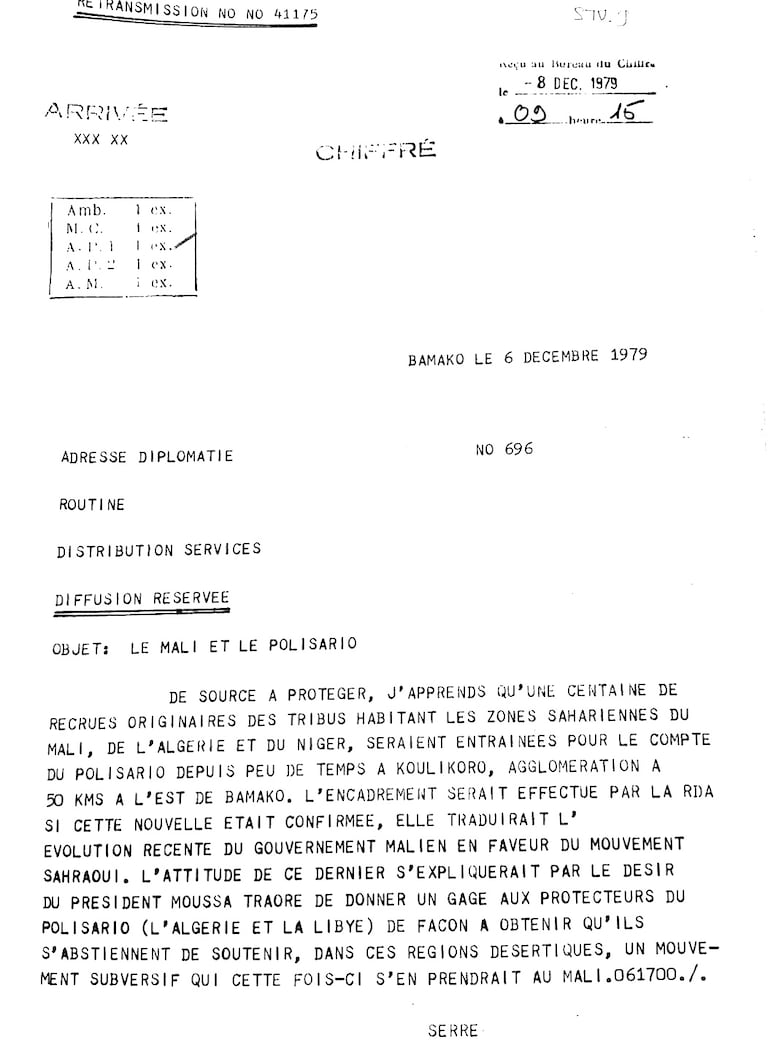
In the Polisario file, the service provided by Algiers notably consists of granting access to the movement. For decades, the latter has supplied men—its best elements—for hybrid wars in the Middle East, particularly on the Syrian, Lebanese and Palestinian fronts. The Polisario is currently being used as a Trojan horse in the Sahel. It helps Iran establish its intelligence services among terrorist groups (Read the first part of the interview devoted to the Polisario). In return, Iran provides financial resources, training, equipment and expertise in asymmetric warfare.
In the sub-Saharan Africa file, Algeria has greatly assisted the Quds Force in weaving its network across the continent. The Algerian intelligence services can facilitate access to their networks in Africa, provide intelligence and supply technical resources.
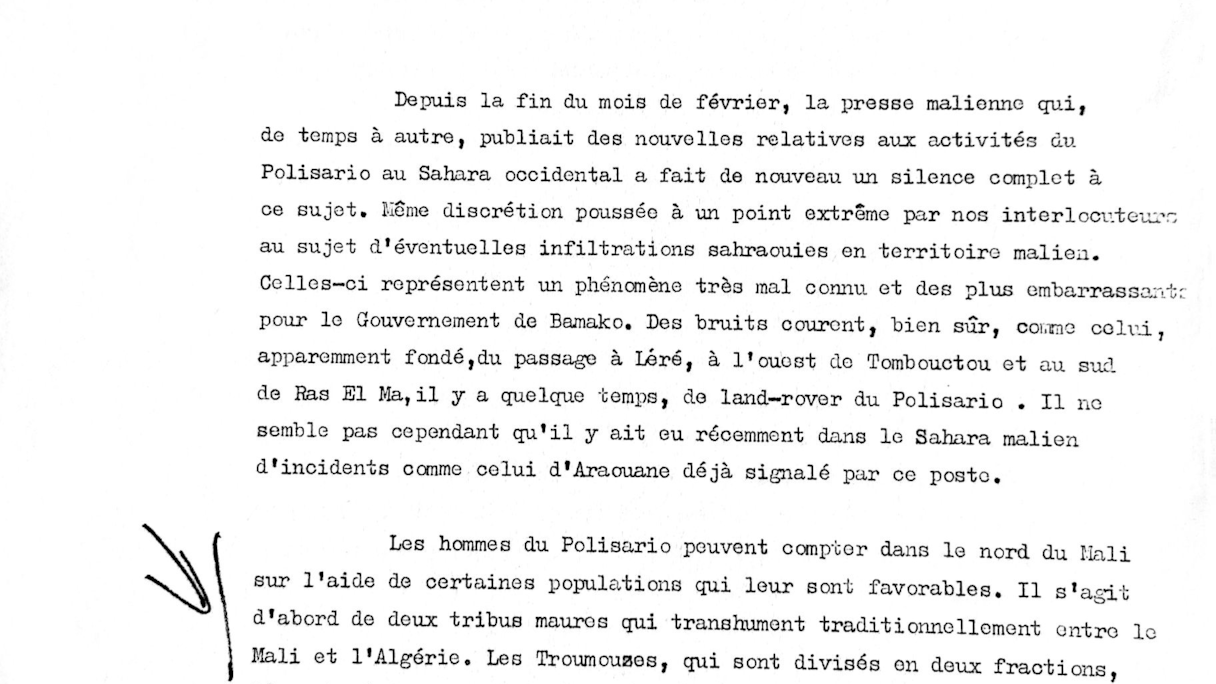
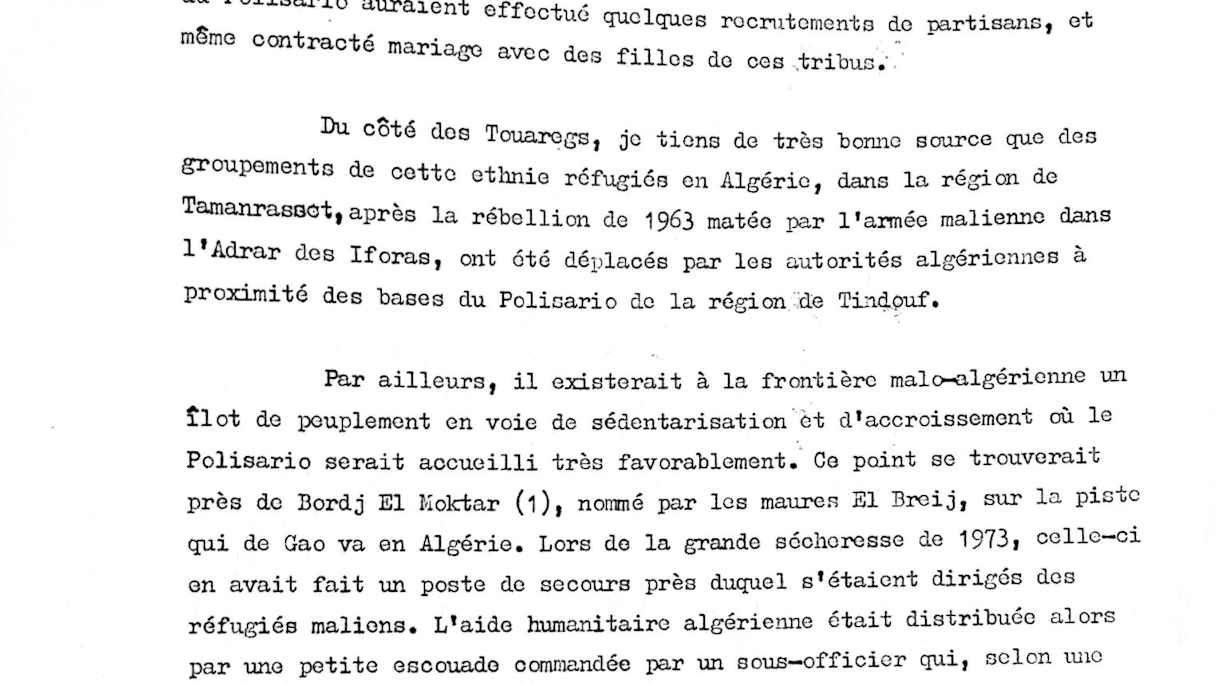
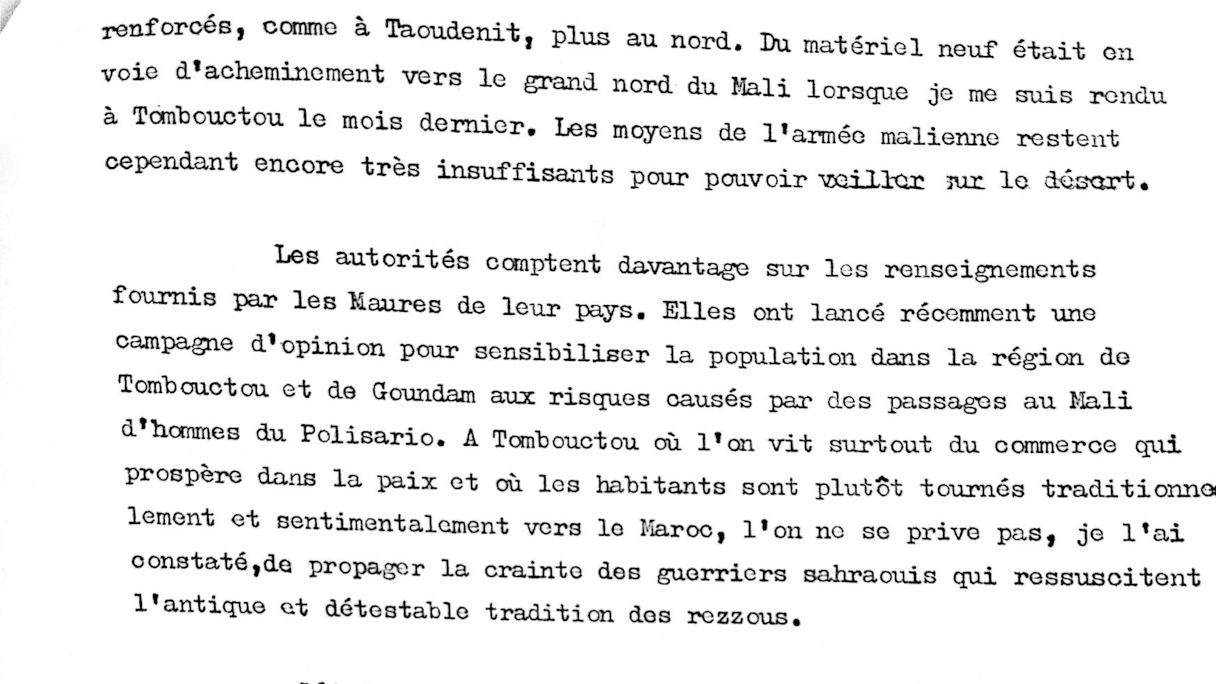
Note confidentielle intitulée «Des infiltrations du Polisario au Mali» (page 1 sur 3), adressée par le chargé d’affaire de France à Bamako, Pierre Cornéa au ministre des Affaires étrangères français, Louis de Guiringaud, le 17 mai 1978. Archives des affaires étrangères, 558PO/1/221.
This cooperation does not imply complete trust. Quite the contrary: each side keeps watch over the other and takes care not to relinquish too much power to its partner.
You say Algeria nevertheless remains on its guard. Do you believe Iran is not playing straight with Algiers, and that there is a risk Tehran could one day turn against it?
Indeed. To my knowledge, Abdelaziz Bouteflika was the first and only Algerian president to truly sound the alarm. He was concerned about the growing influence of Iranian Shiism in Algeria. He was struck by the number of Algerians trained in Iran who subsequently returned home to preach Shia Islam and disseminate the political doctrine of the Islamic Republic.
These individuals had often spent several years in Qom. They spoke Persian, were well versed in the regime’s ideological references and had been financially supported throughout their training.
Bouteflika understood that this network could become a danger to Algeria itself. Cooperation between two intelligence services does not prevent one partner from seeking to penetrate the other’s society.
How has the Quds Force expanded its networks beyond the Middle East?
The Quds Force is part of the Revolutionary Guards, not the Iranian army or the Ministry of Intelligence. It deals exclusively with Iranian interests abroad. It first built organizations in the Middle East. Lebanese Hezbollah served as the blueprint. Other groups were subsequently created or supported, such as Hashd al-Shaabi in Iraq, the Fatemiyoun in Afghanistan, the Zainebiyoun in Pakistan and the Houthis in Yemen. These are proxies that have succeeded. The Quds Force then expanded its activities into Africa, Latin America and Europe. It does not necessarily seek to create an organization identical to Hezbollah everywhere. It adapts its methods to each region.
The Quds Force has gradually become a state within the state. Since Khomeini’s death, the Revolutionary Guards have strengthened their control over Iran’s political, economic, military and diplomatic life.
In Africa and Latin America, Hezbollah has relied on large Lebanese diaspora communities. It has made use of family, commercial and financial networks that have been established for several decades. These networks make it possible to set up companies, open currency exchange offices, transfer money and host operatives arriving from Lebanon or Iran.
In the Maghreb, Africa, Latin America and the Middle East, the presence of the Revolutionary Guards is very significant. Several agents operate under diplomatic cover.
In Europe, the Iranian Ministry of Intelligence plays a more visible role, but the Revolutionary Guards retain oversight. Anyone assigned to Paris, Rome or Frankfurt must obtain their approval.
Embassies are therefore not merely diplomatic representations. They also serve as platforms for intelligence, influence and coordination.
How does Iran finance this global activity despite international sanctions?
Donations from diaspora communities are not enough. It is drug money that allows the Iranians to finance their covert activities. The Quds Force and Hezbollah have forged ties with criminal organizations in South America. According to the information we gathered, the Quds Force and Hezbollah have used these networks to take part in cocaine trafficking and its shipment to Europe. The proceeds from these activities help finance covert operations, allied organizations and military programs. Organized crime thus becomes an instrument of Iranian foreign policy.
The Revolutionary Guards have created front companies in numerous countries: the United Arab Emirates, Qatar, Turkey, Hong Kong, Malaysia and Indonesia. Officially, these companies engage in import-export activities. They can sell Iranian oil or gas, purchase goods on behalf of the regime or channel funds.
The Revolutionary Guards have also established dozens of currency exchange offices, notably in Dubai, Turkey, Qatar and Hong Kong. Since Iran does not have normal access to the international banking system, these structures are used to move money.
Iran’s financial network in Africa is not a recent creation. It has existed for thirty years. Companies, currency exchange offices and Lebanese networks form the invisible infrastructure of Iranian power projection.
The regime also relies on informal transfers, the Lebanese diaspora’s commercial networks and suitcases of cash. The channels are deliberately fragmented so that no single transaction can easily be traced back to the Quds Force.
After observing this system for several decades, do you believe the Islamic Republic can reform itself?
No. What is happening in Iran worries me deeply. I have two homelands, Iran and France, and I remain attached to both. I do not believe the regime can change its nature. Its doctrine is to bring down monarchies, drive Western influence out of the Middle East, annihilate Israel and then confront Western democracies.
This logic is not a temporary deviation. It is inherent to the system itself. It is the program of the Revolution, set down in black and white in the testamentary book left by Khomeini, which anyone can read. The Quds Force, the proxies, the clandestine networks and religious influence are the instruments of this doctrine.
Part of the Western left continues to believe that the regime can evolve. I believe they are mistaken. As long as this system remains in place, there will be no lasting peace in the Middle East or regional stability.
The Gulf countries are threatened, Israel is threatened, the West is targeted, and Morocco itself is concerned because of Iran’s strategy in the Maghreb and the Sahel. This regime must disappear politically for Iran to become a normal country again and reclaim its place among the nations.
After forty years of service, what kind of life do you lead today?
I am now retired from the French National Police, and I am a happy grandfather. In 2024, with the help of Stéphane Joahny (a journalist at Hachette Filipacchi Media), I published my memoirs, Notre agent iranien [Our Iranian Agent] (with Nouveau Monde Éditions). I had the honor of receiving the National Police Medal of Honor. On that occasion, I said, “France owes me nothing. I owe everything to France. But it pleases me to see that France does not forget those who serve it.”
I have never considered serving France to mean renouncing Iran. Quite the opposite. I served France because it welcomed me, and I fought the Islamic Republic because I wanted to defend the real Iran.
Throughout all my years of service, my strength was having two homelands, knowing two cultures and understanding two mindsets. According to my colleagues, it was this dual belonging that enabled me to become a good agent.
