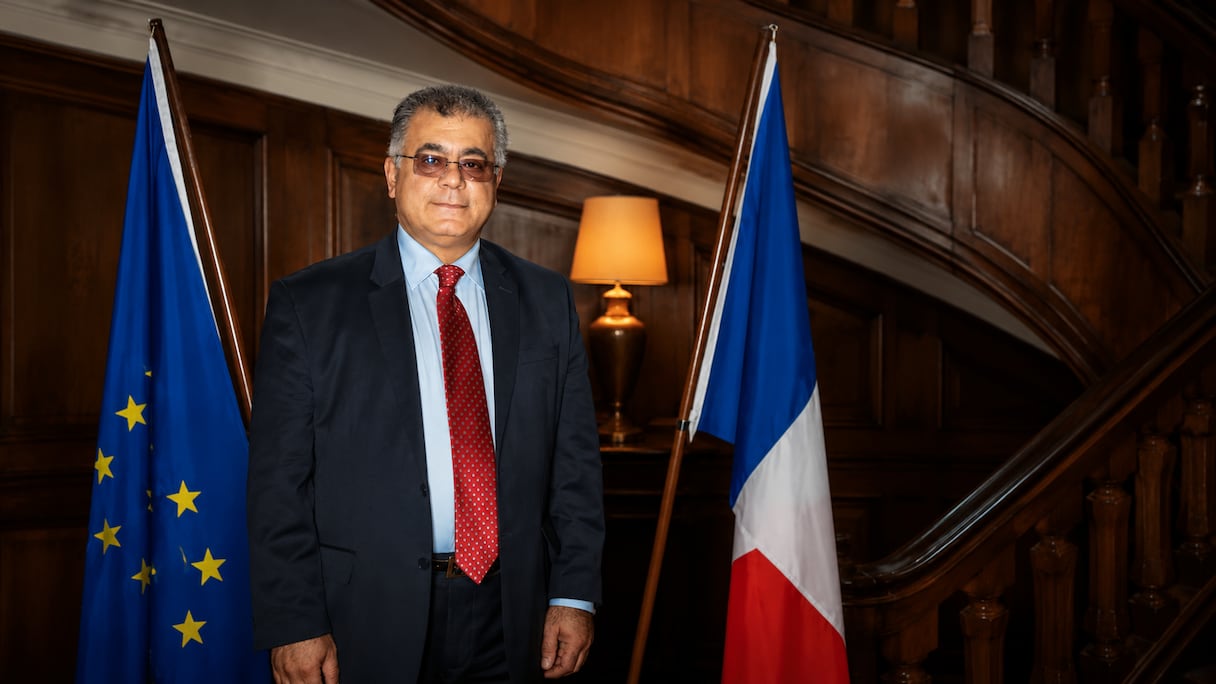
Born in Tehran, Matthieu Ghadiri moved to France to pursue his higher education. He dreamed of becoming an agricultural engineer. His life took a different course when he was recruited by the Direction de la Surveillance du Territoire (DST), the predecessor of today’s Direction Générale de la Sécurité Intérieure (DGSI). His mission was to approach the Iranian intelligence services, infiltrate them, and understand, from within, their methods, their objectives in France, and their networks across Europe. His involvement in the French Socialist Party, where he rose through the ranks to become a prominent official, served as both his cover and his gateway into sensitive circles.
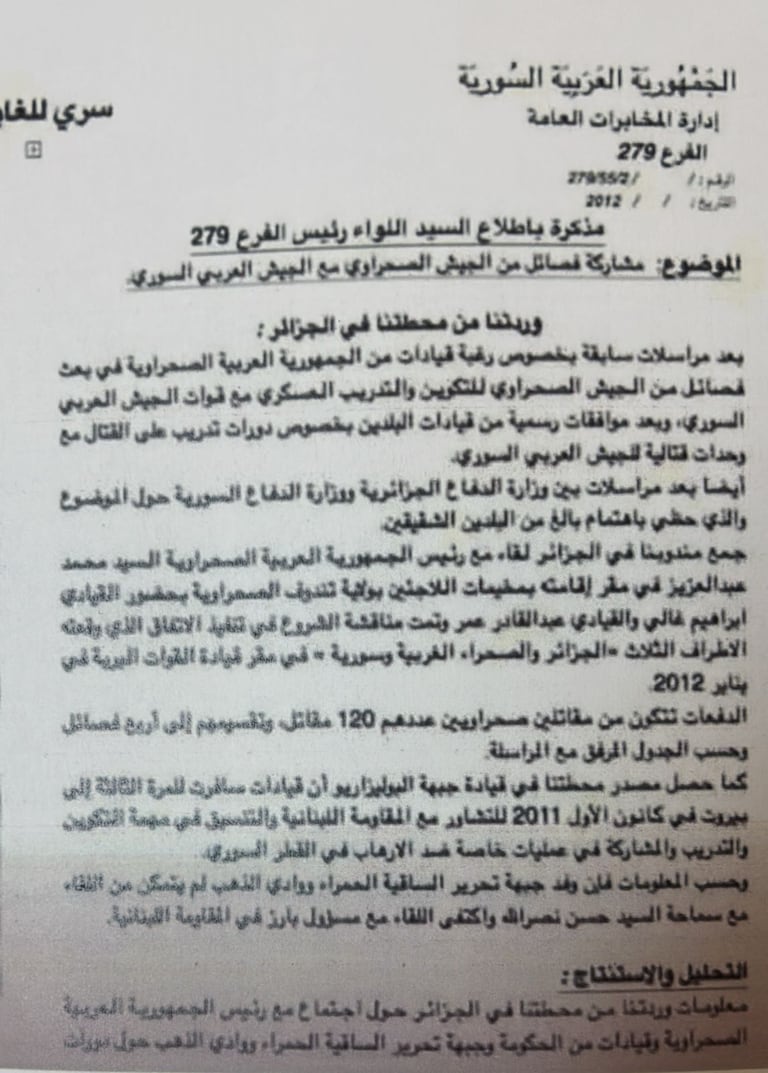
Drawing on this long career in counterintelligence, Matthieu Ghadiri says he witnessed the establishment of a system directed by the Quds Force, with Hezbollah’s support, to integrate the Polisario into Tehran’s regional strategy. Training, equipment, financing, operations in the Sahel, efforts to destabilize the Moroccan monarchy, and the deployment of Sahrawi fighters to Syria and Palestine: according to him, the separatist movement gradually became an instrument of Iranian influence while remaining under Algeria’s political and security tutelage.
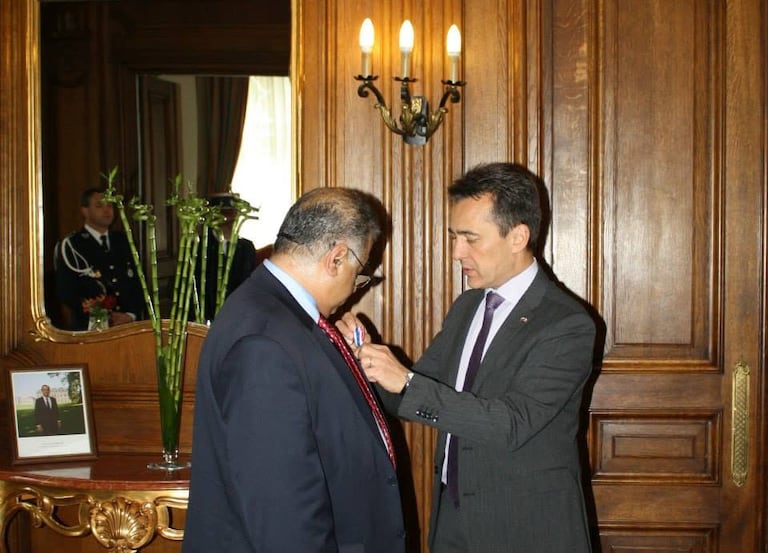
In the first part of his interview with Le360, the former Franco-Iranian agent, who was decorated by France for his service and is now retired, explains the mechanisms, intermediaries, and functioning of this relationship under Algerian military supervision.
The second installment, to be published next Tuesday, will examine the secret pact between the Algerian and Iranian intelligence services.
Le360: Before discussing the Polisario, how did the young Iranian who dreamed of becoming an engineer end up as an undercover agent for French counterintelligence?
Matthieu Ghadiri: I was born in Tehran and arrived in Paris at the age of sixteen and a half to pursue my studies. My original ambition was to become an agricultural engineer. The Direction de la Surveillance du Territoire had other plans.
My path crossed that of two friends who were officers in French counterintelligence. They proposed that I infiltrate the Iranian intelligence services. I accepted. It was 1985, one year after Khomeini officially established Iran’s Ministry of Intelligence.
I accepted because the 1979 Islamic Revolution had transformed both my destiny and that of my country. I have always believed that Khomeini’s Islamic Republic was not Iran. I wanted to protect France, which had welcomed me, but also Iran, to which I remained deeply attached. It was to fight Khomeini’s regime and what it had done to my homeland that I committed myself—at the risk of my life—to working alongside the French intelligence services.
When did you first hear about ties between the Polisario Front and Iran?
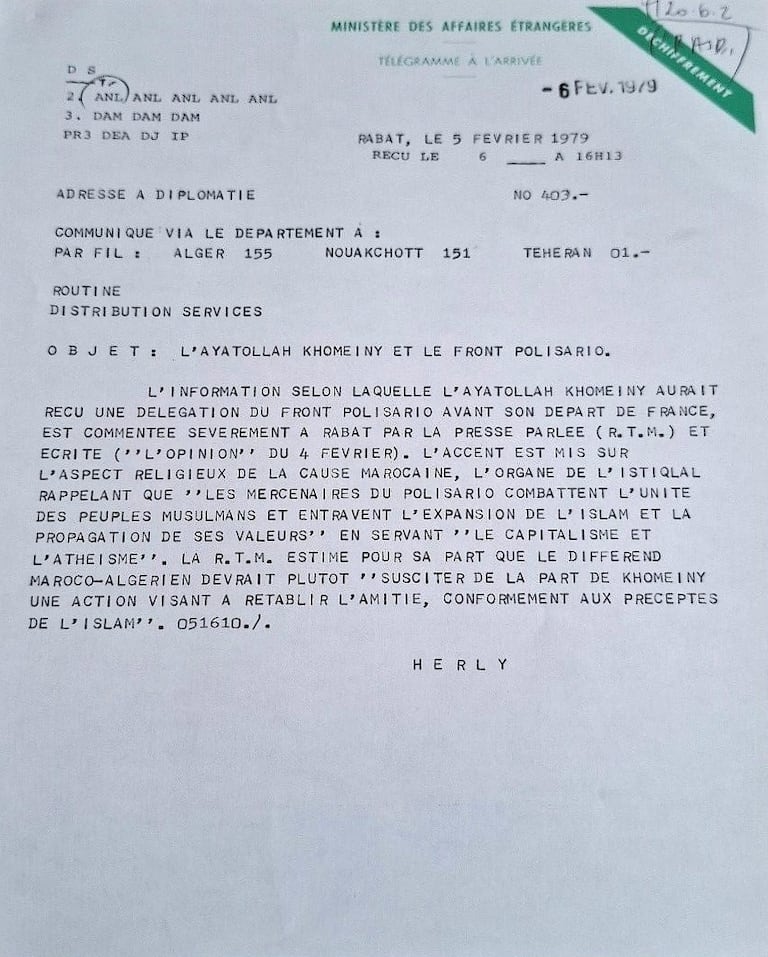
I can answer that with certainty: relations between the Polisario and the new Iranian regime date back to the months preceding the 1979 Revolution. A delegation from the movement met Khomeini while he was preparing his return to Tehran. That meeting took place in France. The Polisario was among the first movements to seek—and obtain—the political backing of the newly established Islamic Republic.
As soon as he came to power, Khomeini sought closer ties with what he called liberation movements. This included the Polisario Front, the Palestine Liberation Organization (PLO), and Palestinian Marxist groups such as the Popular Front for the Liberation of Palestine (PFLP).
The ideology of these organizations—whether nationalist, Marxist, or Islamist—was of secondary importance to Khomeini. What mattered was that they were fighting a state allied with the West or challenging the regional order. The Polisario fit perfectly into that category.
Why was the Polisario of such interest to Khomeini’s regime?
From the outset, Khomeini displayed a profound hostility toward monarchies. He rejected not only the Gulf monarchies but also the Moroccan monarchy. In his eyes, Morocco was an ally of the West and belonged to the camp he sought to confront.
In his view, it was therefore necessary to support countries, movements, or organizations capable of challenging that order. The rhetoric rested on anti-imperialism, anti-colonialism, and anti-Zionism. Anyone invoking those themes in their propaganda could become a partner of the Islamic Republic and receive financial support—or even more.
The rapprochement with the Polisario thus served several objectives. It enabled Iran to confront Morocco indirectly, strengthen its ties with Algeria, and establish a gateway to the Sahara and the Sahel. It was within this framework that cooperation gradually developed between Iranian institutions, the Algerian intelligence services, and the Polisario separatist movement. That cooperation later expanded further, with Hezbollah making use of Polisario fighters on fronts across the Middle East.
How did this political rapprochement evolve into a clandestine military apparatus?
The doctrine of the Islamic Republic is to use political Islam as an instrument of power. This is not simply about religion. It is a political and ideological project designed to transform societies, destabilize regimes regarded as hostile, and extend Iran’s influence.
Very early on, Iran’s leaders realized they could not rely solely on the regular army. Yasser Arafat himself had warned them of the risk of a military coup. He advised them to create a force wholly devoted to the new regime. It was in that context that the Islamic Revolutionary Guard Corps (IRGC) was established.
Within that institution, the Quds Force became the branch responsible for overseas operations. It is simultaneously a military, ideological, and clandestine organization. Its mission is to create, support, or infiltrate foreign organizations capable of advancing the interests of the Islamic Republic without directly implicating the Iranian state.
The principle is always the same: cultivate proxy forces, arm them, finance them, and entrust them with operations that Tehran does not wish to carry out openly. The first major proxy built according to this model was Hezbollah in Lebanon.
Why does Hezbollah occupy such a unique place within this architecture?
Hezbollah is not an ordinary proxy. It is the Islamic Republic’s younger brother and, in a sense, an integral part of its external apparatus. It cannot be compared with Yemen’s Houthis, Iraq’s Popular Mobilization Forces (Hashd al-Shaabi), Afghanistan’s Fatemiyoun Brigade, or Pakistan’s Zainebiyoun Brigade.
The Iranians created Hezbollah, trained it, financed it, and equipped it. They then entrusted it with passing on its expertise to other organizations. Whatever the Quds Force prefers not to carry out directly, it has Hezbollah execute on its behalf.
In the Maghreb and the Sahel, this intermediary offers several advantages. Its cadres speak Arabic, understand the region’s cultures, and can rely on Lebanese diaspora communities that have been established across Africa for generations. They are therefore able to operate far more discreetly than Iranian agents, whose primary language is Persian.
Finally, the use of Hezbollah allows Tehran to deny any direct involvement. If an operation is exposed, the Islamic Republic can claim that it was an independent initiative undertaken by the Lebanese movement. This layer of plausible deniability is an integral part of the system.
Can the Polisario Front therefore be described as an Iranian proxy?
Yes, it was becoming one... But not in the same sense as Hezbollah. The Algerians will never allow Iran to take full control of the Polisario. They accept that the Islamic Republic may assist it, train it, finance it, or equip it, but they are determined to retain political, security, and territorial control over the movement. They also accept that Hezbollah may recruit Polisario members to fight in Syria, Lebanon, or Palestine.
The Iranians are fully aware of this, and they have accepted the arrangement. Any cooperation with the Polisario, whether occasional or long-term, must receive the approval of the Algerian intelligence services. Every Iranian operation in the Maghreb or the Sahel involving the movement is carried out under Algerian supervision.
The system therefore operates on three levels. The Quds Force defines the objectives and gives the green light. Hezbollah handles the operational component, particularly training, logistics, equipment, and the transfer of funds. Finally, the Algerian intelligence services authorize access to the Polisario and ensure that they never lose control over it.
The Polisario is therefore not an Iranian proxy entirely subordinate to Tehran. It is a movement controlled by Algiers, to which Iran is granted access and support within the framework of an agreement with the Algerian intelligence services.
What does each actor gain from this arrangement?
The relationship is based on mutual benefit. Algeria gains external support capable of strengthening the Polisario without having to appear as the sole provider of funding, weapons, or training. Iran, for its part, gains access to the personnel and networks the Polisario possesses across the Sahara and the Sahel.
The Polisario receives financial resources, equipment, rockets, drones, and training. Hezbollah strengthens its footprint in Africa while serving as the operational intermediary between the various actors.
For the Islamic Republic, the Polisario is a regional instrument. It allows Tehran to exert pressure on Morocco while gaining access to networks operating in areas where the Quds Force seeks to establish a presence.
Was Iran’s involvement with the Polisario limited to the military sphere?
No. There is also a religious and ideological dimension. The Iranians established Al-Mustafa University in the holy city of Qom. Its mission is to train clerics and preachers from around the world, particularly from Africa.
The Iranian authorities say they have trained more than 35,000 people over the past four decades. We estimate the actual number to be closer to 20,000, which is still considerable.
According to the information available to us, individuals sent by the Polisario attended these programs. Others came from Algeria, Mali, Burkina Faso, Senegal, and several other Sub-Saharan African countries.
Students generally spent five years in Qom. They learned Persian, Modern Standard Arabic, and the political doctrine of the Islamic Republic. They were housed, fed, and paid. Once their training was complete, they were sent back to their countries of origin to serve as preachers, ideological relays, or advocates of Iranian influence.
You personally witnessed the arrival of Algerians and Sahrawis in Iran. Under what circumstances?
After several years of infiltration, senior Iranian intelligence officials asked me to come to Iran. They wanted to meet me. To avoid attracting attention, I took an unusually long route: Paris to Frankfurt, Frankfurt to Vienna, and finally Vienna to Tehran. The journey lasted nearly twenty hours.
On the final flight, which was due to land in Tehran at around 2:30 a.m., I noticed a large number of Algerians on board. That observation alone was obviously not proof of their mission. But it was consistent with the intelligence we already possessed regarding organized travel to Iran and the training programs provided to nationals from the Maghreb.
Some of these individuals were taken in hand by Hezbollah under the supervision of the Quds Force. The Iranians delegated this task to the Lebanese because they spoke Arabic and could establish relationships more easily with Algerian, Tunisian, or Sahrawi recruits.
The Islamic Republic thus remained in the background. It entrusted the work to its Lebanese proxy and could subsequently claim that it was not directly involved. The same method was employed with the Polisario, throughout the Sahel, and across sub-Saharan Africa.
In 2018, Morocco severed diplomatic relations with Iran, accusing the Iranian embassy in Algiers, among other things, of serving as a conduit between Hezbollah and the Polisario. Are Iranian embassies integrated into the Quds Force’s apparatus?
Everyone employed by the embassies of the Islamic Republic—whether they hold diplomatic status or are locally recruited—must be approved by the Islamic Revolutionary Guard Corps. Without that authorization, no one can be appointed as a cultural attaché, economic attaché, or employee of an Iranian diplomatic mission.
In Iranian embassies across the Maghreb, Africa, Latin America, and the Middle East, the presence of the Revolutionary Guards is particularly significant. In Europe, the Iranian Ministry of Intelligence plays a more visible role, but the Guards’ approval remains indispensable.
The Iranian embassy in Algiers is no exception. Based on the information available to us, if the Iranians wish to assist the Polisario, they must first discuss the matter with their Algerian counterparts and obtain their approval. The proxies then step in to handle logistics, training, and the transfer of equipment.
The embassy therefore functions as an interface. It facilitates contacts between Iranian officials, the Algerian intelligence services, and the operatives responsible for carrying out the mission.
At what level within the Iranian state apparatus is the Polisario dossier handled?
Everything relating to external operations is managed by the Quds Force. Its commander reports directly to the Supreme Leader of the Revolution.
Although it is a branch of the Islamic Revolutionary Guard Corps, the Quds Force enjoys a special status. It is the Supreme Leader’s favored service. Its officials handle international dossiers and enjoy considerable autonomy from the rest of the military establishment.
A dossier such as that of the Polisario is therefore not handled as an ordinary diplomatic relationship. It falls within a broader regional strategy that combines intelligence, clandestine operations, ideological influence, and military support.
What specific role does Hezbollah play between the Quds Force and the Polisario?
Once the Algerians agreed to allow the Revolutionary Guards to establish contact with the Polisario, the operational component was entrusted to Hezbollah. The individuals presented as advisers or military attachés deployed on the ground—who were photographed by the CIA—are, according to the information available to us, Hezbollah members trained by military advisers and operatives of the Quds Force.
They are responsible for training and equipping Polisario members. They take part in the selection process and send recruits for training in Lebanon and Syria. They pass on the techniques they themselves learned from the Iranians and oversee the military dimension without exposing the Islamic Republic directly.
For the past twenty to thirty years, Hezbollah’s networks have played this role throughout the Maghreb, the Sahel, and sub-Saharan Africa. Equipment supplied by Iran passes through their channels. Financial transfers often follow the same route.
Why does Iran rely on Lebanese networks in Africa?
Several African countries, particularly Mali, are home to large Lebanese diasporas that have been established there for thirty, forty, or even fifty years. Hezbollah has successfully leveraged these communities to build commercial, financial, and logistical networks.
It had already applied the same model in Latin America. The diaspora’s family and business networks make it possible to establish companies, transfer funds, host officials, and move equipment without immediately attracting attention.
Hezbollah speaks Arabic and has a deeper understanding of African and Maghrebi societies than the Iranians themselves. It therefore serves as the ideal intermediary between the Quds Force, the Algerian intelligence services, and the Polisario.
Through which routes do weapons and equipment reach the Tindouf area?
Based on what we know, the principal point of departure is Lebanon. In the past, these operations could transit through both Syria and Lebanon. Today, they leave more directly from Lebanon toward certain Sahelian countries, particularly Mali.
The equipment is then redistributed from those countries. Within Iran’s embassies in the Sahel, members of the Quds Force operate under diplomatic cover. They establish contacts with local intelligence services, Lebanese networks, and organizations active on the ground.
It is through these intermediaries that equipment can ultimately be delivered to the Polisario. The routes vary according to the security environment, but the underlying principle remains the same: multiply the number of intermediaries so that no direct link to Iran can be established.
What type of training has been provided to members of the Polisario Front?
Everything the Iranians taught the Lebanese, they instructed Hezbollah to pass on to other organizations. As far as the Sahara is concerned, and beyond the training of personnel that I mentioned earlier, the expertise primarily relates to the construction of underground networks, the storage of weapons, and the preparation of concealed positions. That is Hezbollah’s signature. They taught these methods to Hamas fighters, and today the Polisario has become highly proficient in building weapons caches and small military bases beneath the Sahara’s dunes—underground facilities, much like those in southern Lebanon and Gaza, designed to shelter drones, rockets, and other equipment.
The training also covers the use of drones and rockets, communications, concealment of equipment, and the organization of mobile units. The Iranians developed these techniques alongside Hezbollah before entrusting the Lebanese movement with transmitting them to others.
The objective is to enable an organization to conduct asymmetric operations against a state possessing a more powerful conventional army.
How does funding flow between Iran, Hezbollah, and the Polisario?
Here again, Iran avoids transferring money directly to the Polisario. The Quds Force provides the funds to Hezbollah, which then channels them, through its own networks, to the Algerians.
This can involve shell companies, currency exchange offices, commercial networks, or cash transfers. The Revolutionary Guards have spent decades building this system to circumvent sanctions and the oversight of the international banking system.
In the Polisario’s case, these operations take place under the watchful eye of the Algerian intelligence services. Algiers wants to know what is being delivered to the movement, to whom, and for what purpose. The Algerians accept Iranian assistance, but they do not want it to create a relationship of dependence between the Polisario and Tehran.
Is the Sahel part of the bargain? What does Iran ask of the Polisario in return for its support?
The Iranians know that the Polisario has contacts and networks across the Sahel. They seek to leverage those connections to establish a foothold in areas where the Quds Force wants to expand its presence.
Members of the Quds Force are present in several countries across the region, often under diplomatic cover. They need local intermediaries—people capable of introducing them to officials, armed groups, or commercial networks. The Polisario is also used for its fighters in the Middle East.
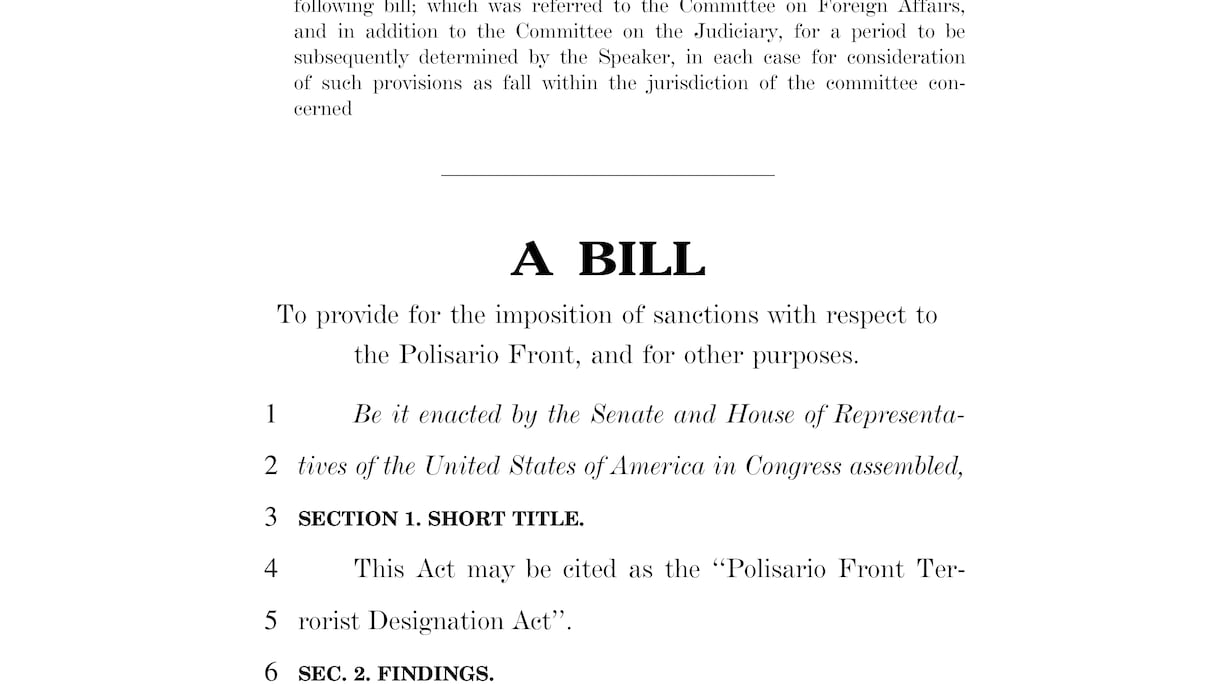
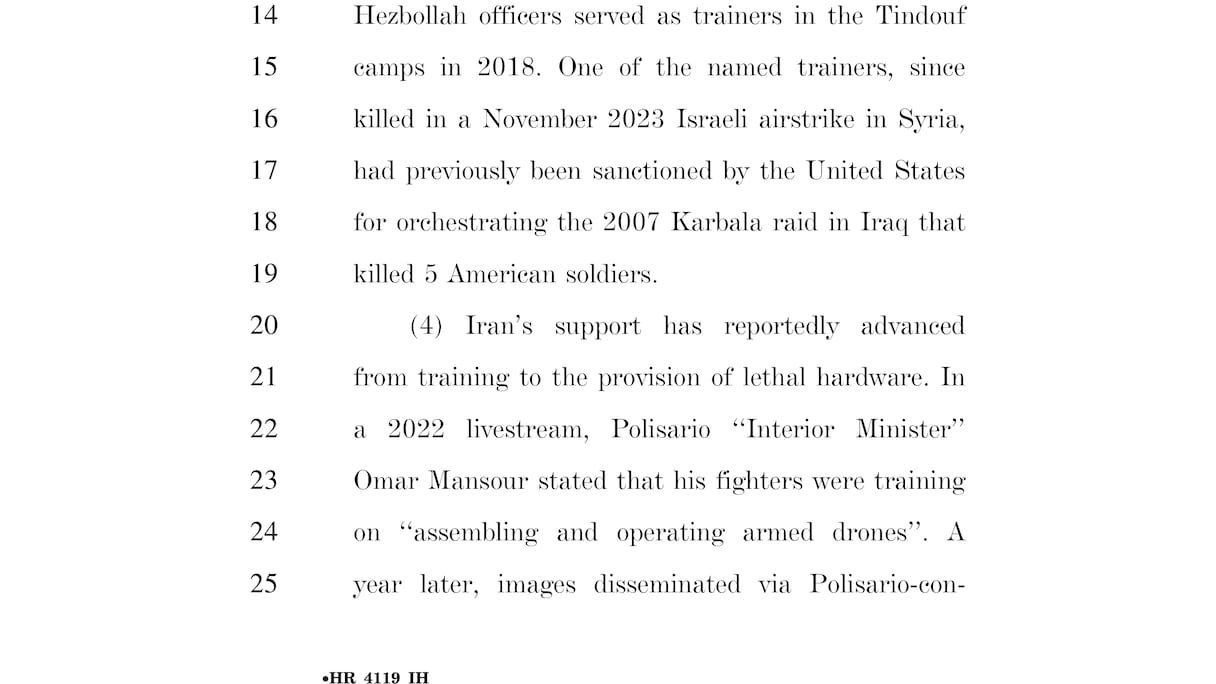
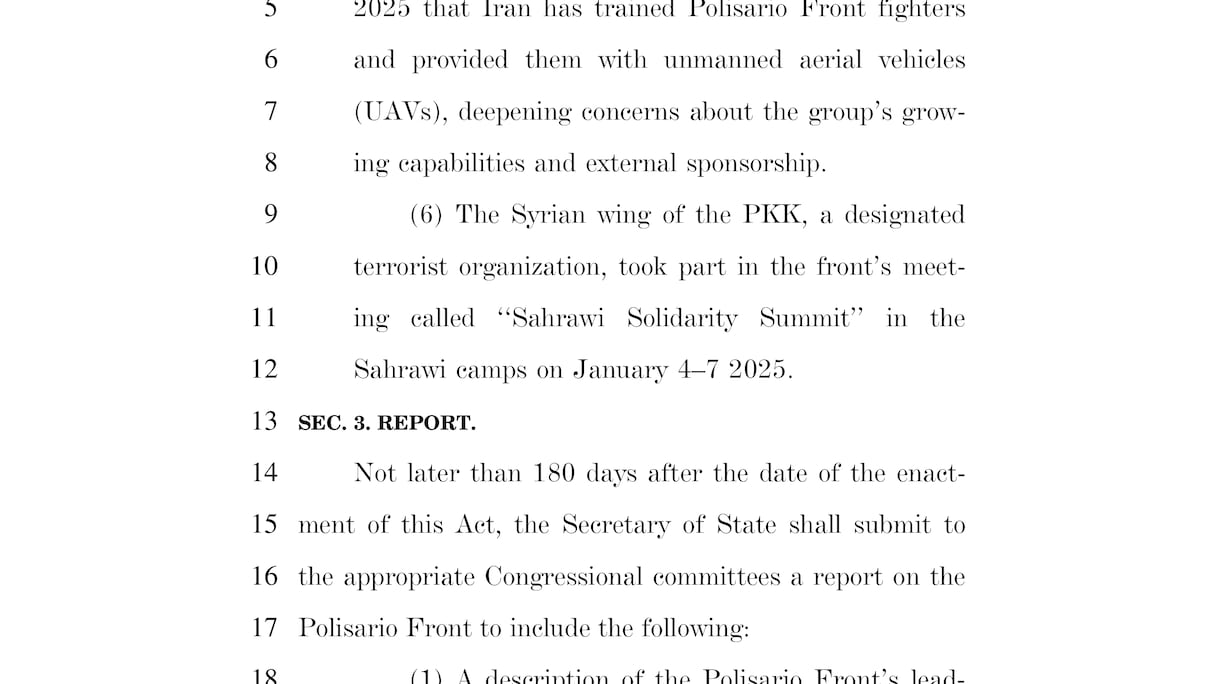
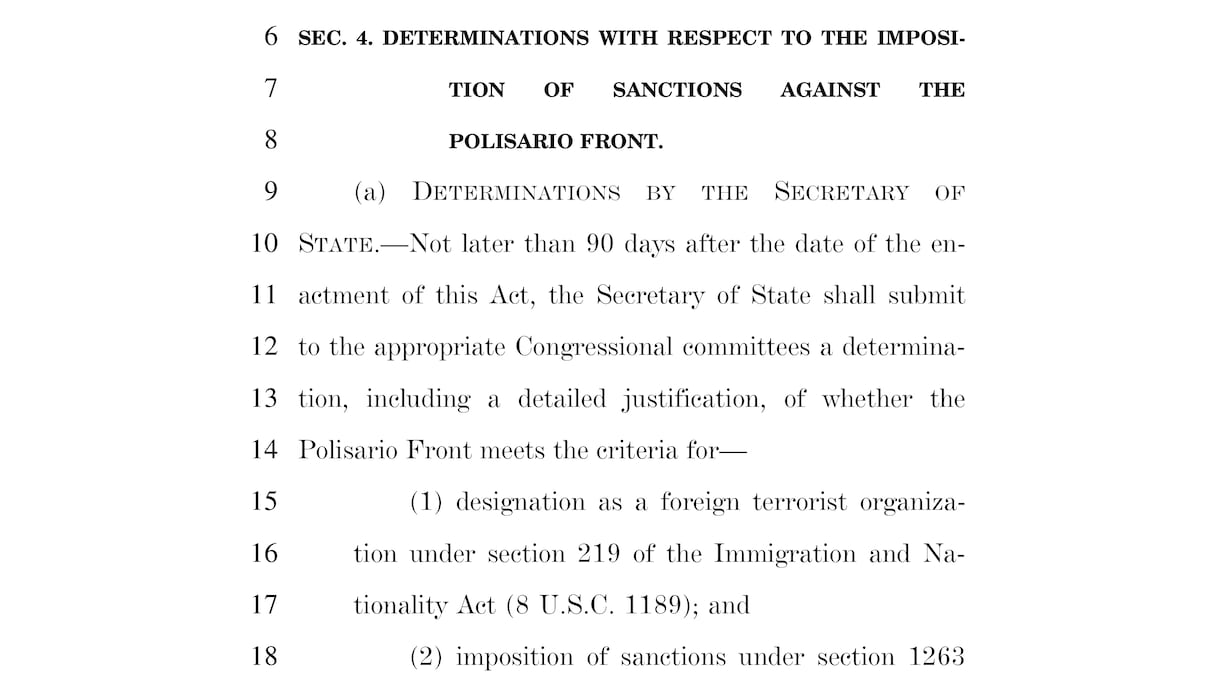
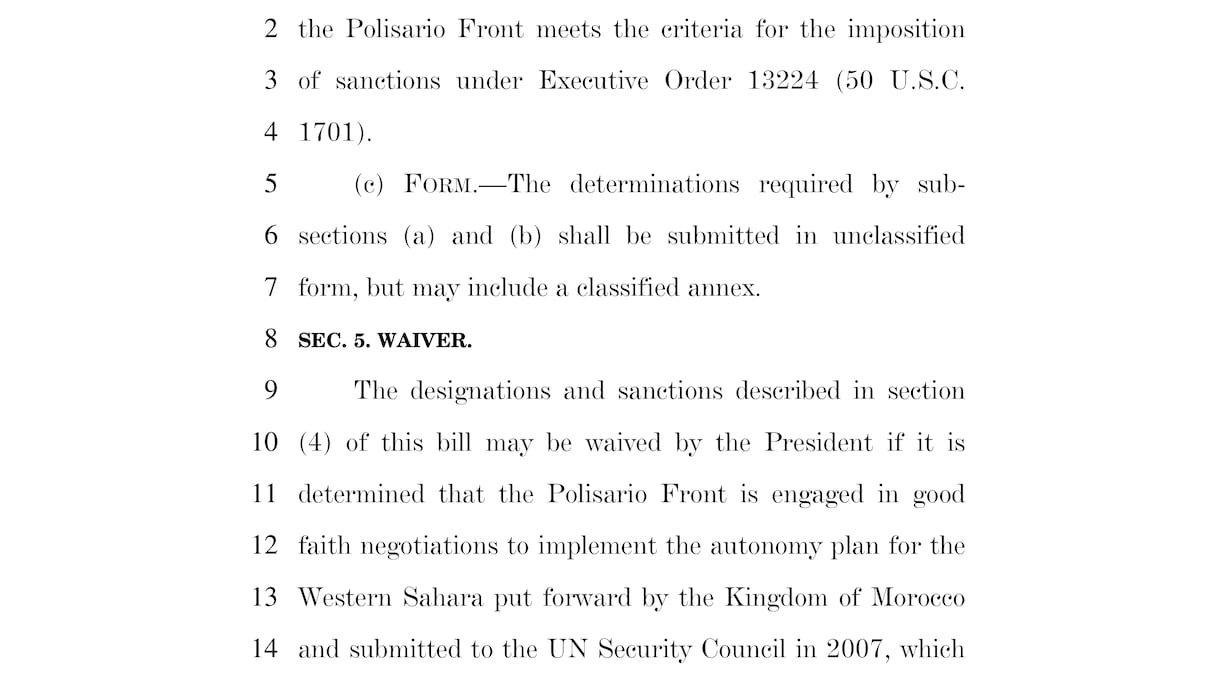
Polisario Terrorist Designation Act, Page 1/5.
The relationship is therefore not based solely on Tehran’s hostility toward Morocco. It also reflects the Islamic Republic’s broader ambition to expand its regional influence.
Aren’t the Algerian intelligence services concerned about allowing Iran to establish a lasting presence in their immediate neighborhood?
They are, and that is precisely why they keep the Polisario under their control. They want to benefit from Iranian support without allowing Tehran to become autonomous in the region.
Relations between the Algerian and Iranian intelligence services are characterized by cooperation, but also by surveillance and mutual mistrust. Each seeks to use the other. Algiers opens certain doors, but it keeps hold of the keys.
The arrangement functions as long as the Islamic Republic accepts that limitation. So far, it has done so because access to the Polisario and the Sahel represents, in its view, a greater strategic benefit than the constraints imposed by the Algerians.
The Polisario’s recent participation in attacks on Malian towns is one example. It served a shared agenda.
What is your view of the U.S. initiative to designate the Polisario Front as a terrorist organization?
I am answering here on the basis of my personal conviction. I love Morocco, and I believe it is the only country capable of playing an “enlightened” role in Africa’s emancipation. To ensure peace and stability in the Maghreb, there must be a strong Morocco. A strong Morocco can contribute to economic development, regional cooperation, and the stability of North Africa as a whole.
Organizations that thrive on chaos—and those who support them—want neither that peace nor that stability. When they cannot attack Morocco directly, they resort to armed movements and indirect operations.
The choice is therefore clear. And as I often like to say: “Those who wish harm upon Morocco also wish harm upon democracy and civilization.”