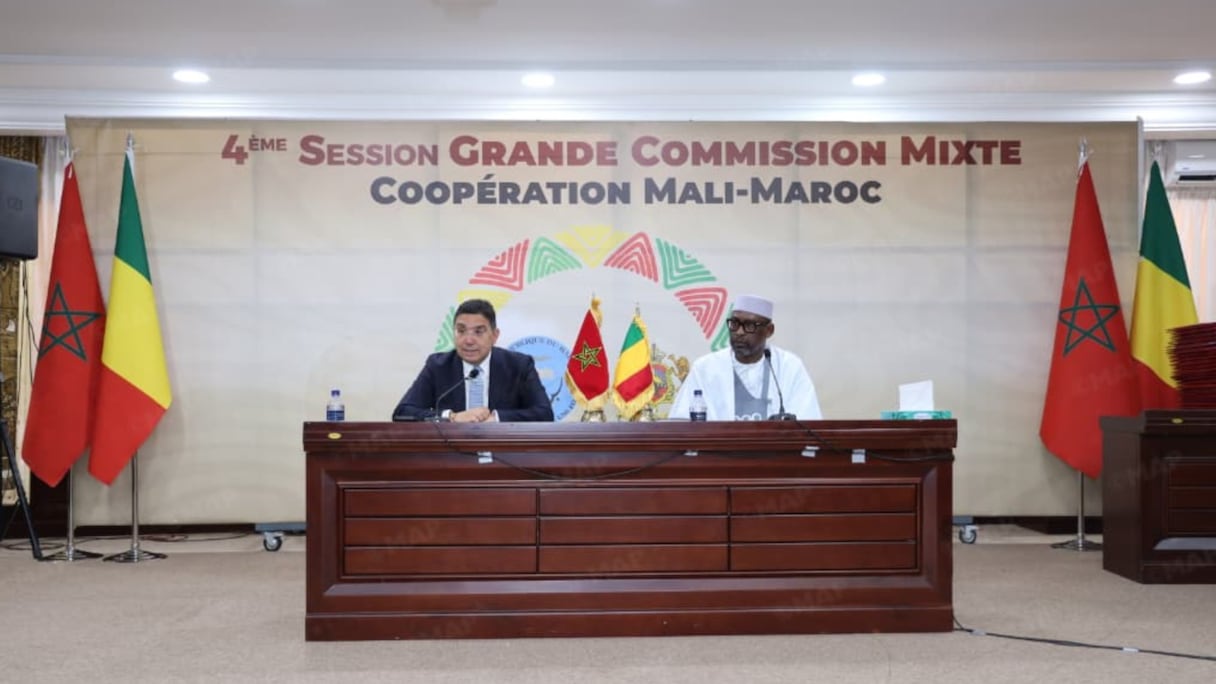
The outcome of the fourth Morocco-Mali High Joint Commission in Bamako went well beyond the signing of cooperation agreements. It reflected the continued convergence between Rabat and Bamako at a time when the geopolitical balance of the Sahel is being reshaped and Morocco is expanding its role as a strategic partner for the region.
Co-chaired by Moroccan Foreign Minister Nasser Bourita and his Malian counterpart Abdoulaye Diop, the commission reaffirmed both countries’ determination to deepen a strategic partnership spanning diplomacy, trade, energy, agriculture, health, education and vocational training.
In their joint communiqué, the two sides pledged to strengthen economic ties, encourage greater exchanges between Moroccan and Malian businesses and translate discussions held during a parallel business forum into concrete investment projects.
Atlantic Initiative moves from political support to implementation
The meeting also underscored Mali’s growing commitment to King Mohammed VI’s Atlantic Initiative, launched to provide the landlocked countries of the Sahel with access to the Atlantic Ocean through Moroccan infrastructure and logistics networks.
Bamako reaffirmed its support for the initiative and expressed its readiness to begin the gradual implementation of projects proposed under the framework unveiled by the royal initiative. Malian officials also recalled the audience granted by King Mohammed VI in April 2025 to the foreign ministers of the Alliance of Sahel States (AES), describing it as a defining moment in advancing the initiative.
Development cooperation expands on the ground
The commission further highlighted Morocco’s expanding development cooperation in Mali.
Acting on the King’s instructions, Morocco formally handed over the Mohammed VI Vocational Training Complex in Bamako to the Malian authorities. Built by the Mohammed VI Foundation for Sustainable Development, the center will eventually train nearly 1,000 students annually in construction, public works, hospitality, tourism and food service, sectors identified as priorities for Mali’s economic development.
Political convergence extends to the Sahara
Political convergence remained equally prominent throughout the visit.
During an audience with Bourita, Mali’s transitional president, Gen. Assimi Goïta, thanked King Mohammed VI for Morocco’s “steadfast and unwavering” support for Mali’s sovereignty, national unity and territorial integrity while expressing appreciation for the Kingdom’s multidimensional support.
The diplomatic convergence was reinforced in the commission’s final communiqué, in which Mali reiterated its support for Morocco’s sovereignty over its entire territory, including the Sahara, and reaffirmed that the Moroccan autonomy plan remains “the only credible and realistic solution” to the regional dispute, in line with UN Security Council Resolution 2797.
The position follows Bamako’s decision in April to withdraw its recognition of the self-proclaimed Sahrawi Arab Democratic Republic (sadr), further consolidating Morocco’s diplomatic momentum across Africa.
Taken together, the outcomes of the Bamako meetings illustrate how Morocco’s relationship with Mali has evolved beyond traditional bilateral cooperation. As Rabat advances its Atlantic Initiative and deepens its engagement with the Alliance of Sahel States, the partnership increasingly reflects a broader strategic vision linking diplomacy, infrastructure, economic integration, and regional connectivity across West Africa.