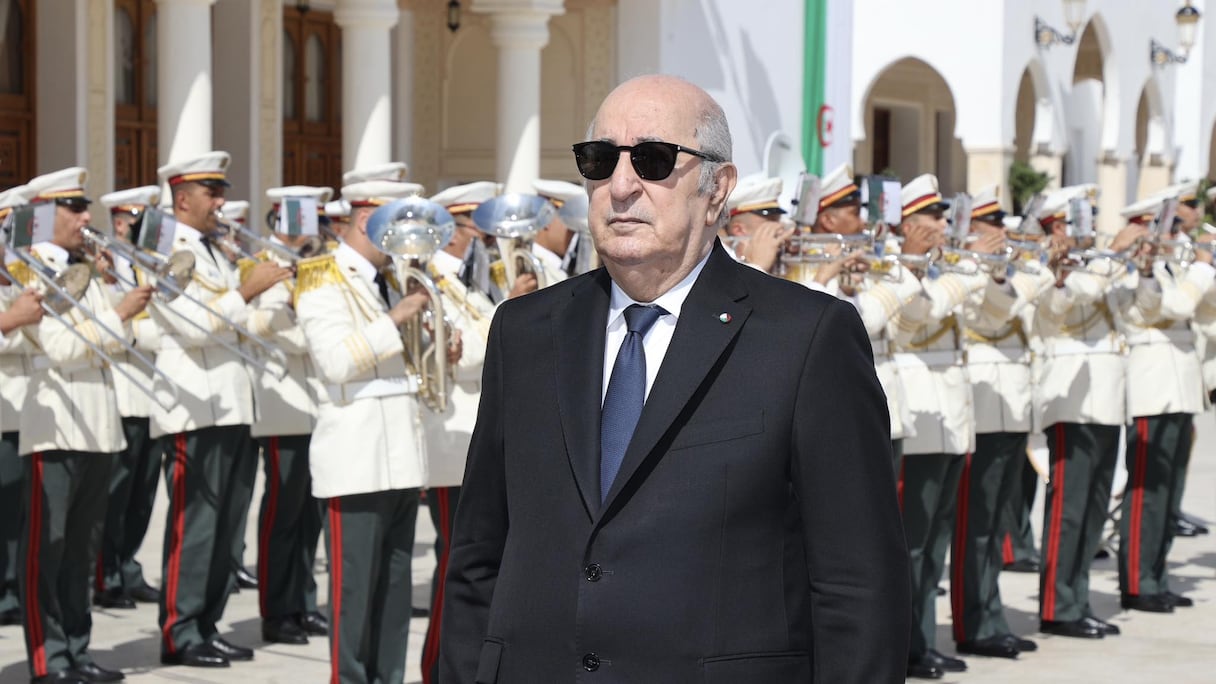
It has become a well-established ritual at the summit of the Algerian state, an annual rendezvous with unpreparedness. Initially scheduled for September 6, the start of the 2026-2027 school year was abruptly postponed to September 21. The announcement, issued last Saturday in a terse statement by the Prime Minister’s office, makes clear that the decision followed direct “instructions” from President Abdelmadjid Tebboune. The new calendar has therefore been imposed from above: administrative staff return on September 6, teachers on September 13, and pupils on September 21.
Barely a week after setting the initial dates, the regime has changed course amid total improvisation. In the absence of any valid official explanation, it has fallen to unions and associations beholden to the regime to handle the damage control: the postponement, they say, is merely a benevolent response to climatic realities, an answer to the summer heat waves suffocating the country. Better still, the measure is being presented as an energy-saving initiative intended to prevent excessive use of air conditioning in schools.
The argument would be laughable were it not symptomatic of a structural collapse. And so, a country incapable of cooling its classrooms in September finds itself forced to keep its schools closed to spare its electricity grid. The contrast is striking, not to say grotesque, with the triumphalist rhetoric of a self-proclaimed “regional power.” The Algerian regime never misses an opportunity to puff out its chest, multiplying promises of solidarity projects and announcements about electrifying Africa. In Niger, a 40 MW thermal power plant donated by Algeria was inaugurated last June. In Chad, construction has begun on a 40 MW power plant in N’Djamena, financed with Algerian public money. In Mozambique, studies are even said to be underway for a 1,000 MW mega-power plant. Not to mention a vassalized Tunisia, in exchange for the continuous supply of around 600 MW of electricity.
Read also : Algeria: In yet another tirade, Tebboune displays the full extent of his vulgarity
Meanwhile, as the presidency hands out megawatts—or at least promises to—to its neighbors, and after it reveled in the false notion that Morocco would be plunged into darkness when it shut down the Maghreb-Europe Gas Pipeline, Algeria’s own national grid is cracking on all sides. On July 13, 2026, electricity consumption, driven by household air conditioning, reached an all-time peak of 21,378 MW, compared with 20,628 MW in 2025.
Blackout
As if to put the finishing touch on this state farce, reality brutally struck down official propaganda on the night of July 14-15, 2026, with a nationwide blackout on an unprecedented scale. From Algiers to Constantine, via Tizi Ouzou, Bouira and Jijel, millions of Algerians, already suffocating in temperatures exceeding 48°C, were plunged into absolute darkness, deprived of air conditioning, and soon cut off from drinking water.
To justify the chaos, official communication became entangled in the convenient excuse of the weather. But neither Sonelgaz nor the government was able to specify the cause of the blackout, barely concealing the structural obsolescence of the infrastructure beneath talk of “colossal investments.” This rhetoric of denial illustrates almost to the point of caricature the gulf between the discourse of a regime that portrays itself as an energy giant and the vulnerability of a country incapable of guaranteeing an uninterrupted electricity supply to its own population.
Read also : Algeria capitulates to Sánchez and rolls out the red carpet
Economic reality is catching up with political rhetoric. Domestic consumption of natural gas—the source of more than 99% of the electricity generated by Sonelgaz—now absorbs 54% to 55% of national production, reaching a record 57.27 billion cubic meters in 2025. For the first time, domestic demand exceeded the volume allocated to exports. The direct result: exports to Europe fell to 45.7 billion cubic meters in 2025 from 49.29 billion in 2024. Algeria is suffocating under the weight of its own consumption, and schoolchildren are paying the price, ordered to stay home for lack of electricity in the land of “blue gold.” With promises to supply more gas to Germany and Spain, following President Tebboune’s latest belly dances aimed at courting these two European countries, there can be little doubt that the school year will be cut short. Unless, of course, summer decides to arrive earlier in the year.
This political-educational vaudeville is nothing new. The spectacle of the start of the school year being turned into a national guessing game had already played out during the 2023-2024 academic year. Back then, an incomprehensible suspense lasting several days kept the country waiting before the September 19 start date was finally announced… on the evening of September 4. Algerians preferred to laugh about it: “The start of the school year in Algeria is like childbirth. You know the month, but not the day.”
Behind these repeated delays and flimsy justifications lies a grim daily reality for parents. While the presidency readjusts its schedules, families remain silent. Compounding the absurdity of state management is a suffocating pall: enforced silence. Whereas repeated postponements and failures of the electricity grid might once have triggered a wave of public outrage and mockery, public opinion is now muzzled by ferocious repression. In today’s Algeria, the slightest criticism of the regime—whether lamenting the lack of preparation for the start of the school year or denouncing a blackout—is treated as an attack on state security or as “demoralizing” the troops. A simple ironic comment on Facebook or a tweet expressing exasperation can instantly earn its author a dawn arrest and a custodial sentence in El Harrach Prison. The only bodies permitted to speak are structures beholden to the regime, tasked with turning incompetence into “presidential wisdom.” Such is Algeria.
