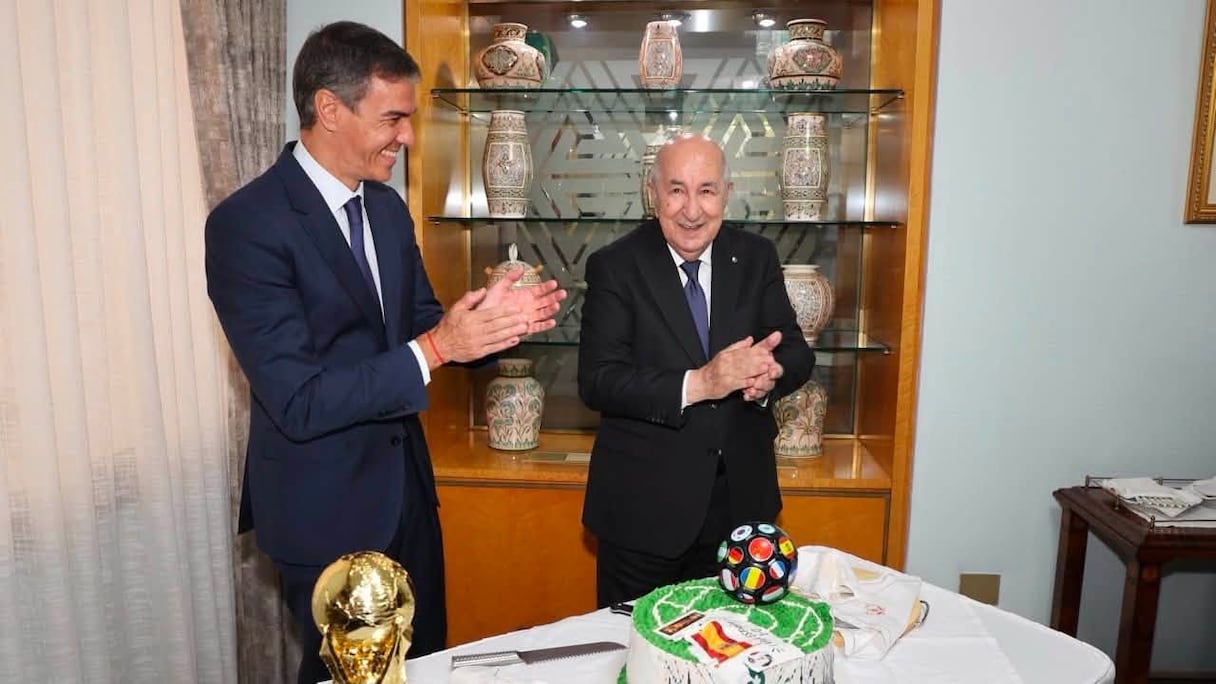
The visit was brief, but the image spoke volumes. Rushing in and bounding out, Pedro Sánchez arrived in Algiers on Monday from New York, held talks with President Abdelmadjid Tebboune and Prime Minister Sifi Ghrieb, announced the opening of a “new chapter” in bilateral relations, then quickly returned to Madrid to welcome home the Spanish national team, newly crowned world champions.
It was a lightning visit that brought four years of Algerian hostility to a close without Spain changing the position that had caused the crisis in the first place. Madrid continues to regard Morocco’s autonomy plan as the “most serious, realistic and credible” basis for resolving the regional dispute over the Moroccan Sahara. Algeria, meanwhile, has moved from attacks and reprisals to rolling out the red carpet for the very same leader it once accused of an alleged “historic betrayal.”
The contrast is telling. Between 2022 and 2024, the Algerian regime repeatedly targeted Sánchez over Spain’s rapprochement with Morocco. Today, the same prime minister, once demonized by Algiers, is received by Tebboune at El Mouradia Palace with full honors. And as though the red carpet were not enough, Algiers sought to add a sweet touch to the reconciliation. The result was an unusual cake intended as a tribute to the Spanish team. Its design was open to interpretation, but the political message was unmistakable.
Sánchez, once portrayed as an adversary of Algeria, was now being celebrated as an indispensable partner. Football added a lighter note to a meeting whose real substance was diplomatic, energy-related and economic.
A victory for Spain without yielding on Morocco
The normalization is a victory for Spain and, more specifically, for Pedro Sánchez. The crisis had been triggered by Algeria’s reaction to a sovereign decision by the Spanish government. In March 2022, Madrid publicly endorsed Morocco’s autonomy plan and opened a new chapter in its relations with Rabat. Algiers retaliated by recalling its ambassador and unilaterally suspending the Treaty of Friendship, Good-Neighbourliness and Cooperation.
The Algerian regime then sought to raise the political and economic cost of Spain’s decision. Trade was brought almost to a standstill, numerous Spanish companies saw their operations blocked and official Algerian rhetoric unleashed a barrage of attacks against Sánchez and his government.
Madrid, however, neither withdrew its support for the Moroccan initiative nor called into question the road map agreed with Rabat. Far from it. Cooperation between Morocco and Spain instead deepened in areas including trade, security, migration management and joint preparations for the 2030 World Cup. In the end, it was Algeria that changed course.
Spanish media outlets themselves interpreted the visit as the end of the crisis opened by Madrid’s position on the Moroccan Sahara. RTVE described the trip as Sánchez’s attempt to “bring the Sahara crisis to an end” and noted that the new bilateral chapter began without the Spanish prime minister making the slightest reference to the dispute during his statement in Algiers. The public broadcaster recalled that Algeria had been the party to suspend the Treaty of Friendship in 2022 in retaliation for Spain’s support for the autonomy plan.
El Mundo, for its part, placed the meeting within the context of the “difficult balance” Spain is seeking to preserve between Morocco and Algeria. The newspaper stressed that the Spanish government intended to consolidate its rapprochement with Algiers after several years of crisis, while acknowledging that the reconciliation was taking place without Madrid revising its position. According to the paper, Morocco’s growing international influence and Algeria’s isolation pushed Tebboune’s regime towards a more pragmatic stance.
Both analyses converge on one essential point. The Moroccan Sahara was the cause of the rupture, but it disappeared from public statements during the visit. Sánchez did not alter his position, while Tebboune did not use their joint appearance to repeat the accusations Algeria had levelled against Spain for years. The normalisation did not result from a concession by Madrid, but from Algiers’ gradual abandonment of escalation.
Sánchez’s “magnificent revenge”
Algerian investigative journalist Abdou Semmar goes even further. He describes the visit as “a magnificent revenge” for Pedro Sánchez against Abdelmadjid Tebboune and recalls that the Spanish prime minister had been “demonized, insulted and branded a traitor” by the Algerian regime between 2022 and 2024, to the point of being portrayed as one of Algeria’s principal enemies.
“Today, they are rolling out the red carpet for him in Algiers, celebrating his arrival and courting him,” Semmar noted, adding that the Algerian authorities had repeatedly invited Sánchez since 2025 in an effort to persuade him to visit the country. According to his account, the insistence reached such a level that former prime minister Nadir Larbaoui publicly asked Sánchez, during an international meeting in Seville, to come to Algeria.
For the journalist, this shift in attitude exposes the failure of Tebboune’s strategy. Algiers had tried to force Madrid to bend through trade restrictions, the suspension of the Treaty of Friendship and a virulent media campaign, convinced that Sánchez would eventually reverse his support for Morocco’s autonomy plan. Yet “the economic blackmail achieved absolutely nothing,” Semmar argued. Sánchez remained in office and did not change his position, forcing Algiers to gradually abandon its strategy of confrontation.
“What did Algeria ultimately gain? Nothing. Spain gained everything,” Semmar concluded. In his view, Sánchez remained “firm, respectful and consistent” without responding to attacks from Algiers. The outcome of the power struggle was fully visible during the visit. The leader vilified for years by Algerian propaganda returned to Algiers as a courted interlocutor, welcomed on a red carpet.
The sequence of events illustrates the scale of the reversal. First came the appointment of a new Algerian ambassador to Madrid, followed by the gradual resumption of trade and, in March 2026, a visit by Spanish Foreign Minister José Manuel Albares. On that occasion, Tebboune announced the reactivation of the Treaty of Friendship, which had been suspended four years earlier.
Gas accelerates Algerian pragmatism
Energy occupied a central place during the visit. Spanish government sources announced a political agreement aimed at increasing imports of Algerian gas, although they did not specify the additional volumes or the planned timetable.
In the first half of 2026, Algeria supplied nearly 34% of the natural gas received by Spain, ahead of the United States, whose share stood at 29.4%. Most of that volume was delivered through the Medgaz pipeline, which directly links Algeria’s gas fields to Almería, while just over 10% was transported as liquefied natural gas aboard LNG carriers.
The agreement seeks to capitalize on the expanded capacity of this energy corridor at a time of uncertainty in international markets and tensions in the Middle East. For Algeria, it also represents an opportunity to attract new investment and consolidate one of its principal European markets.
“We are at the starting point of a new phase in every area of our relationship,” Sánchez said in Algiers. The Spanish prime minister said Algeria “could count on Spain” and expressed his intention to build an economic partnership beneficial to both countries.
The rapprochement will not be limited to gas deliveries. Madrid and Algiers intend to broaden cooperation in the fields of energy transition, industry, infrastructure, food, technological innovation and digitalization. The two governments also agreed to hold the eighth High-Level Meeting in the fall, the first in eight years.
Beyond economic interests, the Algerian regime needs to reconnect with former partners amid growing regional isolation and waning influence over the Sahara issue. Morocco’s strengthening position on the international stage and the widening support for its autonomy plan have forced Algiers to adopt a more pragmatic and realistic tone.
The Sahara disappears from public statements
The absence of the Moroccan Sahara from public statements stands as one of the visit’s principal political outcomes.
The Algerian regime was still seeking to give the impression that it controlled the pace of normalization. Yet it is now Tebboune himself who is receiving Sánchez, calling for greater cooperation, offering energy guarantees and preparing a bilateral summit in Spain.
The reversal is as spectacular as it is difficult to conceal. Pedro Sánchez, whom the Algerian regime attacked and disparaged for years, is now received on a red carpet and elevated to the rank of strategic partner. The government Algiers sought to punish for supporting Morocco’s autonomy plan is now being invited to invest more, while Spain, once subjected to a trade blockade, is again being courted as an economic partner and a privileged gateway to Europe.
Algeria ultimately gave way because its pressure strategy failed. It did not persuade Madrid to reverse its position, did not weaken the alliance between Spain and Morocco and did not succeed in turning gas into an instrument capable of changing Spain’s stance on the Moroccan Sahara. Sánchez maintained his commitment to Rabat intact, and it is now Algiers that is returning in search of dialogue, investment and cooperation.
This lightning visit did not stage a Spanish concession but the diplomatic capitulation of a regime forced to receive with full honors the leader it had vilified only recently. Algiers ultimately lowered its arms, changed its rhetoric and rolled out the red carpet. And, as though the image were not explicit enough, it served the cake as well.
