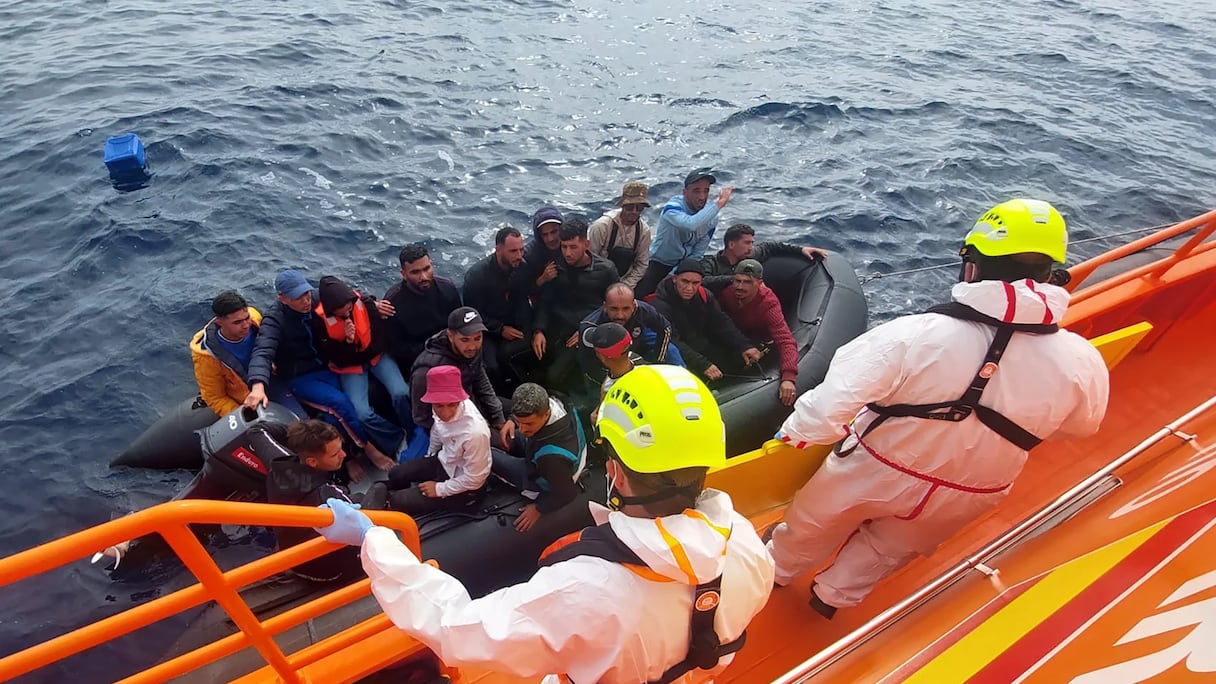
It is a monumental media spectacle obscuring a silent reality. On one side are the shocking images of mass assaults on Ceuta, swiftly replayed on a loop, followed by the return of almost all those who took part. On the other is the discreet lapping of dozens of pateras and other go-fast boats slipping under the radar toward the Balearic Islands or Alicante, carrying young Algerians who will never return. The latest statistics published on August 12 by the International Organization for Migration (IOM) have shattered a widely held assumption: in the Western Mediterranean, the real migratory tidal wave no longer comes from Morocco but from Algeria.
A close reading of the published data immediately points to a major geopolitical conclusion: Algeria is now by far the leading source of irregular migration along the Western Mediterranean route, well ahead of Morocco, despite the latter being separated from Spain by barely 14 kilometers. While European media attention remains fixated on land crossings that are admittedly spectacular but short-lived, the reality lies elsewhere.
The IOM’s official data confirm a profound and structural shift: over the period studied, Algeria alone accounted for 42% of the 5,647 arrivals recorded in Spain, officially making it the «leading country of origin» along this route. By comparison, Morocco accounted for 22%, almost half the Algerian share. As the IOM report points out, although most crossings historically originated in Morocco, the trend was irreversibly reversed in 2025 and has been emphatically confirmed in 2026, with most would-be migrants now departing from Algeria.
A Methodical and Continuous Flow
A comparative analysis of the methods used reveals two radically different migration patterns. On the Moroccan side, the report points to land crossings into Ceuta and Melilla (2,164 arrivals). These attempts are characterized by their discontinuous nature: assaults by large groups concentrated over a very short period. Yet realities on the ground and subsequent data show that these episodes do not result in permanent settlement. As the recent events demonstrated, almost all those taking part in these highly publicized assaults return home. The IOM also links the relative control of these access points to strengthened cooperation between Rabat and Madrid, reflected in the joint management of border crossings.
By contrast, Algerian emigration follows a methodical, almost industrial logic. Boats departing from Algeria, orchestrated by smuggling mafias, deploy a strategy of large-scale dispersal, sweeping indiscriminately across the entire Spanish coastline, from the Balearic Islands to the shores of Almería, Murcia and Alicante. Freed from the constraints of a single crossing point, these networks methodically exploit every favorable weather window to send regular contingents out to sea, operating in near-total silence that contrasts sharply with the harshness of the operations themselves. This maritime logistics system thus creates a one-way dynamic: unlike land assaults, where migrants are frequently intercepted, those who put to sea from the Algerian coast embark on a definitive crossing, feeding a continuous and unilateral flow that nothing currently appears capable of stemming.
Migration as a «Safety Valve»
One of the report’s most revealing findings concerns border-control activity. While Algerian migratory pressure is reaching record levels, interceptions by Algerian naval forces have fallen by 37% year on year, with just 1,002 interceptions between January and April 2026.
This security disengagement raises the question of the Algerian authorities’ responsibility. Algeria, a country rich in hydrocarbon resources, faces major domestic socio-economic tensions and a young population with few prospects. The regime appears to be using irregular migration as a political safety valve. Allowing disillusioned young people to leave provides a means of releasing domestic social pressure and forestalling any risk of popular unrest or political protest. Reducing maritime patrol efforts allows the security and human cost of its own socio-economic crisis to be transferred to the European shore.
Read also : Report: Evidence shows the Ceuta and Melilla assault was directed from Algeria
A strict reading of the official data nevertheless conceals a far more complex geographical reality: while IOM statistics accurately record arrivals on the Spanish coast as the point of entry into the European Union, they fail to reflect the true final destination of this irregular flow: France. For the overwhelming majority of these migrants arriving from Algeria, the Iberian Peninsula is merely a technical stopover, a transit point quickly left behind thanks to a solid network of established communities.
Drawn by pre-existing family networks, obvious linguistic proximity and a deeply rooted history of migration, these contingents make France their primary destination. This onward movement creates a largely underestimated statistical impact: after landing in large numbers in Murcia, Alicante or the Balearic Islands, these travelers in the shadows almost immediately disappear into the Schengen area and make their way to French territory, thereby slipping beneath the statistical radar used to assess their true impact on their final host country.
By the strict logic of the statistics, the conclusion is unequivocal: a massive, steady and silent exodus is taking place from Algeria to France via Spain, obscured by the media’s focus on other Mediterranean flashpoints. The IOM’s August 2026 report sets the record straight. It demonstrates that the image of an overwhelmed Morocco as the «gateway to Europe» masks the true structural reality of the Western Mediterranean: a collapse of domestic governance in Algeria translating into a continuous outflow of its citizens toward Europe.
