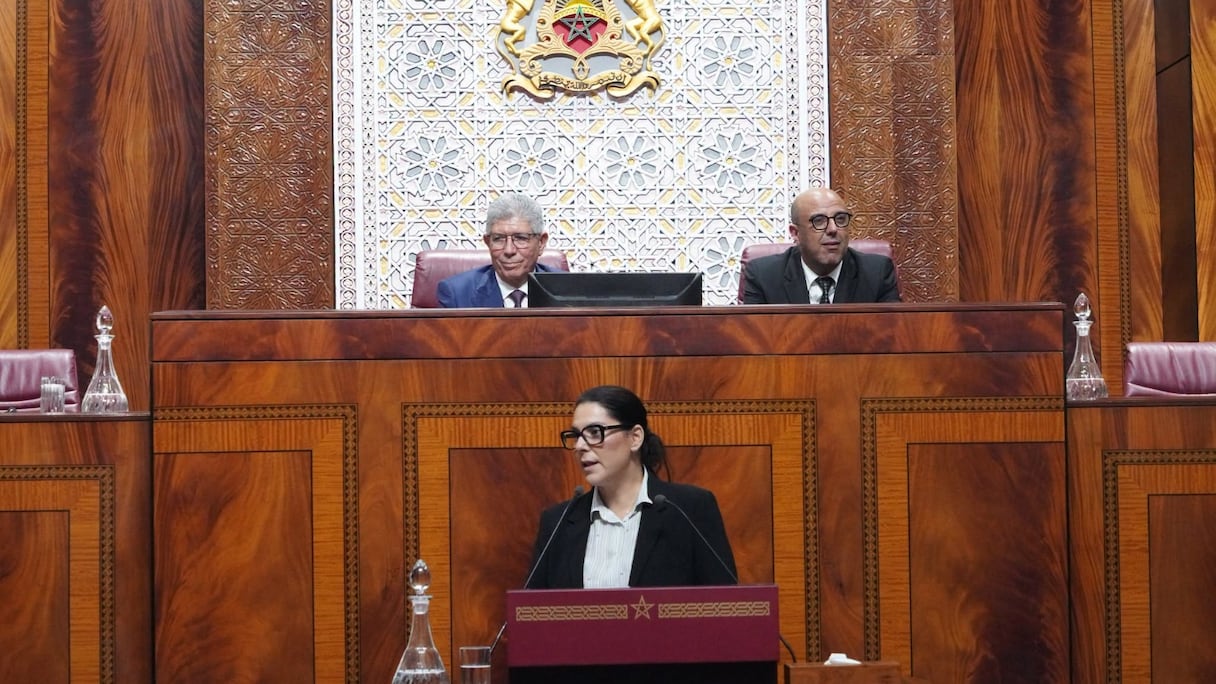
Fatima Ezzahra El Mansouri presented her new government’s program to a joint session of Parliament on Monday, setting out an ambitious political and institutional agenda under Article 88 of the Constitution. Guided by the priorities established by King Mohammed VI and the New Development Model, the government is seeking a fundamental shift in approach: moving beyond expanding programs and services to ensuring they deliver results, promote fairness and make a tangible difference to people’s lives.
Macroeconomic framework: balancing ambition with fiscal discipline
To finance an expanded welfare state without undermining the country’s economic fundamentals, the government has set out a disciplined fiscal path. It is targeting average annual growth of 5%, driven by a recovery in productive investment and a greater contribution from economic activity to the creation of sustainable jobs.
Protecting household purchasing power will remain a central priority. The government has pledged to keep inflation under control, at around 2% a year on average, to prevent household incomes from losing value. On public finances, tighter spending controls and a measured broadening of the tax base are intended to hold the budget deficit to a strict ceiling of 3% of GDP throughout the government’s term. That fiscal discipline should also put public debt on a downward path, with a target of reducing it to around 62% of GDP by 2031.
Targeted measures to ease pressure on households
The government’s plans for a stronger welfare state include direct financial assistance and measures to raise household incomes. Among its flagship cost-of-living measures is a new automatic subsidy covering the entire electricity bill for primary residences where monthly charges do not exceed 100 dirhams. El Mansouri said the scheme would target the most vulnerable households, with payments covered automatically, without applications, paperwork or visits to government offices.
The government also plans to take the King’s social protection program a step further. Monthly direct social assistance will gradually rise from 500 to 1,000 dirhams by the end of the government’s term, while eligibility criteria will be revised to reflect families’ actual incomes. The pension system, meanwhile, will undergo structural reform through consultations with social partners, with a gradual increase in the statutory minimum pension to 3,000 dirhams a month across the main schemes. Widows will also become entitled to a survivor’s pension equal to 100% of their deceased spouse’s pension rights, up from the current 50%, while existing protections for orphans will be maintained.
Closing social and regional divides
To tackle structural youth unemployment and the growing number of young people not in education, employment or training—an estimated 2.9 million people aged 15 to 29—the government will launch a nationwide program in 2027, tailored to local labor markets. Each year, it aims to train 100,000 young people in skills closely matched to employers’ needs and help another 100,000 secure their first job. At the same time, work-study training capacity will be expanded to between 150,000 and 200,000 participants annually, while 60,000 small businesses will receive tailored support to help them remain viable and compete for public contracts.
In education, the overriding goal is to improve the quality of public schooling. By 2031, the government wants at least 80% of pupils to have mastered basic learning skills, notably through the expansion of the Pioneer Schools model. A separate national plan will seek to eliminate school dropout by 2030, using an early-warning system to identify pupils at risk and prioritizing their placement in vocational training or reintegration programs.
Housing policy will also shift its focus from simply building homes to developing decent living environments with access to employment opportunities. Rural areas will receive particular attention through a dedicated program to build or rehabilitate 100,000 homes in emerging rural centers during the current parliamentary term. Eligible households will receive a direct grant of 40,000 dirhams, along with free technical assistance, while rural planning regulations will be simplified.
Water, energy and food security
With geopolitical instability and climate change placing growing pressure on essential resources, securing the country’s water, energy and food supplies is a central plank of the government’s program. On water, the strategy calls for a rapid expansion of alternative supplies, with a target of producing 1.8 billion cubic meters of desalinated seawater by 2031. This will be accompanied by the construction of more dams and the development of inter-basin water transfers to help maintain a balanced supply across regions.
On energy independence, the government has pledged to increase renewables’ share of the national electricity mix to more than 52% by 2030, while accelerating the implementation of Morocco’s green hydrogen offer and its natural gas roadmap.
Read also : King approves request to relieve minister delegate Madiha Khayr of her duties
Food sovereignty will center on greater control over agricultural inputs. A national program aims to raise the share of locally sourced seeds from 20% today to 50% by the end of the government’s term, reducing reliance on foreign suppliers in strategically important agricultural sectors.
Decentralization and a stronger role for private investment
On governance and regional development, the government intends to give fresh momentum to advanced regionalization. To strengthen the autonomy and effectiveness of local authorities, state transfers to regional councils will rise to at least 12 billion dirhams a year from 2027, alongside the full rollout of administrative deconcentration.
The government will also continue strengthening the legal framework against corruption, conflicts of interest and illicit enrichment as part of its efforts to improve public integrity and the business environment.
To support Moroccan businesses, a new regulatory requirement will oblige companies awarded major public contracts to allocate at least 30% of the total contract value to Moroccan micro, small and medium-sized enterprises.
The government’s economic transformation agenda also calls for a shift in the balance of investment towards the private sector. By strengthening the mechanisms of the new Investment Pact and implementing the 2027–2030 tourism roadmap, which targets 26 million visitors by 2030, the government aims to raise the private sector’s share to two-thirds of total national investment, reinforcing Morocco’s position as an emerging and resilient economic power.
