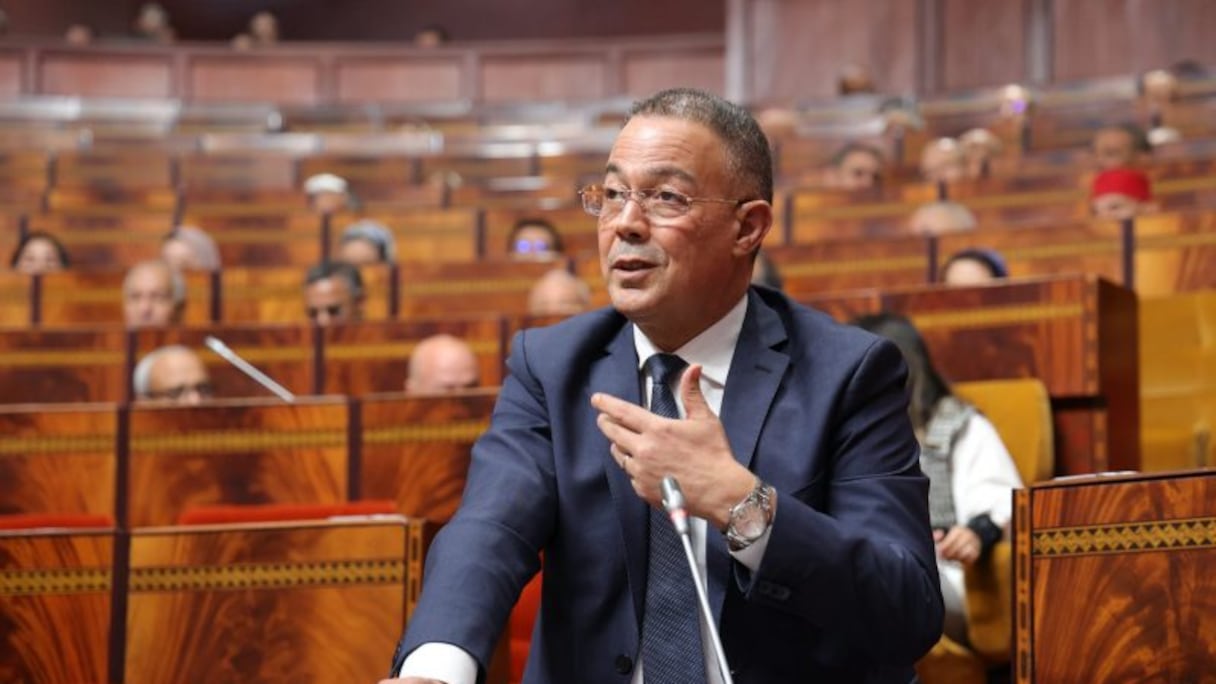
Some officials reach the political forefront only after years of wielding influence behind the scenes. Fouzi Lekjaa has built his career at the heart of Morocco’s budget machinery, where finance bills take shape, ministerial allocations are negotiated and government priorities come up against the limits of available resources. His appointment as Minister of Economy, Finance and Public-Sector Performance is the culmination of that career, but it also brings a considerable expansion of his responsibilities.
At 56, the man who spent years preparing the state’s budget decisions must now take political responsibility for them as head of a major ministry. Yet the very name of his new portfolio points to ambitions beyond keeping the public finances in balance. It also entails ensuring that public money delivers measurable results, that government policies are implemented effectively and that the resources committed achieve their stated objectives.
From agricultural engineering to public finance
Born in Berkane on July 23, 1970, Fouzi Lekjaa trained as an agricultural engineer at the Hassan II Institute of Agronomy and Veterinary Medicine, graduating in 1994. He continued his studies at the National School of Administration before joining the General Inspectorate of Finance in 1997. That move into public finance marked the beginning of a steady rise through the administration, built on technical expertise and an increasingly thorough understanding of how the state operates.
He subsequently joined the Budget Directorate, holding several positions before becoming deputy director in June 2010 and director in January 2011. He would remain at the head of this strategic department for nearly eleven years. During that time, he developed a detailed understanding of government spending, sectoral policies and the trade-offs between political priorities and the resources available to fund them. That experience now forms the foundation of his new role.
Read also : MAD280bn ‘wasted’, but MAD350bn impossible? Lekjaa asks rivals
In October 2021, Lekjaa stepped out from behind the administrative curtain to join the government as Minister Delegate in charge of the Budget. The change in status did little to alter the substance of his work, but greatly increased its public profile. The official who had once prepared budget documents was now responsible for defending them before parliament and explaining the government’s decisions in public.
With each successive finance bill, he became an increasingly familiar figure in discussions of tax revenue, public expenditure, investment and the financing of social policies. He took a leading role in budget debates, answering criticism, defending spending decisions and setting out the constraints on the state’s finances.
A full ministerial portfolio
His position as minister delegate did not prevent him from exercising considerable influence over these matters. In political and economic circles, some came to describe him as the outgoing government’s “real finance minister.” The description reflected the weight he carried in budget discussions, although it does not in itself capture the full extent of the responsibilities he now assumes as a cabinet minister in his own right.
A finance bill, after all, is more than a collection of tables and forecasts. It embodies political choices, establishes priorities and reveals the compromises a government is prepared to make. Command of procedures and figures is essential to preparing decisions, but carrying them out also requires coordination between government departments, oversight of expenditure and an assessment of what publicly funded policies actually achieve.
It is this connection between budget preparation, political decision-making and implementation that is now reflected in the name of his ministry. Public-sector performance brings a second question to the fore, beyond how policies are financed: do the resources committed produce the intended results? Much depends on the quality of planning, the ability of government departments to spend their allocations effectively and the means available to measure the impact of public expenditure on citizens and businesses.
PAM’s political ambitions face the test of the numbers
Lekjaa’s budget expertise also placed him at the center of the Authenticity and Modernity Party’s campaign for the September 23, 2026, legislative elections. In the weeks leading up to the vote, the official responsible for the budget became one of the principal advocates of his party’s economic and social program. His task was not only to defend its ambitions but also to explain how they would be paid for, particularly when addressing business leaders.
PAM presented its program for 2027–2031 as a set of costed commitments, organized around five strategic pacts and backed by a proposed total allocation of 350 billion dirhams over five years.
But a figure of that magnitude immediately raises a fundamental question. Where will the money come from, and under what conditions can the targets be met? This is where Lekjaa has been most consistently engaged. Rather than merely repeating his party’s promises, he has defended the program’s financial structure, explained its funding assumptions and addressed questions about whether the commitments are sustainable.
Turning resources into results
In Azilal, Berkane and Dakhla, and later before representatives of the General Confederation of Moroccan Enterprises (CGEM), he made repeated appearances to explain the program and defend its coherence. On September 10, in Casablanca, he took part in the launch of PAM’s campaign, calling for a change in the direction of government policy and putting purchasing power, healthcare, education and opportunities for young people at the center of the debate.
The election campaign marked a shift in his career. Lekjaa’s involvement helped give PAM a distinctive profile on economic issues, with the costing and financing of its commitments central to the party’s case. But it also highlighted a requirement that now carries particular weight in his new position. A program’s credibility rests not only on the money it promises to raise, but on the government’s ability to turn that money into tangible results.
This is where the question of public-sector performance comes into its own. Increasing health or education budgets does not, by itself, guarantee a corresponding improvement in services. Funds must be allocated properly, projects delivered on schedule and their impact assessed. These are precisely the challenges the new minister will have to confront as the ambitions championed during the campaign meet the practical constraints of implementation.
A command of the figures is not always enough to resolve a crisis. Demands must also be turned into acceptable compromises, and negotiated commitments into measures that can actually be financed. Lekjaa has played a leading role here too, notably during the government’s negotiations with unions in the education and healthcare sectors.
His involvement was most visible in education. In autumn 2023, as strikes disrupted schools across the country, the Minister Delegate in charge of the Budget joined the ministerial committee negotiating with trade unions. The talks covered the unified statute for National Education employees, demands from specific professional groups and salary increases.
On December 26, 2023, Lekjaa joined ministers Chakib Benmoussa and Younes Sekkouri in signing an agreement with five education-sector unions. Among its provisions was a net monthly pay rise of 1,500 dirhams for teachers, phased in over two years.
Budget planning
His role went beyond political negotiation. It also involved working out how the government would pay for the concessions it had made. Salary increases and measures benefiting particular professional groups had to be costed, incorporated into budget plans and reconciled with the state’s other commitments. It is at this intersection of social dialogue and fiscal sustainability that his experience as budget director has proved particularly relevant.
The same applies to healthcare. On February 24, 2022, Lekjaa attended the signing of an agreement between the Ministry of Health and sectoral trade unions following several rounds of social dialogue.
The addition of public-sector performance to his ministry’s remit gives this aspect of Lekjaa’s career particular significance. Until now, his role had been associated chiefly with preparing budgets, raising revenue and defending financial decisions. His new responsibilities extend into a broader field: how effectively public money is spent and what results the state achieves with the resources at its disposal.
The practical scope of this new responsibility will, however, depend on how it is coordinated with the relevant government agencies and other ministries. Public-sector performance is not the responsibility of a single department. It involves the entire government, program managers and the bodies charged with implementing public policy. The challenge will therefore be as much organizational as financial.
Morocco 2030: Beyond the football pitch
Another major undertaking illustrates Lekjaa’s ability to work across several areas of public policy: the 2030 FIFA World Cup, which Morocco will co-host with Spain and Portugal.
Appointed by King Mohammed VI in October 2023 to chair the 2030 World Cup Committee, he was given responsibility for overseeing a program that extends far beyond staging a sporting competition. Infrastructure, transport, facilities, services and coordination between government departments are all part of an undertaking whose benefits are intended to last well beyond the tournament itself.
The creation of the Morocco 2030 Foundation takes this approach further. The bill establishing the body, presented by Lekjaa in July 2025, is intended to coordinate and monitor preparations for major international sporting events while ensuring that the Kingdom honours its commitments. The stated ambition is to use the World Cup to accelerate development, bringing together public institutions, local authorities and the private sector.
Lasting value
This undertaking is directly relevant to his new responsibilities. Financing infrastructure, planning investment and monitoring delivery are all matters of economic and budgetary management. But public-sector performance is just as important. The task is to meet deadlines, control costs, coordinate the various parties involved and ensure that the facilities built continue to serve a purpose after the competition.
The success of this collective investment will therefore be measured by more than compliance with FIFA’s requirements or the timely completion of infrastructure. It will also depend on whether those facilities deliver lasting benefits to local communities, businesses and citizens, and whether the economic returns justify the resources invested.
Lekjaa thus takes charge of a ministry whose workings he knows intimately, but whose expanded remit demands more than the management of budgetary trade-offs. His new task is to bring fiscal discipline, economic ambition and effective government action together. The measure of his tenure will be how successfully he translates the figures into results.
