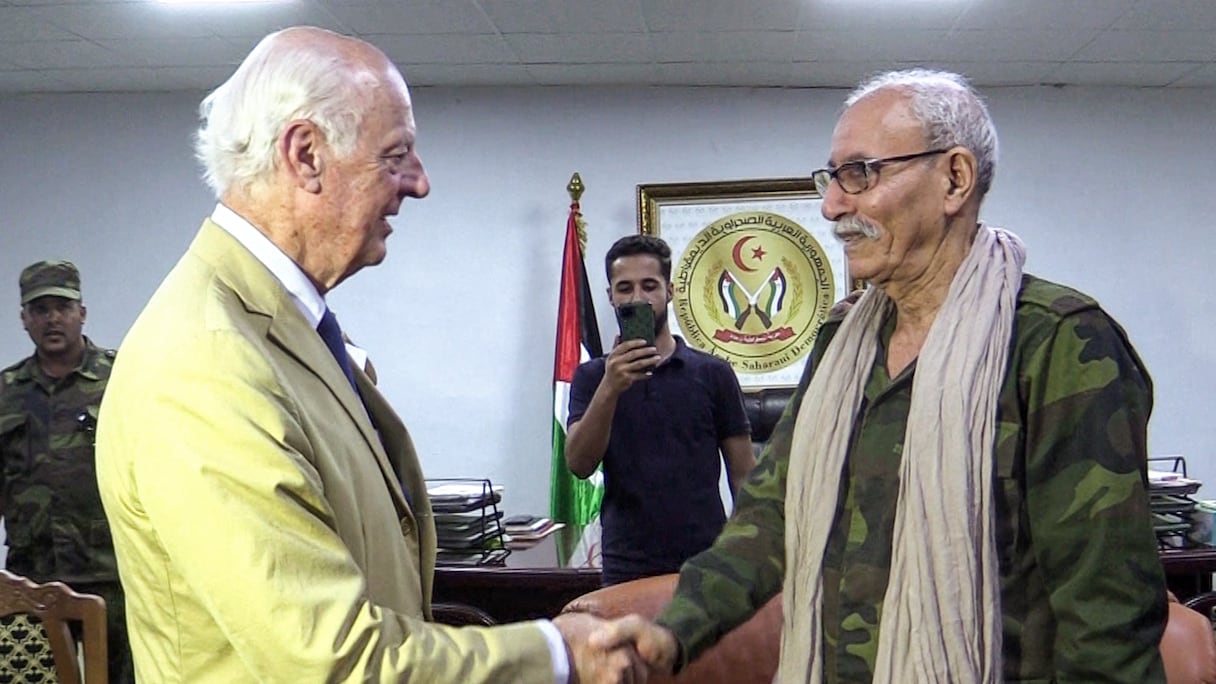
The statement was issued in New York on Monday, October 12, following a letter from Polisario leader Brahim Ghali to UN Secretary-General António Guterres. The grievance concerns remarks made by Staffan de Mistura on October 8 during closed-door Security Council consultations on MINURSO.
The Polisario accuses the UN envoy of a “lack of neutrality” and of “publicly aligning himself with Morocco’s positions,” reportedly over his support for autonomy under Moroccan sovereignty as the basis for future negotiations. The separatist movement calls his conduct “extremely concerning,” questioning his “credibility, impartiality and independence.” It is now threatening to “reconsider its engagement” with him.
Nor is this the first such complaint. The Polisario says it had already written to the UN on March 4 and September 21 to take the envoy to task. Three letters in seven months. This is no longer an attempt to influence a mediator. It is an exercise in finding someone to blame.
A mediator who has never been Rabat’s man
The charge is difficult to square with De Mistura’s record. If any UN envoy has given Rabat cause for suspicion, it is Staffan de Mistura. In 2024, he revived the long-discarded idea of partitioning the territory during a Security Council briefing, prompting Moroccan Foreign Minister Nasser Bourita to dismiss it as a “reheated” proposal. That same year, De Mistura’s visit to Pretoria, whose government openly supports the Polisario, caused irritation in Morocco.
There is another contradiction. On October 7, the day before De Mistura’s briefing, former Algerian “diplomat” Amar Belani published an opinion piece entitled “After Boulos, Staffan de Mistura in Rabat’s Crosshairs.” Five days later, the Polisario was portraying the very same man as an instrument of Morocco. Which is it?
Ten days of mounting anxiety
The events of the past ten days tell their own story about the mood in Algiers and Tindouf. On October 3, Abdelmadjid Tebboune told television viewers that Algeria would not be “more Sahrawi than the Sahrawis” and that Resolution 2797 was “taking its course.” It is hard to imagine a clearer way for a president to prepare his people for a retreat.
On October 8, Ahmed Attaf followed suit. Algeria’s foreign minister said he was watching developments “with considerable astonishment mixed with legitimate concern” and expressed alarm at the prospect of the dispute being “reduced to a mere refugee issue.” That same day, Staffan de Mistura briefed the Security Council.
On October 11, Algerian police announced the arrest of 61 Moroccans suspected of preparing “acts of sabotage,” without providing a single detail about their alleged targets. The following day, the Polisario issued its statement attacking the UN envoy. Meanwhile, Amar Belani has been publishing one opinion piece after another, sometimes two in a single day, to insist that everything is going perfectly well.
Taken together, these episodes hardly suggest a coherent strategy. What they reveal is anxiety. Those confident of their position do not spend ten days issuing a barrage of statements, warnings and conspiracy allegations.
The message they refuse to hear
What has so alarmed the Polisario and Algiers comes down to a single point in De Mistura’s October 8 briefing. After three rounds of talks in Washington and Madrid, negotiations have reached an impasse, and the obstacle is the Polisario’s refusal to give the autonomy plan serious consideration. For the first time, the UN mediator has explicitly identified the party holding up progress.
That is what the Polisario finds intolerable. Since the adoption of Resolution 2797 a year ago, autonomy under Moroccan sovereignty has formed the basis for negotiations. The Personal Envoy is merely operating within the framework established by the Security Council. In attacking him, the Polisario is effectively challenging the Council itself and, by extension, an international community that has already reached its decision.
The swan song
The approaching deadline explains the panic. The Security Council is due to adopt a new resolution at the end of October, and neither Tindouf nor Algiers expects it to reverse course. Unable to change the substance of the resolution, they turn on the mediator, manufacture controversy and raise the spectre of conspiracies. It is the behavior of those who sense that the contest is slipping beyond their control.
None of this agitation will change the outcome. A movement that threatens to sever ties with the UN mediator while professing its commitment to the UN process is not strengthening its position. It is isolating itself. Nor does a regime that responds to a diplomatic setback by arresting foreign workers persuade anyone that it is confident or composed.
In both Tindouf and Algiers, October 31 is now approaching with something close to panic. Yet Resolution 2797 had already sounded the final whistle.
