After the rapid succession of events—most of them disastrous—that have shaken or involved Algeria in recent months, from deadly forest fires and the resumption of executions under the death penalty to the severing of diplomatic relations with the United Arab Emirates and the unprecedented military intervention in Niger, not to mention the approaching annual UN Security Council meeting on the Sahara, Tebboune’s explanations on all these issues had been eagerly awaited.
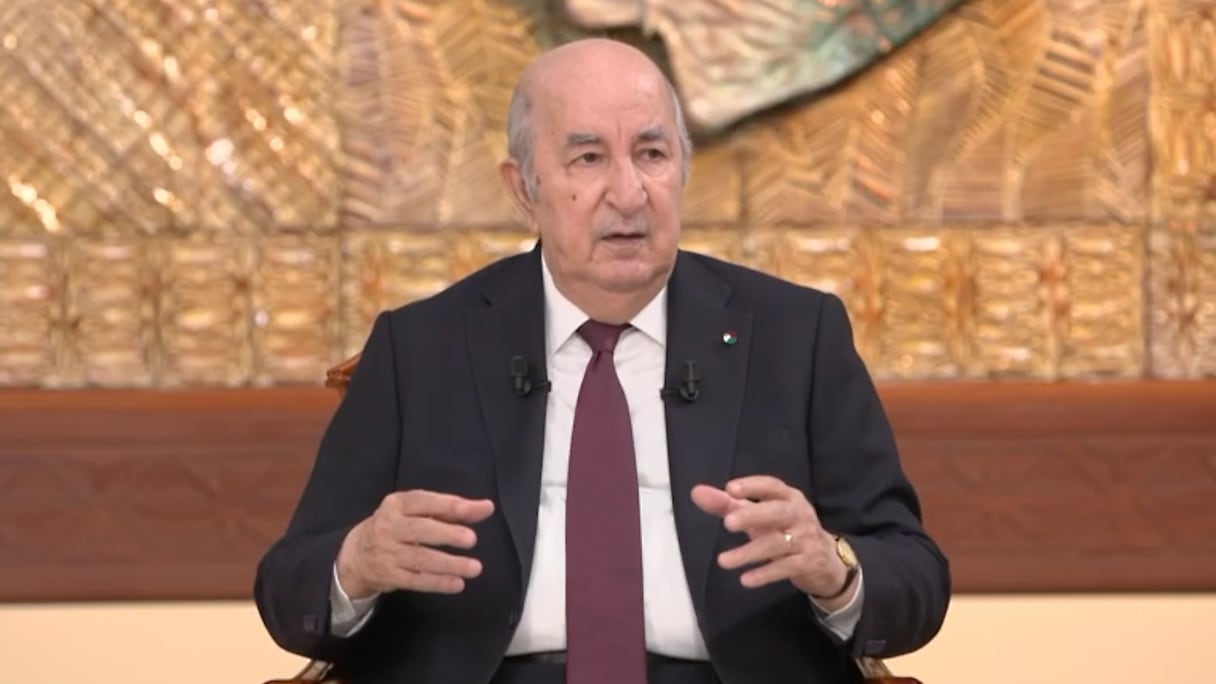
By Saturday night, disappointment had once again set in after two hours of prerecorded presidential chatter before three journalists well known as members of the regime’s media mouthpiece brigade. Although they went through the motions of raising all the issues in the news, their main failing was to steer their guest’s answers very much in the direction he wanted them to go.
A telling example came with the first question on the Sahara, when the journalist’s tongue slipped into telling the truth before he quickly caught himself and returned to the approved propaganda line.
The journalist said that Algerian Foreign Minister Ahmed Attaf had told the 81st UN General Assembly that his country supported “direct negotiations between Algeria… er… sorry… between the Polisario and Morocco.” Embarrassed by this non-slip of the tongue, Tebboune responded with a blatant falsehood, claiming that the latest “UN Security Council resolution identified two parties to the dispute: the Kingdom of Morocco and the Polisario.” Yet Resolution 2797 of October 31, 2025 clearly identified Algeria as the principal party to the Sahara conflict.
No stranger to contradiction—and certainly not for the last time—Tebboune, who previously said that this “resolution is running its course,” once again acknowledged that the “resolution is there, it exists.”
In other words, it represents a painful diplomatic setback for Algeria. That did not stop him from reaffirming his support for the Polisario, even as he expressed concern over the undefined legal status of Sahrawis born in the Tindouf camps since 1975.
Read also : Algeria: In yet another tirade, Tebboune displays the full extent of his vulgarity
Asked what solution he advocates to end the Sahara conflict, Tebboune once again said he would support whatever solution the Polisario accepts. Yet the separatist movement has no decision-making power of its own and, as a puppet, merely carries out the instructions of the Algiers regime.
That said, Tebboune appears to be preparing Algerian public opinion, steeped in decades of anti-Morocco propaganda, to accept autonomy for Western Sahara under Moroccan sovereignty.
Although he distorted the substance of the latest Security Council Resolution 2797, Tebboune nevertheless insisted that his country respects it stricto sensu. Yet the very resolution Tebboune invokes explicitly establishes autonomy as the basis for a solution to the Sahara conflict. To cite that resolution while adding that “we are not more Sahrawi than the Sahrawis. Whatever solution the Sahrawis accept, we will accept too” marks a major shift from Tebboune’s customary diatribes and uncompromising stance. It can be read as an attempt, on the eve of a highly anticipated new resolution, to prepare Algerian public opinion to accept the present and future of the Sahara under the sovereignty of the Kingdom of Morocco.
Morocco obsesses the Algerian president even when he does not mention it by name. Tebboune thus turned to the Trans-Saharan gas pipeline, indirectly suggesting that the sole purpose behind a project that will bleed Algeria dry is to compete with the Nigeria-Morocco Atlantic gas pipeline.
Algeria’s current push in Niger, marked above all by the unprecedented deployment of military aircraft following a failed military coup in Niamey, is aimed at getting the country to accept the pipeline crossing its territory. But on Saturday, Tebboune justified Algeria’s military intervention in Niger by pointing out that the coup in Niamey had taken place on the very day Nigerien Prime Minister Mohamed Lamine Zeine ended his visit to Algiers. Tebboune described this as a “provocation” against Algeria, without saying who exactly was doing the provoking.
Read also : Sahel: The implications of Algeria’s unprecedented military intervention in Niger
Asked about the severing of diplomatic relations with the United Arab Emirates, Tebboune was remarkably evasive, unable to cite a single concrete reason for such an extreme step and speaking vaguely of “provocations” at one point and “interference” at another. He accused Abu Dhabi of ingratitude, repeating for the umpteenth time that Algeria had created, or helped create, the UAE’s first hydrocarbons company.
On foreign policy, however, not a word about relations with Spain. For weeks, official propaganda had been celebrating the supposed honeymoon between Algiers and Madrid, which was to be crowned with great fanfare at a high-level summit between the two countries in the Spanish capital on October 20 and 21. But Spain’s request to postpone that meeting sine die has left the erratic Algiers regime reeling.