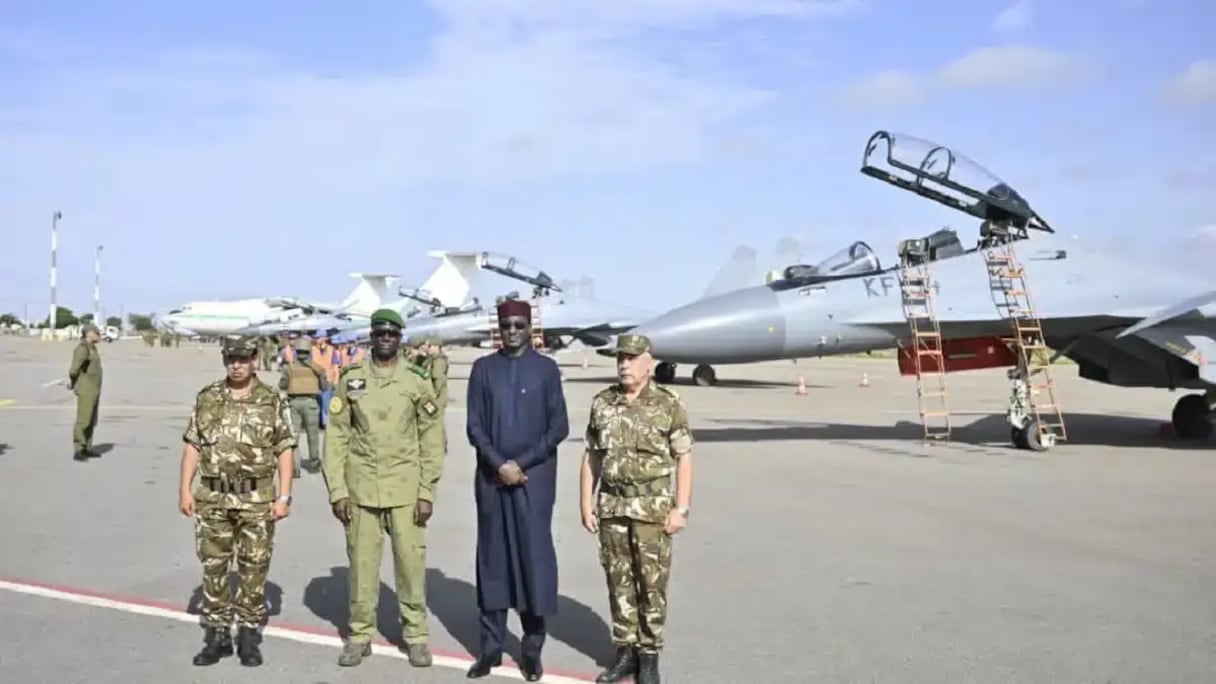
In a statement dated Sunday, August 30, the Algerian Ministry of Defense caused a surprise by announcing the unprecedented deployment of military aircraft to Niamey in support of Niger’s authorities, which had thwarted an attempted military coup on Saturday, August 29. “Following the regrettable events that recently occurred in the Nigerien capital, Niamey, in an attempt to destabilize the country, and in response to a request from the Nigerien authorities, Army General Saïd Chengriha, Minister Delegate to the Minister of National Defense and Chief of Staff of the People’s National Army, ordered the deployment of two patrols of Sukhoi Su-30 fighter jets (four aircraft), on a mission to support the Nigerien army in confronting this attempt to destabilize the brotherly country of Niger,” the Algerian Defense Ministry statement said, adding that the decision had been taken on the instructions of President Abdelmadjid Tebboune.
Yet on Monday, August 31, the Algerian presidency issued its own statement, announcing that President Tebboune had held telephone talks that same day with the Nigerien president. Tebboune is said to have assured his Nigerien counterpart, Abdourrahmane Tiani, of Algeria’s full support “in all areas.” General Tiani escaped an attempted military coup plotted during the night from Friday to Saturday. The coup was thwarted thanks to the decisive intervention of Africa Corps troops, which operate under the Russian Ministry of Defense.
According to a statement issued Sunday by the Russian Foreign Ministry, the latter rapidly put an end to the mutiny and restored order in the Nigerien capital. Algiers, which had just hosted Nigerien Prime Minister Mahamat Lamine Zeine on August 26 and 27, seized the opportunity to lend its support to the Nigerien authorities by dispatching military aircraft, including four fighter jets. It is an unprecedented move, breaking with the doctrine Algeria had followed until now of not deploying its army beyond its borders.
Even if Algeria’s military intervention in Niamey is symbolic and intended primarily for the announcement effect, the fact remains that the unprecedented deployment of Algerian military aircraft to Niger contradicts the position regularly trumpeted by the Algiers regime, namely that it rejects any form of foreign military intervention in Sahel countries or interference in their internal affairs.
Once again, Algiers is laying its contradictions bare by supporting a government it deemed illegitimate three years ago, when it vilified General Tiani and openly condemned his July 2023 seizure of power against the country’s former elected president, Mohamed Bazoum. Algiers was in turn accused of interfering in Niger’s internal affairs, triggering an open crisis with Niamey.
Algeria also opposed the military intervention advocated by the Economic Community of West African States (ECOWAS), of which it is not a member and whose statutes provide for the option of militarily restoring the lawful government of a member state in the event of a military coup. Caught in the snares of its own contradictions, Algerian diplomacy claimed that Niamey had tasked it with mediating between the new military authorities and ECOWAS. Niger firmly denied this, leaving Algerian Foreign Minister Ahmed Attaf embarrassed by this blatant lie.
How, then, does a country that has elevated military non-intervention into a creed—to the point of never having sent a single Blue Helmet to contribute to UN peacekeeping operations—suddenly come to violate its own principles by intervening militarily where it was least expected?
It is true that Algeria’s Constitution, amended in 2020 following a referendum widely boycotted by voters, opened the way for the possible deployment, under certain conditions, of Algerian troops abroad. In particular, for peacekeeping missions under the auspices of the UN, the African Union or the Arab League. So-called “counterterrorism” operations may also justify sending Algerian military personnel beyond the borders of neighboring countries.
However, under Article 91 of the 2020 Constitution, any military deployment beyond Algeria’s borders is subject to the prior approval of two-thirds of the members of the Algerian Parliament. Clearly, the deployment of fighter jets to Niger bypassed this constitutional procedure. This sudden shift in attitude by the Algiers regime, through its military intervention in Niger, is part of Algeria’s new diplomatic logic, which now consists of bending over backwards for its Sahel neighbors.
After several years of crises and diplomatic feuds with Mali and Niger, it cannot be ruled out that Algeria, in its new posture, will be called upon to withdraw its overt or covert support for certain separatist and terrorist groups, the main sources of the Sahel’s current instability. For it is precisely this double game by Algiers—supporting both the governments in power and their enemies—that constitutes the Gordian knot at the heart of its disputes with its neighbors. The strengthening of Russia’s military presence in the Sahel is certainly not unrelated to Algiers’ ongoing reversals in the region.
On July 9, 2026, Russian Foreign Minister Sergei Lavrov was in Niamey, where he above all reaffirmed his country’s military support for the Alliance of Sahel States (AES), comprising Mali, Niger and Burkina Faso, countries with which Moscow has signed defense agreements. Lavrov’s visit took place as part of the second round of consultations between the Russian foreign minister and his AES counterparts.
Read also : From rupture to reconciliation: Algeria’s Mali U-turn adds to a record of diplomatic retreats
Yet the AES states, particularly Mali, have repeatedly accused Algeria of being the “sponsor of terrorism” in the Sahel. Lavrov, moreover, did not fail to allude to that accusation. At a press conference held in October 2025, he indirectly castigated Algiers’ support for Mali’s Tuareg rebels, reminding Algerians that their country’s borders are “artificial,” having been arbitrarily drawn with a ruler by the colonial power.
Sergei Lavrov’s outburst badly rattled the Algiers regime, which hastened, a few weeks later, to roll out the red carpet for General Abdourrahmane Tiani—the same man it has now rushed to rescue alongside the Russian paramilitaries whom Algiers was still denouncing only yesterday as mercenaries.
While now falling in behind Russia’s strategy in the Sahel, Algeria is also attempting, according to some observers, to capitalize on the “spectacular” deployment of an army squadron to Niger in order to counterbalance Morocco’s influence in the region.