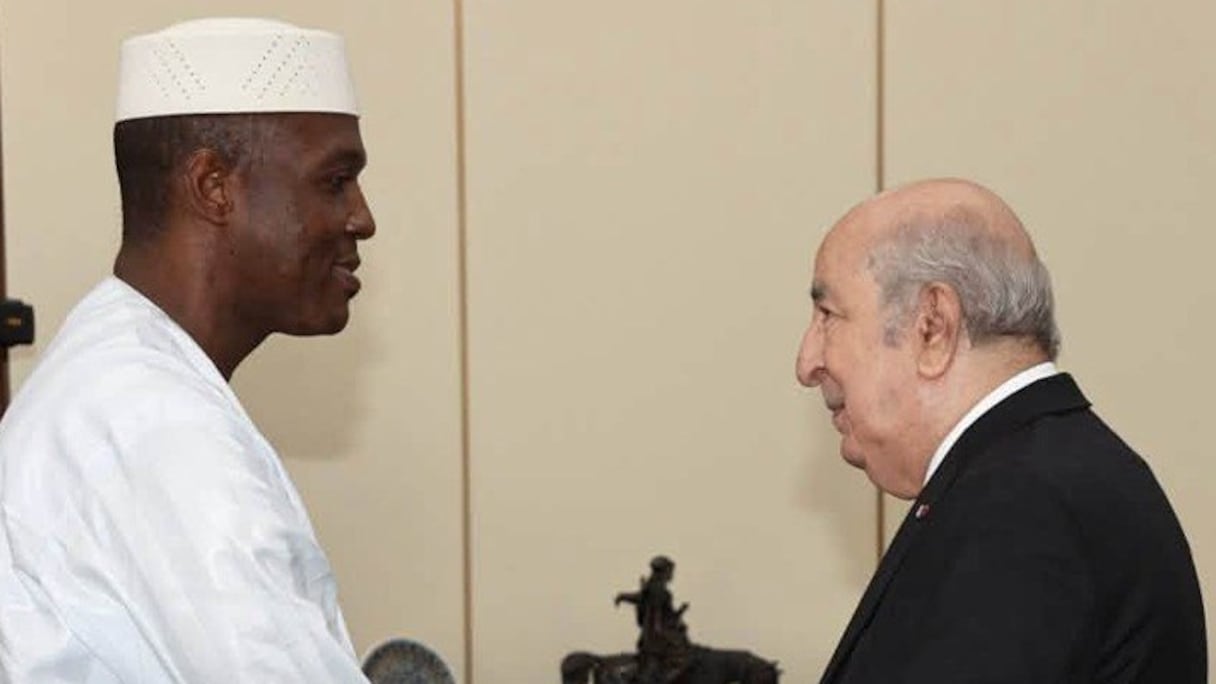
On Monday, August 24, 2026, Algerian diplomacy staged what it is attempting to sell as a “strategic reset.” Mali’s transitional Prime Minister Abdoulaye Maïga arrived in Algiers for an official working visit, welcomed in the airport’s VIP lounge by his Algerian counterpart, Sifi Ghrieb, and subsequently by President Abdelmadjid Tebboune. The visit comes after more than two years of a major diplomatic crisis, including fourteen months during which relations were completely severed. But beneath the veneer of official embraces lies an outright capitulation.
The rapprochement between Algiers and Bamako stems not from any political masterstroke by the Algerian authorities, but rather from an acknowledgment of failure. Faced with Mali’s steadfastness, Algiers was forced to yield. In July 2026, President Abdelmadjid Tebboune ordered the return of Algeria’s ambassador to Bamako. Mali reciprocated by sending its representative back to Algiers, paving the way for the simultaneous reopening of their respective airspaces. On August 9, 2026, an official telephone conversation between the two prime ministers laid the groundwork for the Algiers meeting. Finally, in mid-August 2026, Algeria hastened to act as an intermediary in a prisoner exchange: the release of 80 Malian soldiers by Tuareg rebels in return for fighters captured by the Malian army. This abrupt reversal forced Algeria’s official press to abandon its insults and suddenly sing the praises of an “active reconciliation.”
The deterioration in Algerian-Malian relations began in December 2023. Emboldened by certainties inherited from a bygone era, Algeria believed it could get away with anything as it continued to patronize the authorities in Bamako. Acting as a self-appointed guardian, Algiers organized official and clandestine meetings with figures from the Malian opposition as well as leaders of the armed Tuareg rebellion in the north, all without the slightest consultation with Mali’s transitional government. This direct interference triggered a devastating chain reaction. Bamako recalled its ambassador from Algiers on December 20, vehemently denouncing “hostile acts” and the Algerian authorities’ hosting of separatist or extremist elements. Algeria retaliated the following day with the same measure.
On January 25, 2024, the Malian government terminated the 2015 Algiers Agreement with immediate effect, ordered Algeria to cease interfering in its sovereign affairs and categorically rejected its mediation. In the spring of 2025, the crisis reached a security point of no return. A Malian armed forces drone operating in the border region of Tinzaouatene was shot down. Bamako accused Algeria of downing the aircraft to protect separatist fighters. Algiers responded by accusing Mali of territorial incursions. The rupture was complete. Airspace was closed.
The Tebboune Regime’s Silent Capitulation
The outcome of this diplomatic confrontation lays bare the amateurism of the Algerian authorities. After waging a hateful campaign during which the press under its orders branded Malian officers “putschists,” “ignorant” and “incompetent,” Algiers is once again passing under the Caudine Forks. With its tail between its legs, the Algiers regime is capitulating. Without securing the slightest commitment from Bamako to comply with its security or political diktats, Algeria has agreed to resume normal cooperation. Its futile threats of strangulation and attempts at blackmail have merely exposed the weakness of its strategic position.
Some analysts argue that Algeria owes this forced reconciliation to the diplomatic efforts of... Morocco. A geopolitical leverage effect: “It was the absolute dread of seeing the Kingdom establish itself definitively in the Sahel that forced Abdelmadjid Tebboune to swallow his pride,” says exiled Algerian journalist Abdou Semmar. As evidence, he points out that immediately after the crisis with Algiers erupted on December 20, 2023, Malian Foreign Minister Abdoulaye Diop traveled to Marrakech on December 23 and 24 to formalize Mali’s full accession to Morocco’s Atlantic Initiative, a project offering the Sahel country access to the ocean. To avoid being driven out of its own southern borderlands, the Algerian authorities were forced to swallow their venom and beg Bamako to reopen dialogue. Too late.
A Pyromaniac Diplomacy
The Malian fiasco is no isolated accident: it follows the same hysterical logic that guided the crises artificially provoked by Algeria with Niger, Spain and France. In every case, Algiers acts in anger, decrees a blockade or an abrupt rupture, realizes the extent of its isolation, then pitifully seeks normalization while conceding across the board. As early as July 2023, Algiers arrogantly interfered in Niger’s transition, issuing moralistic invectives, threatening border security and organizing the expulsion of migrants under brutal conditions. Niger responded by shutting the door on its former Algerian big brother. In an attempt to rebuild bridges, Algeria was notably forced into a financial capitulation in February 2026, during the visit to Algiers by General Abdourahamane Tiani, President of the Republic of Niger. The Tebboune regime was compelled to write a cheque for at least €50 million, financed by the Algerian taxpayer, to subsidize local projects in Niger.
The same pattern played out with Spain. In March 2022, following Madrid’s historic decision to support Morocco’s autonomy plan for the Sahara, Algiers flew into a rage. The regime recalled its ambassador, suspended the twenty-year-old Treaty of Friendship and Good-Neighbourliness, and unilaterally froze non-gas commercial transactions with Spanish companies. The outcome was a complete humiliation: Spain did not shift its position by a single inch. Realizing that its sanctions were primarily hurting its own economy, Algiers quietly sent an ambassador back to Madrid in late 2023, before discreetly lifting all trade restrictions over the following months, without securing the slightest concession from Spain.
The most bruising episode remains the French one. Paris formalized its irreversible support for Morocco’s sovereignty over the Sahara, a position communicated directly by Emmanuel Macron to Abdelmadjid Tebboune on June 14, 2024, during the G7 summit in Bari. Following the official announcement of the French position in July 2024, Algiers recalled its ambassador, suspended security cooperation and mobilized its customary rhetoric over historical grievances. Eighteen months later, the bluff collapsed. In February 2026, French Interior Minister Laurent Nuñez traveled to Algiers and publicly dictated the resumption of cooperation at El Mouradia Palace. As an added bonus: the systematic readmission of Algerian nationals subject to deportation orders. The Sahara issue, which had supposedly caused “the most serious crisis in history,” was simply buried by an Algerian regime entirely submissive to Paris’s demands.
The Unchanging Pattern of Algerian Fiasco
Every foreign-policy intervention of the Tebboune era follows the same mechanics of failure, unfolding in four successive phases. The first begins with anger and hysteria, marked by incendiary statements, hasty recalls of ambassadors and threats of economic and security reprisals. Then comes an attempt at blackmail, characterized by the suspension of contracts and airspace, the adoption of a posture of historical victimhood and the self-delusion that Algeria holds the upper hand.
This approach inevitably leads to isolation and realization, as the utter ineffectiveness of the measures taken becomes apparent. The spiral ends in abandonment and capitulation, manifested in unilateral concessions. What does Algeria gain at the end of this succession of diplomatic hysterics? In a word: walou. Nothing. By multiplying threats without ever possessing the means to carry them through, the Tebboune regime has destroyed what remained of the Algerian state’s credibility. Algeria is now perceived by its regional and international partners as an unpredictable, impulsive actor, governed by emotional outbursts and with which no long-term commitment can be entered into with any confidence.
This drift has no precedent in the country’s very young history. Neither under Houari Boumédiène, nor Chadli Bendjedid, nor Liamine Zéroual, nor even during Abdelaziz Bouteflika’s two decades in power had Algeria been so isolated from its immediate environment. This diplomacy by impulse is the exclusive hallmark of Abdelmadjid Tebboune’s tenure, characterized by a profound misunderstanding of global geopolitical balances, amateurish management of the machinery of state and a grossly inflated view of Algeria’s regional weight.
The “Pragmatism” Scam
To justify these repeated retreats, the regime invariably pulls a magic word out of its hat: “pragmatism.” Where was this pragmatism when the Algerian authorities threatened to cut off gas supplies to Spain, closed their airspace to civilian aircraft, branded neighboring leaders “putschists” and spread the poison of ethnic division throughout the Sahel? In the specific case of Mali, where was this supposed pragmatism when Algeria’s official media spent morning, noon and night insulting the authorities in Bamako, when a Malian drone was shot down by the Algerian military and Algiers’ diplomacy backed separatist movements? This belated “pragmatism” is nothing more than a pitiful dressing-up of capitulation.
This episode reveals the deeper nature of the Algerian regime: a gerontocratic government disconnected from contemporary geopolitical realities and incapable of constructing a credible diplomacy. Knowing no language other than power politics and threats, the regime finds itself trapped whenever its interlocutors refuse to yield to blackmail, ultimately forced into backroom negotiations in an attempt to repair its own blunders, while spending its time wasting... time.
Believing that it cannot maintain the cohesion of a population exasperated by the socio-economic crisis without designating an external threat, the Algiers regime will not be able to go for long without manufacturing a new enemy. With permanent conflict with Morocco a structural constant, and the exploitation of historical grievances against France vital to its survival, the Algerian authorities always need a third enemy as a pressure-release valve when tensions overheat. At present, it is the United Arab Emirates that is bearing the brunt of the vile attacks from the Algiers regime’s media, including state outlets.
But it is a safe bet that the country Tebboune contemptuously calls a “douayla,” a “micro-state,” and which currently unleashes the fury of a servile press will tomorrow be rehabilitated from top to bottom in the name of sacrosanct pragmatism. The same pattern that led to the theatrical staging of reconciliation with Bamako will be repeated with the Emirates. The leaders of that Gulf country, who respond with icy contempt to the feverish hysteria of the Algiers regime, no doubt know that Tebboune will soon send his ministers to Abu Dhabi to do penance.
