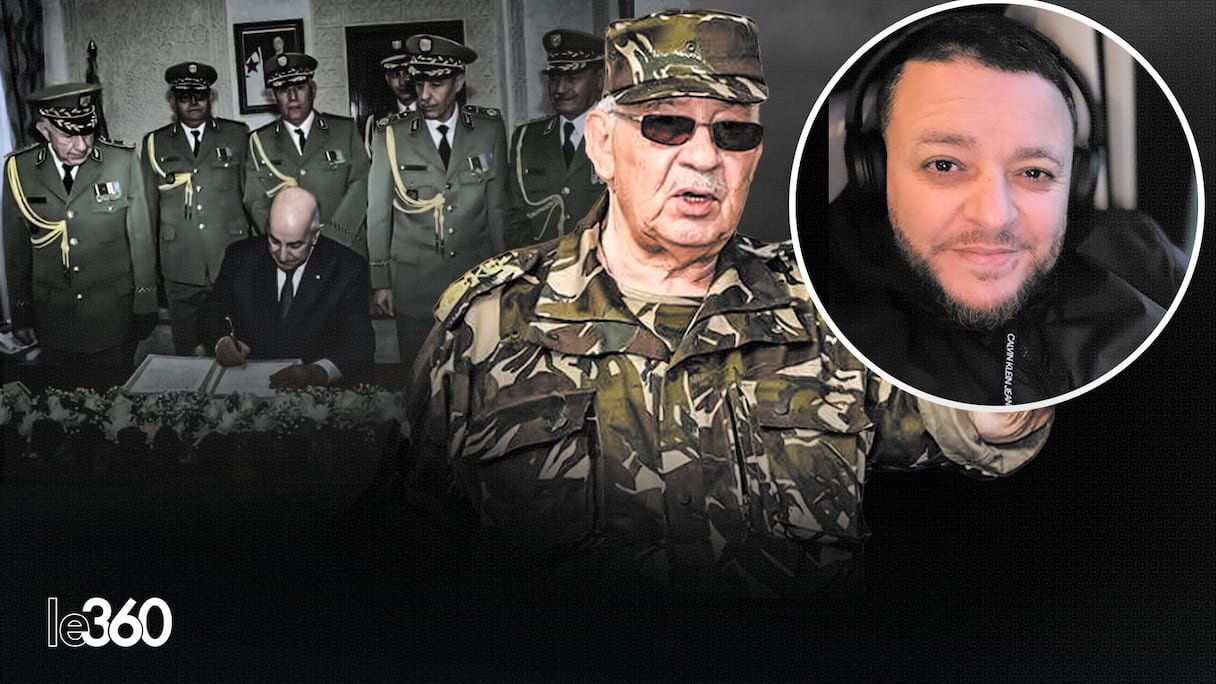
It is an unprecedented audiovisual record, a veritable media bombshell now shaking the inner sanctum of Algerian power. From France, where he lives under persecution, facing the constant threat of kidnapping networks and the subject of a priority extradition request from Algiers, Toufik Bennacer has broken the omertà. The son of the late General Larbi Bennacer, one of the longest-serving chiefs and pillars of Algeria’s military justice system, and brother of Colonel Boualem Bennacer, Algeria’s former consul in Alicante and a former senior foreign intelligence officer, Toufik Bennacer has spoken at length to journalist Abdou Semmar. His revelations have come in a series of interviews broadcast on the latter’s YouTube channel.
From his unique position as a true “child of the establishment,” raised within the secured residences of the High Command itself, Bennacer is laying bare state secrets, systemic corruption, the madness of those in power and the vicious clan wars eating away at the backbone of the Algerian regime.
An Insider From the Heart of the Establishment
To grasp the significance of these revelations, one must understand who Toufik Bennacer is. Born at the heart of the military establishment in Blida, he grew up in the shadow of his father, General Larbi Bennacer. Having joined the army in 1973, Larbi Bennacer served as an investigating judge and later as a prosecutor in Blida, Oran and Constantine, before becoming central inspector and ultimately taking charge of the Central Directorate of Military Justice (DCJM) in 1999. Trained in criminology and psychology in France and Canada, Larbi Bennacer was, according to his son, a rigorous legalist and an architect of Algeria’s modern forensic police.
Toufik grew up amid the material comforts and political intimacy of Algeria’s rulers. “We were one family,” he says, listing the VIP neighbors at the military residences in Oran and Blida and at the Club des Pins: General Athmane Tartag, alias “Bachir,” former head of Algerian intelligence; General Smaïn Lamari, former chief of the Counterintelligence Directorate; General Abdelhamid Bouhidel, director of military infrastructure at the Ministry of National Defense; General Abdelhamid Bendaoud, former head of foreign intelligence and former chief of the External Security Directorate (DSE); as well as the Zeroual family. He recounts his father’s direct proximity to the Bouteflika clan—particularly Saïd, the all-powerful brother of the late president—to former police chief Ali Tounsi and to the chief of staff of the infamous General Toufik, one of the architects of Algeria’s Black Decade and its 200,000 deaths.
Toufik Bennacer portrays his father as a man of conviction, unyielding in his principles. Larbi Bennacer died in a road accident on September 1, 2005. His sudden death deprived his children of their natural protector, later leaving them exposed to the ferocity of the nomenklatura.
An Uneducated and Megalomaniacal General Staff
At the heart of Toufik Bennacer’s revelations is an exposé of the erratic workings of the People’s National Army (ANP), particularly during the unchecked reign of Lieutenant General Ahmed Gaïd Salah, the former chief of staff. Bennacer paints an uncompromising portrait of a man with an appallingly low level of education who was catapulted to the pinnacle of power. “He did not even know what DNA was. He confused everything. It was impossible to have anything resembling a rational discussion with him. He could go from jovial and affable to paranoid and furious in the blink of an eye, without any explanation whatsoever,” he says, pointing to the absurdity of Algeria’s military promotion system.
Bennacer, who moved behind the scenes of the central power structure, also reveals Gaïd Salah’s eccentric lifestyle and whims. The former army chief had turned the High Command into his personal fiefdom, governing the country’s political and economic life according to his moods and paranoias. Although he claimed to live a “modest” lifestyle, he nevertheless indulged in a number of eccentricities, including keeping exotic animals—peacocks, in this case—at his residence. In his car, he played the same raï song, “Zawali ou F7el” (“Poor but Brave”—quite a program), over and over again, invariably swaying along to it. “It was unbearable,” Bennacer recalls.
The sudden death of Gaïd Salah on the night of December 22-23, 2019, forms the centerpiece of Toufik Bennacer’s revelations. Through his family background and his managerial duties, Bennacer enjoyed privileged access to the inner workings of power and provides a direct and detailed account of a death that reshaped the upper reaches of the Algerian regime. To understand what he saw and heard, one must recall the degree of material intimacy he had with the country’s former strongman. Toufik Bennacer personally handled the logistics and management of Gaïd Salah’s private residence and domestic affairs. This position of trust gave him unrestricted, permanent and direct access to the chief of staff’s home, bringing him into close contact with his tight security detail, his doctors and his inner circle.
Signs of a Targeted Elimination
According to Toufik Bennacer’s account, Gaïd Salah’s death was anything but a peaceful end or an ordinary cardiac arrest. Bennacer was informed directly of the medical emergency affecting the general in his private quarters. Upon arriving at the scene and coming into immediate contact with those around him, he describes an atmosphere of panic and an unusual rush by security officials to seal off the perimeter. He recounts a scene of utter disarray inside the residence. He saw an overwhelmed emergency response, contradictory orders and medical care that was strangely disorganized for the country’s de facto ruler. And there was one particularly striking detail: enormous bloodstains in Gaïd Salah’s bathroom. “I am not a doctor, but you do not vomit blood as a result of cardiac arrest,” he counters.
Bennacer says he heard the accounts and cries of distress of relatives and household staff who were present when the fatal episode occurred. They all described a man who had still been on his feet only hours earlier, having just presided over major political meetings and installed Abdelmadjid Tebboune as president of the Republic.
What Toufik Bennacer firmly describes as a “suspicious death,” which he believes resembled a political assassination or poisoning, rests on a series of other anomalies he says he witnessed or heard about that very night and in the days that followed. As soon as the death was confirmed, Gaïd Salah’s chief bodyguard and personal physician were immediately removed, isolated and prevented from speaking or giving their version of events to the press or senior army officers.
Bennacer reveals that, in the face of obvious doubts quietly voiced by some senior officers, the absolute instruction issued by the emerging power structure, embodied by Abdelmadjid Tebboune and General Saïd Chengriha, was to prohibit any forensic examination or autopsy of the body. Bennacer witnessed efforts to seal the coffin as quickly as possible and arrange hurried state funeral proceedings so that any physical evidence of a possible toxic substance would be buried along with the general. He subsequently watched a ferocious purge unfold before his eyes. The chief of staff’s death immediately triggered a witch hunt against anyone who possessed the secrets of that night.
Gaïd Salah’s children were prosecuted, his lieutenants arrested, and those who had managed his residence—including Bennacer himself—were quickly perceived as inconvenient witnesses who needed to be neutralized, ultimately sealing Toufik Bennacer’s departure into exile and his decision to reveal everything publicly. The tragic irony of the Algerian system lies in Gaïd Salah’s fate. Although he was the chief architect of the emergence of the new nomenklatura and imposed Abdelmadjid Tebboune as president, he was swept from official memory almost as soon as he was buried. The man who had ruled as an absolute master was consigned to history’s dustbin, while his clan was methodically purged, imprisoned or driven into exile by the very people he had brought to power.
Systemic Corruption and a Ruthless War
Through his disclosures to Abdou Semmar, Toufik Bennacer lifts the veil on the financial and material workings of a military system operating as a hermetic and deeply corrupt caste. He describes an institution transformed into an economic oligarchy. The Algerian army no longer merely protects the “System,” but an entire financial empire in which resources and privileges are diverted first and foremost to sustain the lifestyles of senior officers and their offspring.
The revelations shed light on the large-scale diversion of National Defense budgets, which remain shielded from any cuts. The military establishment operates through a mechanism of impunity in which appointments to senior positions provide opportunities to appropriate public rents. One example is General Abdelkader Lechkham, the former head of military communications, accused of siphoning off staggering sums estimated at nearly $2 billion through the systematic overbilling of army communications equipment and the management of secret accounts abroad.
One of the most revealing aspects addressed by Toufik Bennacer concerns the status of the “children of the nomenklatura.” In Algeria, being the son of a senior officer immediately opens the door to unsecured bank loans, exclusive import licenses and state-owned land. Ahmed Gaïd Salah’s sons, Adel and Boumediene, thus became overnight barons of real estate and agribusiness in eastern Algeria thanks to their father’s support and instructions. They owned flour mills, newspapers, transport companies and state-owned agricultural land transferred to them for the symbolic price of one dinar.
There is also the case of Khaled Tebboune, one of President Abdelmadjid Tebboune’s sons, who was implicated in the high-profile scandal involving 701 kilograms of cocaine seized at the port of Oran. His initial imprisonment followed by his swift exoneration illustrates the protection afforded to the children of the establishment. Toufik Bennacer himself acknowledges that, as a general’s son, his transition into the business world in Algiers took place in an environment where his family name served as a commercial master key.
Corruption also serves as an instrument of mutual control within the High Command. The hierarchy turns a blind eye to officers’ corrupt dealings as long as they remain loyal. The moment a general falls from favor or loses a clan war—as under the Chengriha era—his financial files are conveniently dusted off by the military justice system to justify his removal under the guise of “fighting corruption.” And while health, education and infrastructure budgets undergo drastic austerity measures, the budget of the Ministry of National Defense (MDN) remains untouchable and beyond audit by the Court of Accounts. This financial sanctuary guarantees the preservation of the caste’s privileges.
This patronage-based management of the military establishment confirms Bennacer’s analysis: beyond the patriotic rhetoric, the Algerian regime has structured itself around the overriding defense of the generals’ economic interests and the wealth of their offspring, directly at the expense of the country’s resources and its population.
Underlying it all is a fratricidal war between clans and security services. One example is the permanent purge within the intelligence apparatus. No fewer than 14 heads of these services have been dismissed since 2020, in the aftermath of President Tebboune’s accession to office. This relentless revolving door illustrates a regime in a state of permanent paranoia, with each clan seeking to neutralize the others. It was in this war, where “anything goes,” that the Bennacer family found itself targeted: brothers who were colonels and police officers were arrested or persecuted in an effort to silence the state secrets they possessed. Hence the earthquake Toufik Bennacer has triggered in Algeria and the veritable outcry now directed against him. Having become a priority target of the regime, Bennacer is the subject of a massive smear campaign by the army’s official and unofficial media relays, as well as relentless pressure to secure his extradition. He knows that the Algerian regime does not forgive one of its own “sons” for airing the dirty laundry of the military dictatorship in public.