Morocco’s cooperation with Interpol dates back to 1957. Over the decades, the National Central Bureau in Rabat (NCB-Rabat) has become a key hub in the fight against cross-border crime. It serves as Interpol’s sole point of contact in Morocco, coordinating exchanges between national security services, foreign counterparts and the organization’s General Secretariat.
The Police Review details the bureau’s activities over the 10-year period, covering its operational work, international partnerships and role within Interpol.
Lisbon, 1957: Morocco joins Interpol
Morocco submitted its application to join Interpol on March 6, 1957. The organization’s General Assembly considered the request during its 26th session in Lisbon and approved it on June 17, with 37 votes out of 38 cast. Haiti, Laos and Tunisia also had their membership applications approved during the same session. Morocco became Interpol’s 60th member state.
The National Central Bureau in Rabat was established that same year. Attached to the DGSN’s Judicial Police Directorate, it has since connected Moroccan security services with Interpol’s General Secretariat and the national central bureaus of other member countries.
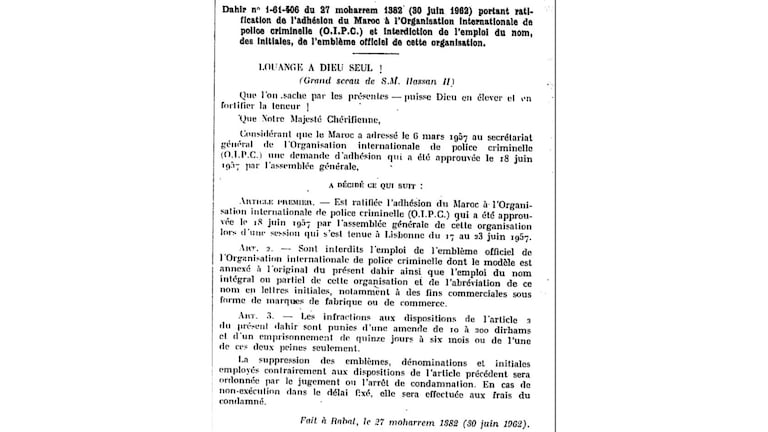
A royal decree dated June 30, 1962, subsequently ratified Morocco’s membership. It also prohibited the commercial use of Interpol’s name and emblem.
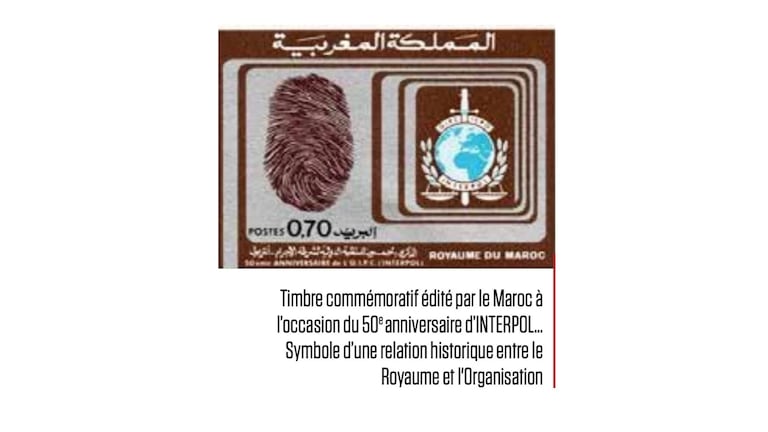
A decade later, on February 18, 1973, Morocco issued a commemorative stamp to mark the organization’s 50th anniversary.
How Interpol works
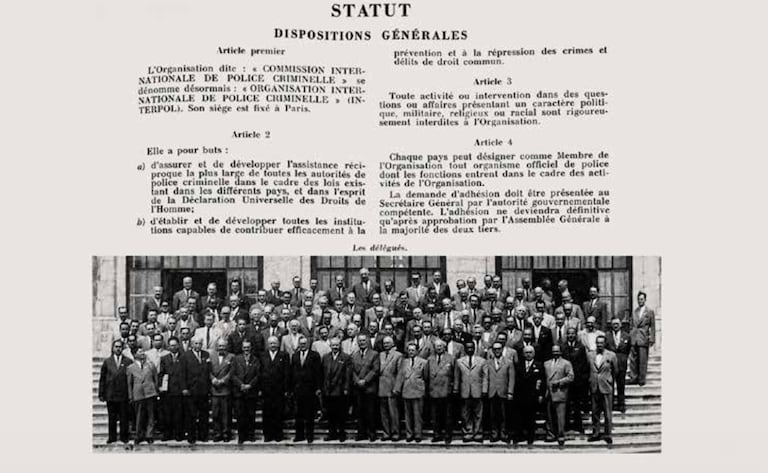
Interpol was founded in Vienna in 1923 at the initiative of Johannes Schober, the city’s police chief. Initially known as the International Criminal Police Commission, the organization was reconstituted in 1946, with its headquarters established in Paris. A new constitution adopted on June 13, 1956, gave it its current name, the International Criminal Police Organization, or ICPO-Interpol. Its headquarters have been in Lyon since 1989.
The organization has 196 member countries. Each government pays an annual statutory contribution, providing Interpol with financial autonomy. Its working languages are Arabic, English, French and Spanish.
Article 2 of Interpol’s constitution sets out its mission: to ensure the widest possible mutual assistance between criminal police authorities, within the limits of each country’s laws and in the spirit of the Universal Declaration of Human Rights. Article 3 prohibits the organization from intervening in matters of a political, military, religious or racial character.
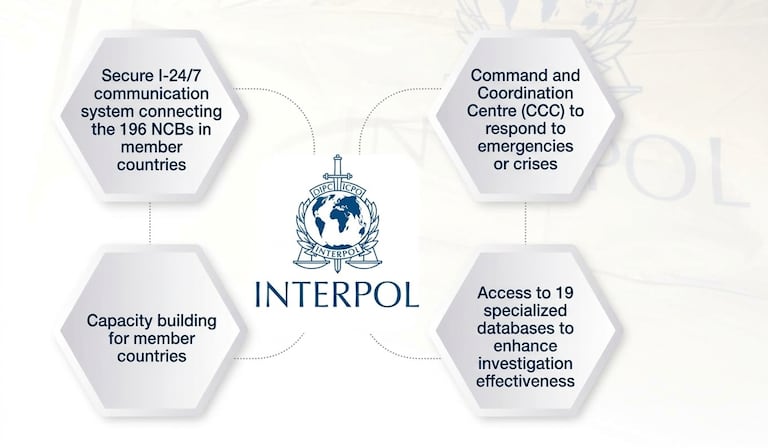
Interpol’s main communications tool is the secure I-24/7 network, launched in 2002. It connects all 196 national central bureaus, allowing them to consult databases, request information and exchange data instantly.
Investigators also have access to at least 19 databases. The Stolen and Lost Travel Documents (SLTD) database contains more than 138 million travel and identity documents reported stolen, lost, revoked, invalid or stolen while blank. Other databases cover personal records, child sexual exploitation, missing persons, facial recognition, stolen works of art and firearms tracing.
The Command and Coordination Centre, established in 2003, operates around the clock. It issues alerts and notices in emergencies and can deploy teams at a member country’s request during natural disasters, terrorist attacks, major sporting events or international summits.
Interpol also provides training, including online courses through its Virtual Academy. Its programs cover terrorism, human trafficking, cybercrime and gender equality.
One point of contact for all Moroccan services
Under Article 32 of Interpol’s constitution, NCB-Rabat is the organization’s sole point of contact in Morocco. All competent national services channel their requests through the bureau, which coordinates with other national central bureaus and the General Secretariat in Lyon.
The Police Review describes the bureau as “a central link” in information exchange, operational coordination and international police cooperation.
Mohammed Dkhissi has headed the Judicial Police and NCB-Rabat since January 2016. He also serves as head of the Arab Liaison Bureau. In an interview with the review, he described the bureau’s work as “a permanent and structured link” between Morocco, the national central bureaus of member countries and Interpol’s General Secretariat.
This cooperation operates through Interpol’s official channels and includes the secure, real-time exchange of criminal intelligence, coordination of cross-border police operations and support for international investigations. Police Prefect Mustapha Hajjam heads NCB-Rabat.
The bureau has a wide range of responsibilities. It coordinates the search for and arrest of fugitives wanted under international arrest warrants, exchanges information on suspects in ordinary criminal cases, and helps identify individuals and unidentified bodies. It also circulates criminal networks’ methods of operation and arrest warrants issued by Moroccan courts.
Its work includes carrying out extraditions and transfers with member countries and coordinating the execution of international letters rogatory, or requests for judicial assistance.
NCB-Rabat also represents Morocco within Interpol’s institutional bodies. Its officials attend General Assemblies, annual conferences of national central bureau chiefs, regional conferences, thematic meetings and workshops. The bureau also prepares reports and assessments on bilateral, regional and international police cooperation.
Seven operational sections divide up this work. They handle general affairs, international arrest warrants, identification, notices and the cancellation of searches, international letters rogatory, extraditions and transfers, and efforts to combat the trafficking of stolen vehicles.
Three support sections complete the structure: the secretariat, the technical section and the statistics section.
Fugitives arrested in Morocco and abroad
The bureau’s work runs in both directions. A member country can request the arrest of an individual wanted for a serious ordinary criminal offense and circulate a notice through Interpol. NCB-Rabat then enters the notice into Morocco’s national wanted-persons database.
Read also : Swedish police chief praises Morocco after fifth fugitive arrested in a month
The Police Review describes the response to these alerts as demonstrating “a very high level of operational responsiveness.” It cites the arrest in Morocco of high-profile fugitives, followed by their extradition to the countries seeking them.
The same mechanism works in reverse. Partner countries help locate, arrest and extradite individuals wanted by Moroccan justice authorities. The review describes this as a commitment to “full reciprocity” and says the process respects Article 3 of Interpol’s constitution, which it identifies as safeguarding the neutrality, legality and legitimacy of the organization’s work.
The figures published by the bureau cover January 1, 2015, through December 31, 2025.
In judicial cooperation, Moroccan authorities received 1,685 international letters rogatory from foreign countries. Drug trafficking accounted for the largest share, with 408 cases, followed by terrorism, fraud, money laundering and homicide. Of the total, 1,462 requests were executed, representing approximately 87%.
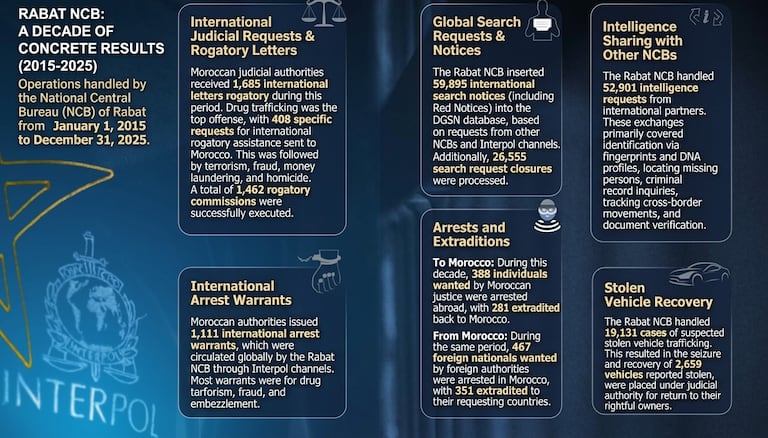
Moroccan justice authorities also issued 1,111 international arrest warrants, which NCB-Rabat circulated through Interpol. The warrants mainly concerned drug trafficking, terrorism, fraud and embezzlement.
In the opposite direction, the bureau entered 59,895 wanted-person notices from other national central bureaus into Morocco’s national database. These took the form of notices and Red Notices. During the same period, the bureau issued 26,555 cancellations of searches.
The alerts led to arrests both inside and outside Morocco. Abroad, 388 people wanted by Moroccan justice authorities were arrested, and 281 were extradited to Morocco. Within Morocco, 467 foreign nationals sought by their own countries’ judicial authorities were arrested. Of those, 351 were extradited.
The bureau also handles information requests from its foreign counterparts. Over the 10-year period, it processed 52,901 requests concerning the identification of individuals through fingerprints and DNA profiles, the location of missing persons, criminal records and cross-border movements. The requests also included checks on administrative documents.
Stolen vehicle trafficking accounted for another substantial part of the workload. NCB-Rabat processed 19,131 cases, leading to the seizure of 2,659 vehicles reported stolen. The vehicles were handed over to the judicial authorities for return to their rightful owners.
In 2017, Morocco extended the I-24/7 system to all its border posts. Border control services can now consult Interpol databases in real time to check wanted persons, stolen or lost travel documents and flagged vehicles.
The Police Review presents this expansion as the clearest example of Interpol’s tools being integrated into Morocco’s national security systems.
Read also : Swedish police thank Morocco as new security pact delivers extraditions
NCB-Rabat is also undergoing continuous modernization. This includes upgrading technical resources, adapting staffing and developing specialized skills to keep pace with changes in international cooperation mechanisms and Interpol’s evolving priorities.
24 joint operations
The DGSN has taken part in 24 operations conducted under Interpol’s auspices.
Neptune and Phoenix target terrorism. The latest Neptune operation, carried out in summer 2025, involved several countries simultaneously and focused on maritime borders between North Africa and southern Europe. Authorities sought to prevent the movement of terrorist fighters and tackle trafficking in drugs, weapons and migrants.
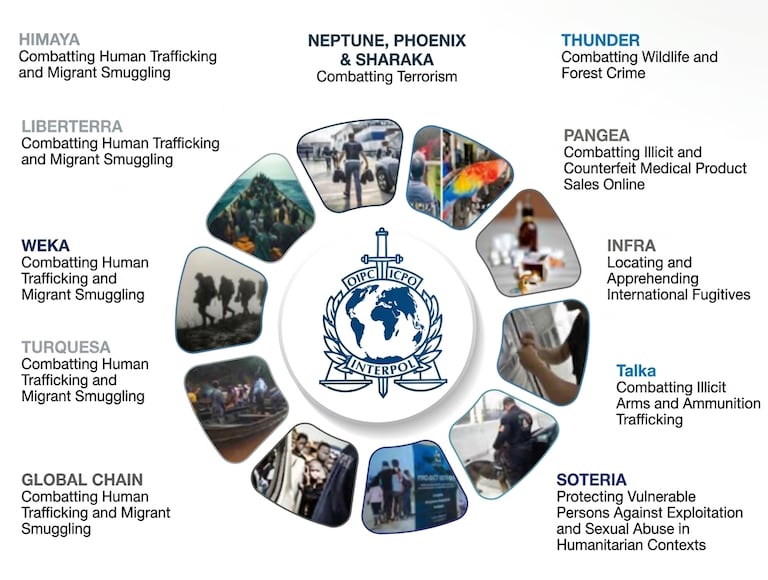
Other operations focus on specific forms of crime. Pangea targets counterfeit and illicit medicines, while Infra focuses on internationally wanted fugitives. Talka addresses firearms and ammunition trafficking, Thunder targets wildlife crime, and Soteria focuses on sexual exploitation and abuse.
Global Chain, Turquesa, Weka and Liberterra target human trafficking and migrant smuggling.
Weka was launched and organized in Morocco with the participation of Interpol experts. Interpol subsequently published the results on its website and commended Morocco for its efforts. In a post on X, the organization said Morocco hosted the operational coordination unit and carried out 49 arrests, almost all linked to migrant smuggling.
The DGSN also participates in regional initiatives. Sharaka focuses on counterterrorism, while Himaya targets human trafficking and migrant smuggling.
The Moroccan security agency also contributes to Interpol’s “CT” analytical file on foreign terrorist fighters and takes part in training courses, workshops, coordination meetings and conferences under the organization’s annual program.
Morocco gains a place in Interpol’s leadership
Mohammed Dkhissi was elected Interpol’s vice president for Africa in November 2024 at the organization’s General Assembly in Glasgow. He won in the first round by a large majority for a three-year term. He sits on Interpol’s Executive Committee and chairs its operational subcommittee.
The committee examines international police operations, data processing and governance, and procedural matters related to Interpol’s functioning. Dkhissi also chairs the organization’s regional conferences for Africa. He led the 27th conference in Cape Town from August 27 to 29, 2025, the first edition to be conducted in Arabic.
He described his election as “a strategic responsibility rather than a personal distinction.”
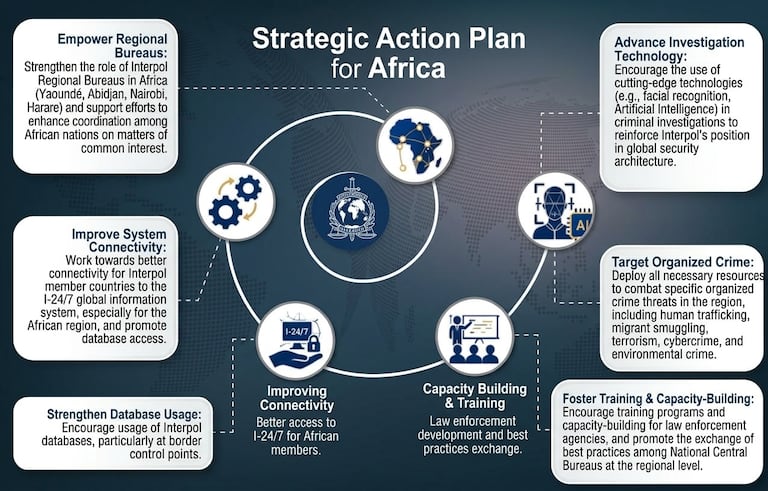
Dkhissi has outlined a three-year action plan for Africa. It calls for strengthening Interpol’s regional bureaus in Yaoundé, Abidjan, Nairobi and Harare, improving African countries’ connectivity to I-24/7, expanding training and promoting advanced technologies, including facial recognition and artificial intelligence.
Other DGSN officials hold technical positions within Interpol. Divisional Commissioner Hakima Yahya, head of the National Laboratory of Scientific and Technical Police, chairs the DNA Experts Group.
Divisional Commissioner Layla Ezzouine, head of the Digital Forensics and Imaging Department, serves as vice president of the Global Cybercrime Expert Group, known as CyberEx.
Morocco also sits on the Permanent Committee on Information Processing and seconds several officials to Interpol’s headquarters in Lyon.
Marrakech 2025: a test for the network
Marrakech hosted Interpol’s 93rd General Assembly from November 24 to 27, 2025. Morocco had previously hosted the organization’s 76th session in 2007.
More than 800 delegates from 179 countries attended the 2025 gathering, including 82 police chiefs and 25 ministers and deputy ministers. More than 30 regional and international organizations were represented.
NCB-Rabat played a role in preparing the event. Mustapha Hajjam, a member of the organizing committee, served as the point of contact for the agreement on privileges and immunities that every host country must conclude with Interpol.
The agreement defines the facilities and protections granted to the organization and participants, including arrangements for entering and leaving the host country. Hajjam coordinated discussions between the Ministry of the Interior, the DGSN and Interpol until the agreement was signed.
The General Assembly adopted Interpol’s 2026-2030 strategic framework and elected France’s Lucas Philippe as president for a four-year term.
A resolution on cybercrime received 134 votes in favor, none against and five abstentions. Another resolution approved the pilot phase of the “Silver Notice,” designed to facilitate the exchange of information on assets suspected of being linked to criminal activity.
Read also : French national wanted in Paris shooting case arrested at Casablanca airport
Abdellatif Hammouchi, director general of the DGSN and the General Directorate for Territorial Surveillance (DGST), received Interpol’s Medal of Honor, First Class, the organization’s highest distinction.
During the assembly, Hammouchi held 43 bilateral meetings and signed two memorandums of understanding, one with Norway and another with Ethiopia. He also handed Interpol’s flag to Hong Kong, which is due to host the organization’s 2026 General Assembly.
Dkhissi also announced that Interpol will hold an international seminar on artificial intelligence and cybercrime in Morocco in the near future.
