As August 2026 draws to a close, Algeria is going through one of the darkest crises in its recent history, ravaged by a wave of fires of unprecedented ferocity that has struck more than thirteen wilayas. At the heart of the disaster, the wilaya of Jijel stands as the ultimate martyr of this tragedy, accounting for most of the human losses. But beyond the scorched mountains and devastation, a second tragedy is unfolding behind closed doors: that of state lies, anonymity imposed on the dead and a deafening official silence over the scale of the disaster and the number of victims.
While the authorities are striving to conceal the scale of the disaster in order to preserve a façade of control, cross-checked information from security and hospital sources and local witnesses, reported by independent journalists, converges on a terrifying estimate: the death toll is believed to have surpassed 300. But for the regime, it has remained frozen at 12 deaths since the fires began.
Grimly, the real figure is expected to rise. Even the regime’s unofficial mouthpiece, YouTuber Saïd Bensdira, usually quick to defend the indefensible in the name of the System and the Algerian deep state, could no longer hold back. After a long silence, he finally denounced the total failure in the management of the disaster, in which the multiple causes of death inevitably point to the responsibility of the public authorities.
Dignity Trampled
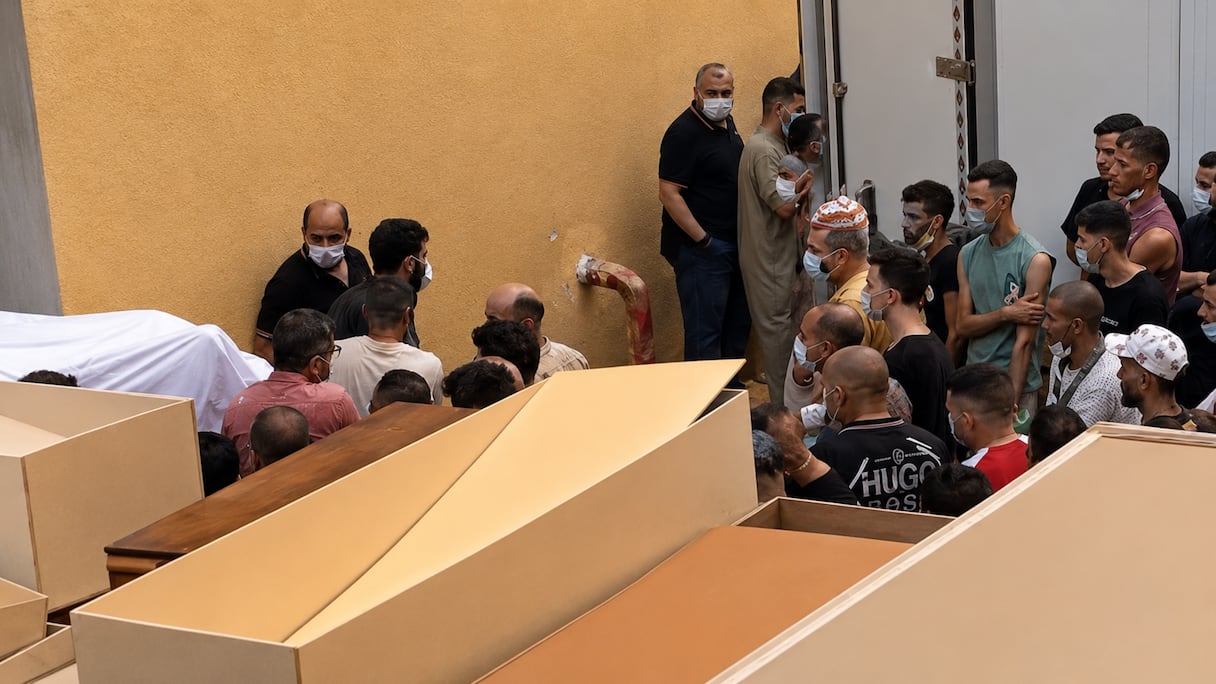
To the tragedy of losing a loved one has been added the outrage of post-mortem dehumanization. Faced with overflowing morgues and an inability to manage the crisis, the state resorted to expediency. In one disaster-stricken municipality, 20 victims were hastily buried. Ten in one mass grave and another ten directly opposite. On the makeshift headstones, there were no names, no dates of birth or death, only anonymous registration numbers.
Entire families are enduring the shock of being denied their mourning. Despite the exhausting efforts of relatives to obtain the required legal and bureaucratic authorizations—the medical examiner’s approval, clearance from the gendarmerie, authorization from the public prosecutor—the authorities’ response to the emergency has been to reduce the dead to anonymity.
More absurd still: during the Interior Minister’s visit to El-Milia hospital, the release of bodies to their families was suspended for several hours for protocol reasons, adding bitterness to grief. For lack of resources, bodies were transported in refrigerated trucks intended for food products.
To prevent the scale of the catastrophe from cracking the official narrative, the regime has imposed a veritable blanket of silence. Public and private media—television channels, newspapers and news websites—have received strict instructions: a total ban on publishing reports from the ground, giving a voice to victims’ families or reporting on the evolving death toll. The instruction is to erase the human dimension.
Instead, announcements, more announcements. Such as the announcement to... reinstate the death penalty for people involved in forest fires, the only concrete order issued by President Abdelmadjid Tebboune yesterday, Sunday, during a meeting “devoted to the necessary measures for managing the effects of the recent fires.”
As for everything else, move along, there is nothing to see. The official media are even announcing the end—or near end—of the wildfires.
Faced with this media vacuum, mourning and information have migrated to social media. It is through the poignant accounts of journalists and death notices posted by citizens, particularly in Jijel, that the reality of the tragedy is coming to light. Videos of collective burials and testimonies from families who have lost loved ones circulate through the digital underground, forming the only record of national memory in the face of the authorities’ censorship.
Systemic Incompetence
The most damning fact is that the vast majority of these deaths were not an unavoidable fate. In a country that, on paper, has sufficient financial resources, crisis prevention and management mechanisms could have been activated. Although Météo Algérie had issued heatwave and hot-wind warnings, and the mapping of high-risk areas—Jijel, Béjaïa, Skikda—had been thoroughly documented since the tragedies of 2021, no large-scale preventive evacuation plan was deployed. Despite promises made five years earlier after the Kabylie tragedy, the shortage of forward fire stations, the inadequate public warning network and delays in acquiring water-bombing aircraft left civilians encircled by flames, isolated and without timely assistance.
Why such obstinacy in concealing the figures? For the regime in power, acknowledging the real death toll would amount to admitting the crushing failure of its prevention and protection policies. Fearing that the country would become associated with a grim record on the Mediterranean stage and that it would have to answer for its management of public funds and emergency services, the choice was made to hide the reality.
To divert Algerians’ attention from the tragedy unfolding before their eyes, media outlets in the regime’s pay, foremost among them the official APS news agency, prefer to lash out violently at TF1 and France Télévisions, accusing them of preparing reports on businessman Ayoub Aissiou, whom Algeria wants extradited from Spain.
Or to cobble together an entire news narrative about drug trafficking in Europe in order to attack Morocco.
By refusing to grant the dead public and official recognition, the state is not merely committing a deliberate omission intended to diminish the gravity of its failings. It is guilty of an unforgivable political and moral failure, akin to a form of failure to assist persons in danger and an erasure of memory. In the current tragedy, a minimum of truth has become the last refuge of dignity. But even that, the regime denies Algerians.
