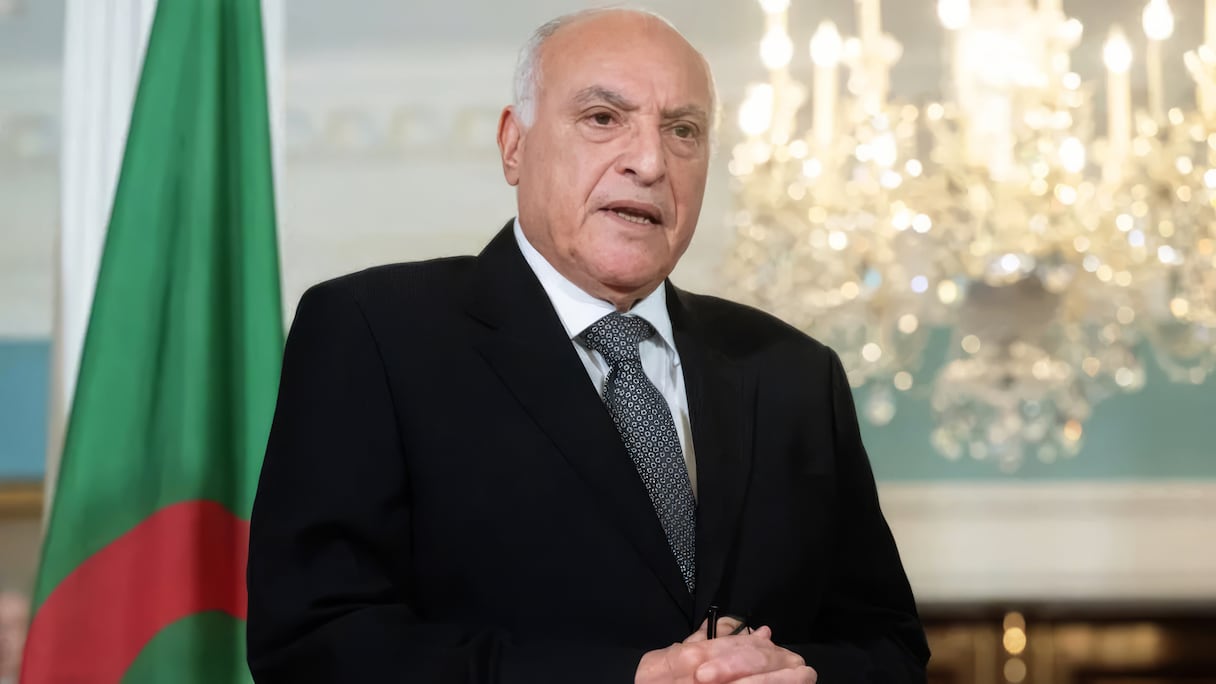
Taking the floor at the 81st session of the UN General Assembly, Algerian Foreign Minister Ahmed Attaf delivered the kind of performance the regime in Algiers has made its trademark whenever the Sahara is concerned: grandiose, artificially solemn and tragically detached from contemporary geopolitical realities. Solemnly declaring that “the passage of half a century cannot transform an imposed reality into a legal truth,” Algeria’s top diplomat offered up an anachronistic defense of a doctrine that has run out of road, desperately trying to conceal just how badly it has foundered.
With his tired rhetoric and glaring contradictions, Attaf perfectly illustrated the growing isolation of an Algerian regime caught in the trap of its own making, increasingly divorced from realities on the ground and from the direction in which the international community is moving.
Empty grandstanding
From the opening lines of his New York address, Ahmed Attaf walked straight into a contradiction as glaring as it was apparently unintended. Denouncing the supposed “logic of the fait accompli” and calling for negotiations conducted “in good faith and with sincere and genuine intent […] far removed from any logic of diktat or bargaining,” the minister rather conveniently forgot that the chief purveyor of regional diktat on this issue is Algiers itself.
The veneer of peacemaking quickly peels away once the substance of his remarks comes under scrutiny. While professing reverence for international law, Attaf attempts to resurrect a dusty Third Worldist dogma, pretending the world has stood still. He strikes a tone of false magnanimity when referring to the “Sahrawi refugees” hosted on Algerian soil for half a century. But the display of compassion barely conceals the cynical geopolitical exploitation of a population confined to the Tindouf camps, denied a census and turned into a diplomatic asset.
To preach decolonization while blocking any attempt at genuine emancipation or a transparent census under UNHCR auspices is political schizophrenia in plain sight. Attaf’s grandiloquence fools no one anymore. It barely conceals the anxiety of a regime forced to watch, powerless, as its arguments steadily fall apart.
Algiers’ fiction of standing on the sidelines
In his pathological attempt to absolve his country of responsibility, Algeria’s foreign minister continues to pretend that Algeria somehow stands outside the conflict itself, casting his country as little more than a sympathetic spectator. It is a gross historical falsehood. Algeria is far more than a hospitable neighbor. It is the instigator, financier, jailer and sole military patron of the Polisario Front. For decades, Algiers has refused to shoulder its responsibilities, sheltering behind a façade of neutrality. Yet confronted with the realpolitik of the major powers and under the joint auspices of the United States and the UN, the Algerian regime was ultimately forced to drop the pretense and take its seat at the negotiating table.
That moment of truth took concrete form in crucial rounds of diplomacy conducted under intense international pressure, from talks in Madrid to successive meetings steered by Washington, formally establishing Algiers’ direct and indisputable involvement as a principal and indispensable party to the regional dispute. To stand at the UN and pretend otherwise is an exercise in self-delusion.
The glaring omission of autonomy as the only solution
Ahmed Attaf’s contradictions reach their peak in his selective invocation of international law. The minister appeals to the authority of the UN while deliberately brushing aside the Security Council’s most recent and consequential resolutions.
By pretending that Security Council Resolution 2797, adopted by an overwhelming majority, simply does not exist, Algeria’s foreign minister engages in an absurd rewriting of the UN record. It bears recalling that Resolution 2797 clearly and irreversibly establishes the primacy of Morocco’s autonomy initiative, described as serious and credible by the international body, while drastically narrowing the room for the obsolete alternatives still championed by Algiers. By clinging to formulas left over from the last century, Attaf shows that Algiers respects the UN only when it validates Algeria’s geopolitical obsessions, leaving his country increasingly isolated from an international trajectory that is cementing Moroccan sovereignty.
The charade of the “sole representative”
Another untenable rhetorical trick is Attaf’s insistence on presenting an armed militia entrenched in Tindouf as the “sole representative” of the Sahrawis, even as it faces the prospect of being designated a terrorist organization by the United States and comes under mounting international security scrutiny over its conduct and its documented links to terrorist networks operating across the Sahel-Sahara region and to Iran.
In denying any voice to the actual inhabitants of the Southern Provinces, the Algerian minister displays breathtaking contempt. Sahrawis live in their homeland, take an active part in their country’s development and have no need for lectures from a bitter Algerian bureaucrat on how to express their political choices.
They demonstrated as much in the legislative elections held on September 23, 2026. Despite Algiers’ fulminations, the Kingdom’s Southern Provinces stood out on Wednesday for their high turnout: 77% in Laâyoune-Sakia El Hamra, 61% in Dakhla-Oued Eddahab and 53.48% in Guelmim-Oued Noun. Those figures confirm a trend already evident in previous elections. National turnout, meanwhile, stood at 38.02%, further underscoring the deep institutional roots of democracy in the Kingdom’s Saharan provinces, where citizens freely elect their own MPs and legitimate representatives, far removed from the totalitarianism of camps held under the bayonets of the Polisario.
As far back as 2007, when national turnout stood at 37%, voters in the Southern Provinces were already turning out in far greater numbers, with 50% in Laâyoune and as much as 62% in Dakhla. The same pattern held in 2011: against a national average of 45.4%, Oued Eddahab recorded turnout of 58.5%. That tradition of active citizenship has endured ever since. In 2016, with national turnout at 42.3%, Laâyoune registered 57.2%. The gap widened further in 2021: against a national average of 50.18%, turnout reached 66.94% in Laâyoune and 58.30% in Dakhla.
The hypocrisy of “grand principles”
In truth, the Algerian regime is the last government on earth entitled to lecture anyone on morality or parade its attachment to grand principles. It does not merely shelter a manufactured rebellion. It bankrolls it with billions of dollars drawn from the Algerian people’s energy wealth, arms it heavily and throws every ounce of its diplomatic machinery into a futile war of attrition against neighboring Morocco.
But the most revealing part of Algiers’ diplomatic and political contortions lies in what Ahmed Attaf carefully left unsaid. The minister takes pains to conceal what his country is doing behind the scenes in a desperate attempt to save itself from what it knows is coming. While official rhetoric grows hoarse at the UN, Algerian diplomacy is pulling every lever it can to court the United States—a United States firmly and unequivocally on Morocco’s side when it comes to the Kingdom’s territorial integrity.
There is no shortage of examples of this relentless courtship: from the desperate “The sky is the limit” line deployed by Algeria’s ambassador in Washington in an attempt to woo the US administration with promises of economic opportunity, to the maneuvering surrounding Massad Boulos’s recent visit and meetings with Algerian officials.
With Ahmed Attaf’s appearance before the 81st session of the UN General Assembly, Algeria once again offers the sorry spectacle of a regime trapped inside its own geopolitical fantasies. By swimming against the tide of half a century of legal, democratic and diplomatic change, Algeria’s foreign minister has merely confirmed that his country has boxed itself into a complete strategic dead end. Between denying UN resolutions, scorning the sovereign will expressed at the ballot box by the Sahrawi population and quietly bending over backwards to court Washington, Algeria’s position now resembles little more than a tottering house of cards. History is moving on, driven by realism and the legitimacy of Morocco’s position. Attaf’s stale refrains are now merely the swan song of a diplomacy going under.
