While European media attention often remains focused on the land hotspots in northern Morocco, a much deeper structural reality has emerged.
According to converging analyses by El Independiente, the Spanish Institute for Migration Analysis (IEAM), Frontex and the International Organization for Migration (IOM), the migration landscape in the Western Mediterranean has shifted, with Algeria overtaking Morocco as the “main point of departure for migrants” heading toward the Iberian Peninsula.
The figures point to a profound reversal in the trend. As reported by El Independiente, citing the IEAM, Algeria accounted for “more than 75% of maritime departures on the Western Mediterranean route from the Algerian coast in 2025.”
The analysis notes that the country “is far from being merely a transit corridor, but functions both as a destination for thousands of African migrants, a maritime departure platform toward Spain and a militarized frontline controlling the main migration routes from the Sahel.”
IOM reports, for their part, provide further detail on the recent evolution of these flows. Detections on the Western Mediterranean route increased by 27% in 2025. Between January and April, the IOM found that Algeria had become the “leading country of origin” on this route, accounting alone for 42% of the 5,647 arrivals recorded in Spain, well ahead of Morocco at 22%.
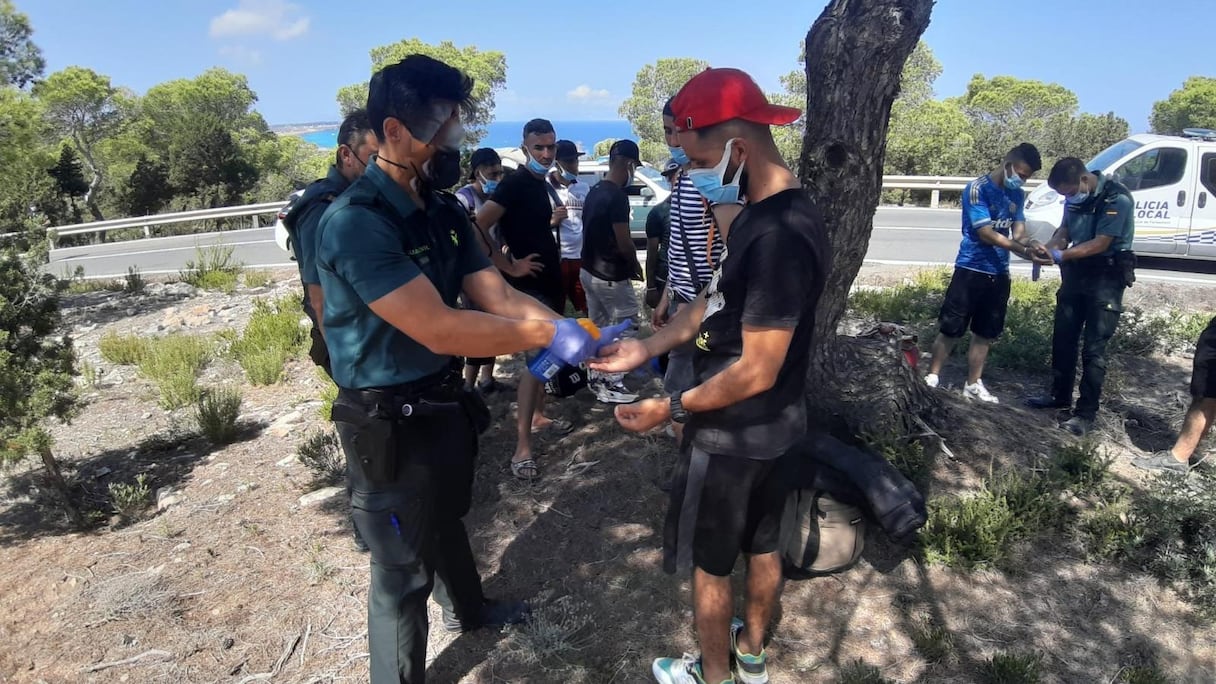
Unlike Moroccan flows, which are concentrated around specific land border crossing points, boats departing from Algeria use a large-scale dispersal strategy, mainly targeting the Balearic Islands and the coasts of Alicante, Murcia and Almería.
The increased pressure on Spain’s coastline has coincided, paradoxically, with tighter controls along Algeria’s southern borders, particularly with Niger and Mali. Driven primarily by a security-based approach, this military control policy has been accompanied by mass expulsions toward the Sahel.
The Algerian Defense Ministry recorded 24,071 irregular migrants arrested in 2025. At the same time, the organization Alarme Phone Sahara has documented a sharp increase in expulsions, with 34,236 people expelled to Niger in 2025, compared with 31,000 in 2024 and 26,000 in 2023. More than 14,600 people were pushed back during the first five months of 2026 alone.
A safety valve
El Independiente has highlighted the harshness of these operations, referring to so-called “unofficial” convoys in which migrants from West and Central Africa “are abandoned at Point Zero, in the middle of the desert, before being forced to walk around 15 kilometers to the Nigerien town of Assamaka to seek assistance.”
For the IEAM, tighter controls in southern Algeria do not stop the flows but instead displace them, illustrating “the contrast between expulsions carried out in southern Algeria and the growing importance of its coastline as a departure point for Spain.”
At the same time, a marked withdrawal of Algerian naval forces has been observed along the northern coast, with maritime interceptions falling by 37% in one year, to just 1,002 interceptions recorded between January and April 2026.
This double approach serves as a “safety valve” for Algeria’s political and social system in the face of internal tensions and the lack of opportunities facing part of its youth.
A wave reaching every layer of society
The irregular exodus shaking Algeria is not limited to the poorest sections of the population or those most affected by the economic crisis. It is also reaching wealthier circles and even the corridors of power.
This reality was illustrated dramatically by the case involving Adel and Boumediène Gaïd Salah, two sons of the late General Ahmed Gaïd Salah, former Chief of Staff of the People’s National Army and former Deputy Minister of National Defense. The two brothers have been missing for several days, raising questions even within their own family circle.
Their disappearance comes amid a particularly sensitive judicial climate, marked by converging reports pointing to an imminent summons by military justice authorities and the potential preparation of measures to place them in pretrial detention. However, Algerian authorities have issued no official statement clarifying their situation.
It was Toufik Bennacer, son of General Larbi Bennacer, who publicly raised and circulated the possibility that the two men had left the country illegally. He claimed that the brothers had left Algeria aboard a pleasure boat to cross the Mediterranean and reach Europe, taking the route used by harragas.
The Iberian Peninsula is often only a first stop for Algerian migrants. Supported by existing family networks, linguistic proximity and deep historical ties, the vast majority of these exiles make France their final destination.
After landing in Murcia, Alicante or the Balearic Islands, they quickly disappear into the Schengen area, feeding a continuous, quiet and structural migration flow that largely escapes the European Union’s traditional understanding of migration patterns.
