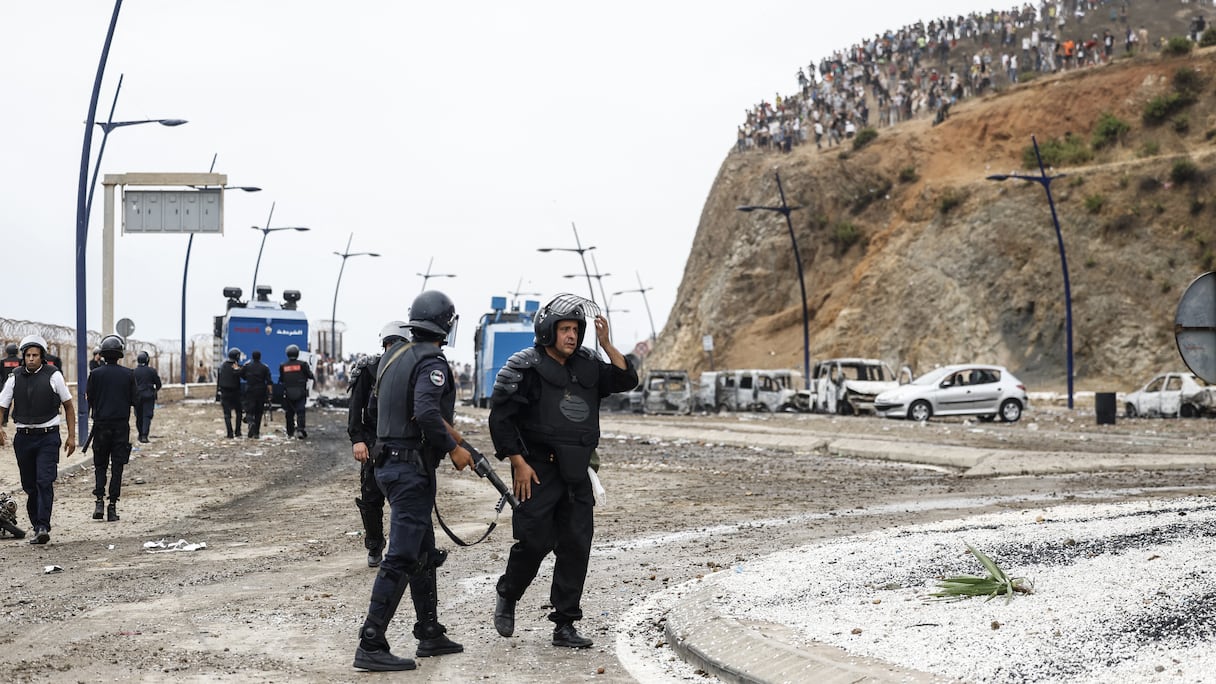
At the heart of Spain’s information maelstrom over the Ceuta crisis, the shifting interpretations of a recognized expert, José María Gil Garre, co-director of the International Security Observatory and an intelligence specialist, illustrate just how spectacularly analytical narratives can change course.
In the space of just a few weeks, the analyst has gone from a documented thesis pointing to a digital operation directed from Algeria to directly implicating a faction within Morocco’s power structure—the Makhzen—in the management of the crisis. It is a glaring contradiction that warrants scrutiny in light of the expert’s two successive reports and the political contexts surrounding them.
Made public yesterday, Saturday, on José María Gil Garre’s LinkedIn account, his new reading, which assigns a sector of the Makhzen direct responsibility for managing the migrant influx towards Ceuta, is surprising in more ways than one.
To see him move in next to no time from an analysis accusing Algiers to a hypothesis directly implicating a faction within Morocco’s power structure marks a bewildering change of course, to say the least.
The Documented Case for an Assault Directed from Algeria
In his initial analysis, widely picked up in early August 2026, Gil Garre rejected the idea of a spontaneous movement born of desperation, describing the assault instead as a “meticulously directed operation of influence, disinformation and tactical agitation” orchestrated from Algeria.
The expert’s open-source investigation identified a central strategic hub: a command node administered through telephone lines registered under the +213 international dialling code, corresponding to Algeria. This administrator was no mere relay for opinion but performed a tactical and operational coordination role on the ground, directly managing instant-messaging groups such as the WhatsApp group “سبتة كرياج هجمة” (Attack to Cross into Ceuta), detected as early as July 28, 2026, followed by the group “هجمة” (Assault), created on July 31 to redirect pressure towards Melilla.
Read also : Report: Evidence shows the Ceuta and Melilla assault was directed from Algeria
The administrator using an Algerian number issued genuine tactical instructions. The analysis noted the splitting of crowds into micro-cells to circumvent roadblocks and the timing of assaults immediately after the final evening prayer (Isha). Added to this was strict operational discipline, with mobile phones switched off during the night to avoid geolocation, as well as psychological conditioning through digital saturation.
The investigation described a multi-stage operation. From July 8 to 15, 2026 came the fabrication of a false legal narrative based on a misinterpretation of a July 8 Spanish Supreme Court ruling on maritime pushbacks, transformed into the false claim that the border was legally open. From July 15 to 25, the expert described massive amplification across social media, with TikTok and Facebook flooded with maritime maps and swimming routes from Belyounech and Fnideq. From July 28 to 30 came the activation of the Algerian +213 node and the setting of Fnideq as the gathering point for the night of July 30-31. The physical assault on the ground took place that night. Then, from July 31 to August 2, there was remarkable tactical responsiveness, with the immediate creation of the Hijma Melilla group to shift pressure towards the second enclave once Ceuta had been sealed off.
The digital ecosystem relied on specialized roles for each platform: WhatsApp as an operational command post; TikTok as the main vehicle for recruitment and psychological warfare, with accounts such as @haragaa_ceuta1 and @haragama00 accumulating millions of views; Facebook as a logistical marketplace for diving equipment; and Instagram as a vehicle for visual social proof. The analyst described the entire operation as “hybrid warfare,” demonstrating highly structured digital interference.
An Operation Orchestrated by the Makhzen
Up to this point, the thesis—highly credible—was gaining traction. But now the tone and the target have changed radically. According to José María Gil Garre’s new report, the massive influx of migrants towards Ceuta on July 31 was no longer the product of Algerian manipulation but was orchestrated by the Makhzen, naturally described as the circle of power surrounding the King.
The new report’s key “arguments” point to a command capability. The expert states that this power circle “had command authority over the gendarmes and Auxiliary Forces deployed at the Ceuta border.”
Spanish military intercepts are said to show that “operational instructions were transmitted down to the forces present on the ground,” particularly concerning orders to remain at their posts and the calculated management of the flow of migrants. And, of course, the situation on July 30 was supposedly not the result of an unforeseen loss of control but of the “deliberate management of the crossing,” used as a “means of pressure on Spain,” directly linked to the state of bilateral relations between Rabat and Madrid and ongoing negotiations between Morocco and the European Union. One must admit, this is vague.
The report also implicates the Spanish state apparatus. Several intelligence services—the CNI, military intelligence, intercepts by Electronic Warfare Regiment 32, border sources and open sources—had converging information indicating a high risk several days before the mass arrival. Yet, according to Gil Garre, these warnings were not converted into a comprehensive risk assessment or preventive measures, leaving Spain’s response essentially reactive. According to the expert’s sources, this chain of knowledge had begun to take shape as early as the second half of June.
The text highlights supposed divisions within Spain’s governing Socialist Workers’ Party (PSOE). On the one hand, Socialist officials—members of the Federal Executive Committee—are said to have privately acknowledged government management failures and pointed to Moroccan responsibility while also highlighting shortcomings in the warning system. On the other, the public discourse of Pedro Sánchez and his ministers maintained an official line exonerating Rabat. As if to add some spice, the analyst issues a stark warning “based on highly reliable sources.” According to him, unless appropriate measures are adopted, the next human avalanche could involve 100,000 people carrying Moroccan flags.
The moral of the story: the next bilateral treaty between Morocco and the European Union must imperatively include full recognition of Ceuta and Melilla as Spanish—and, incidentally, European—territories. Failing that, the border will continue to be instrumentalized as a lever of strategic pressure.
More seriously, the analytical contortions performed by José María Gil Garre, moving in remarkably short order from denouncing Algerian cyber interference to identifying border management directed by the Makhzen, highlight the volatility of security expertise in times of geopolitical crisis. They also raise questions about the objectivity of such analyses and about the motivations of their authors, which evidently waver depending on the circumstances. Whether the issue is analyzing cross-border digital hybrid warfare or the tactical instrumentalization of migration flows as part of a diplomatic power struggle with the European Union, these contradictions underscore the extent to which the borders of Ceuta and Melilla remain grey zones where competing intelligence, influence struggles and intense information battles intersect. At the risk of sending some into a veritable thousand-beat waltz.
