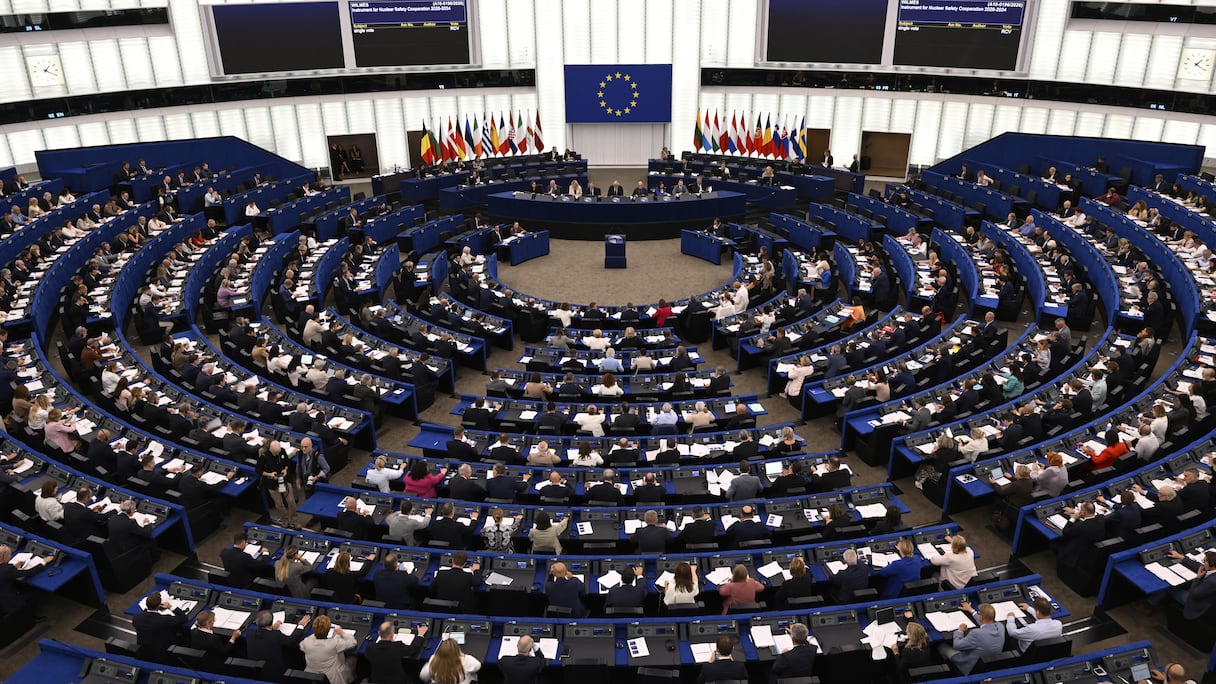
The European Parliament adopted on September 17 a resolution that had been heavily hyped and loudly promoted by the Spanish wing of the EPP Group, an offshore extension of Spain’s PP and Vox. Saddled with the grandiose title “Recent hybrid attacks and instrumentalization of migrants in Ceuta,” the resolution carried all the hopes of the Spanish right that the Strasbourg chamber would turn itself into an inquisition tribunal against Morocco. What emerged instead was an empty shell, barely concealing the political rebuke suffered by a radicalized Spanish right that chose to jeopardize the future. Here is why the European maneuver by PP and Vox amounts to a political debacle.
The Landslide Never Came
PP and Vox had promised a show of force. They swore that Europe—their Europe—would mobilize en masse to send a forceful message to Rabat.
In reality, the resolution adopted on Thursday secured just 339 votes out of 720 MEPs: less than half.
It was a narrow tally produced by a motley coalition of the EPP, ultra-nationalists and the far right. How can this be described as a “massive vote” when nearly half of the European Parliament opposed the maneuver?
More telling still, the Socialists and Democrats (S&D), part of the liberal bloc, the Greens and the Left refused to support the final text, denouncing an attempt to stigmatize a strategic partner.
The vote ultimately reflected national political divides more than European dynamics. Spain, in particular, offered the spectacle of a delegation split in two: PP and Vox MEPs—30 votes—backed their resolution, while the Socialists, the left and the Greens—26 votes—opposed it. The confrontation between the Sánchez government and its opposition in Madrid was reproduced in Strasbourg almost line for line. In other words, the real target of the PP-Vox tandem is less Morocco than Pedro Sánchez, with the 2027 elections looming.
Italy, interestingly, reproduced much the same configuration: Fratelli d’Italia, Lega and Forza Italia—34 votes—aligned themselves with the EPP, while the Democratic Party and Five Star Movement—29 votes—came out against.
Germany, meanwhile, fielded the most divided delegation, at 43 votes to 33, accounting for most of the abstentions, with around ten CDU-CSU members not even taking part in the vote—an indication of the German center’s reluctance in the face of the PP’s extremist impulses.
This voting pattern contains two pieces of good news for Morocco. First, it de-Europeanizes the grievance, reducing it to internal Spanish political quarrels. Second, it deprives the coalition that carried the resolution of the substantial majority it would have needed to deal Morocco a serious blow.
The PP’s mountain gave birth to a mouse—and a small one at that.
What PP and Vox Wanted—and What They Got
Through Jorge Buxadé, Vox demanded nothing less than the immediate suspension of all EU funding for Morocco, a challenge to the EU-Morocco Association Agreement and economic sanctions. The PP followed suit, fanning the flames of a supposed “hybrid war” allegedly orchestrated by Rabat.
So what does the adopted resolution actually say? None of that. There is no suspension of the Association Agreement. No economic sanctions. At most, the text makes vague calls for “conditionality” in access to the European market and for a “stricter framework” governing the disbursement of funds—nothing new, since conditionality already exists under the European Pact on Migration and Asylum.
PP and Vox Rebuffed in Their Campaign to Incriminate Morocco
The European Parliament’s treatment of the 12 amendments containing provisions hostile to Morocco reveals a clear rebuke for their sponsors and an enormous gulf between the final resolution and what had been plotted against the Kingdom.
At no point did the European Parliament incriminate Rabat. The amendment sought by Spanish far-right Vox MEP Jorge Buxadé Villalba offers the clearest illustration. All the provisions explicitly targeting Morocco and demanding the immediate suspension of funding were carefully sifted out and summarily discarded—under pressure from the ECR Group.
Hostile amendments calling for the suspension of the Association Agreement with Morocco and targeted sanctions were likewise rejected. On the radical left, an amendment from The Left seeking to condemn the Moroccan authorities for “inciting crossings” was also rejected, as were the preambular recitals implicating Morocco.
Worse still for PP and Vox, the resolution neither points the finger at Rabat nor attributes responsibility to Morocco for the events in Ceuta. The text even aligns with Rabat in condemning the “instrumentalization of migration” by smuggling networks, something Morocco has consistently denounced. It is a slap in the face for those who sought to demonize Morocco and turn it into the scapegoat for a migration crisis.
Morocco Described as a “Key Partner” in a Resolution Supposedly “Condemning” It
Much to the dismay of the PP-Vox duo, the resolution explicitly describes Morocco as a “key partner” of the European Union. The wording underscores Morocco’s importance while contradicting the exhausted Francoist narrative of PP and Vox portraying the Kingdom as a threat.
Far from sanctioning Rabat, the resolution instead reaffirms the centrality of the EU-Morocco partnership. Those who wanted Morocco put in the dock achieved precisely the opposite: recognition of the Kingdom’s key role in the region.
The Text’s Practical Impact Is Limited on Three Counts
First, legally, the resolution has no binding force. It expresses a political position that the European Commission is under no obligation to follow and which, in this case, it already contradicts, with European commissioners—including the commissioner responsible for migration—having publicly praised the Kingdom’s cooperation and favored strengthening the partnership.
Second, politically: the majority that carried the text is neither stable nor replicable on major issues, where the support given to the EPP by PfE and ESN does not materialize.
Third, substantively: every measure capable of concretely affecting the Kingdom’s interests was removed from the final text. The impact on Morocco is nil.
The PP Has Fallen Into Its Own Trap
By aligning itself with Vox’s positions, Alberto Núñez Feijóo’s PP is making a strategic mistake: it is jeopardizing the future.
Morocco is not only a leading economic and trading partner for Spain; it is also a key player in the fight against irregular migration, as well as in security and energy cooperation.
By yielding to the siren calls of the far right, the PP is antagonizing a partner with which it will have to work sooner or later. The laborious passage of the European Parliament resolution of September 17 should serve as a warning: confrontation does not pay. It isolates Spain rather than protecting it.
For Morocco, the Vote Nevertheless Brings Good News
Europe did not follow the maximalists. It refused to turn a migration crisis into an open diplomatic conflict. Despite relentless pressure and harassment from the Spanish right, the European institutions stayed the course of realpolitik.
Morocco remains an indispensable partner, and attempts to demonize it are running up against the wall of hard interests. By describing Morocco as a “key partner” and refusing to incriminate it, the resolution sends a clear message: Rabat is not isolated, and the maneuvers of PP and Vox have failed to convince.
Successive statements by senior European officials during the plenary debate, at press briefings and in their communications unanimously reaffirmed Morocco’s role as an “important strategic partner of the EU” at a time when challenges are mounting on Europe’s borders.
PP and Vox wanted to humiliate Morocco in Strasbourg. What they got was a gutted resolution and a labored vote. The Spanish right would do well to reflect on this failure before persisting down a path that, in the long run, serves no one’s interests.
