A single sentence was enough to shatter the script of the European debate on Ceuta. “Ceuta is not Spain. Ceuta is not Europe,” Ilaria Salis declared from the floor of the European Parliament on Tuesday. The Italian MEP did more than challenge the EU’s response to migration or the rhetoric of the right. She questioned the territorial premise on which Spain had built its entire campaign in Strasbourg.
A member of Alleanza Verdi e Sinistra and part of The Left group, Salis presented the city as a colonial anomaly. “Geographically, it is in Africa and, historically, it is a remnant of European colonialism,” she argued. In her view, the mass arrival of migrants on July 30 and 31 must be examined through this contradiction. She accused the right of immediately turning the episode into “racist and nationalist propaganda.”
The MEP denounced the millions of euros the EU spends fortifying “this piece of African land” and linked the deaths during the crossings to “the infamy of geopolitics and the colonial spirit that still permeates Europe.” She went even further in her conclusion. Europe, she argued, cannot claim the right to restrict freedom of movement “including on the African continent.”
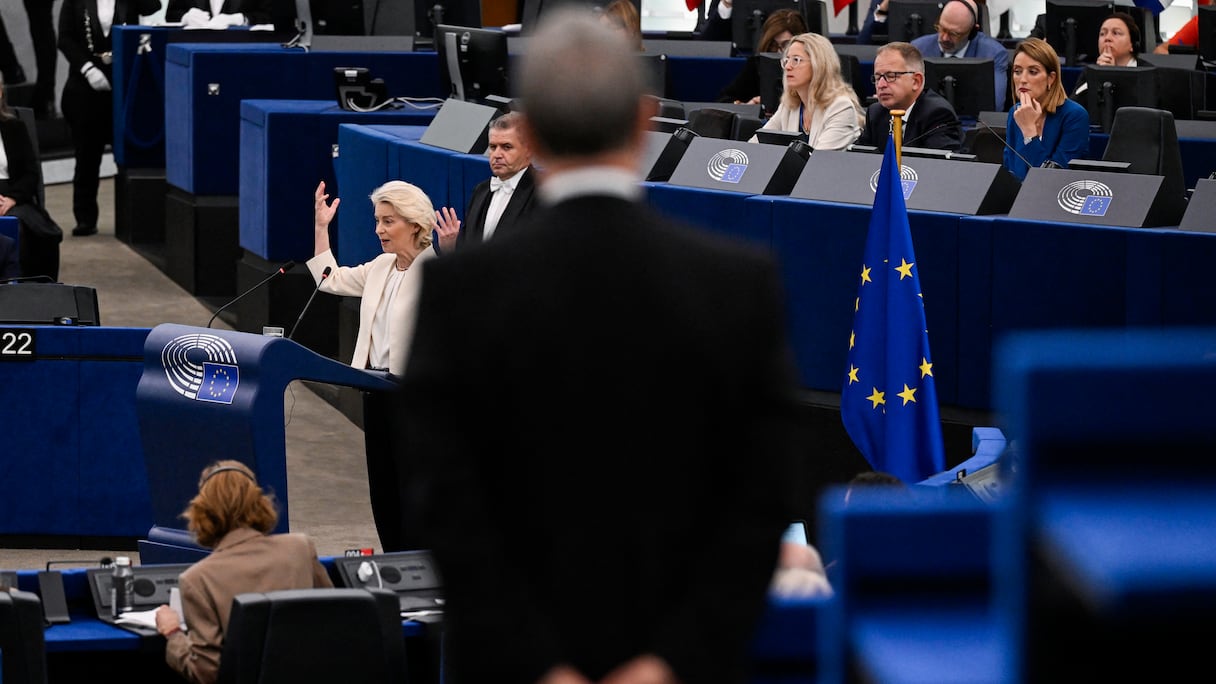
The response came a few hours later. On Wednesday, in the same chamber, European Commission President Ursula von der Leyen defended the exact opposite position. “Ceuta is Spain. Ceuta is Europe. And Europe will be at your side,” she said during her State of the Union address.
For several weeks, Spain had been working to bring the crisis onto the European stage. It had called for funding, the intervention of European agencies, a stronger Frontex presence and a political response recognizing the Ceuta border as the external border of the European Union as a whole. But by Europeanizing the crisis, it also Europeanized the debate over the territory.
Reducing Salis’ intervention to an isolated outburst, however, would miss the main point. She spoke from the heart of the very institution that Spain is asking to assume political, financial and operational responsibility for protecting Ceuta. Her intervention shows that European support does not amount to a blank check and that bringing the issue to Brussels also gives political forces from other countries room to challenge its historical foundations.
She was not the only one to open that door. Swedish MEP Abir Al-Sahlani, a member of Renew Europe, asked her fellow lawmakers whether they knew where Ceuta was geographically and what distinction they drew between “being in Europe” and “being part of the European Union.” Without explicitly challenging Spanish sovereignty, her intervention showed that questions over the equation between European geography, EU membership and Spanish sovereignty were not confined to The Left group.
Until now, Spain could present the dispute as a bilateral issue with Morocco and keep any discussion of sovereignty off the table. In the European Parliament, however, the border has become a subject of collective debate. If Spain asks for Ceuta to be protected as European territory, MEPs also gain political space to question what Europe’s presence on the African continent represents. That is precisely what Salis did, forcing the rest of the chamber to take a position.
The Price of Europeanization
In reality, Spain has not brought a single strategy to Brussels, but three. Prime Minister Pedro Sánchez’s government is pursuing pragmatic Europeanization. It has sought financial assistance to strengthen reception, surveillance and returns, while calling for support from Frontex, Europol and the European Union Agency for Asylum. The European Commission ultimately granted Spain €114.7 million and is considering a more permanent Frontex presence. The approach is aimed at sharing the costs of the emergency without jeopardizing cooperation with Morocco, which the Spanish government continues to regard as essential.
Read also : Far-right leaders tear up Moroccan flag; two Moroccans die in Ceuta hours apart
The People’s Party, meanwhile, is pursuing political Europeanization. It was the European People’s Party that promoted Tuesday’s debate under the title “Recent Hybrid Attacks and the Instrumentalization of Migrants in Ceuta, and the Need for a Coordinated Response to Protect the EU’s External Borders.” PP spokesman Borja Sémper himself acknowledged that his party intended to “Europeanize” the issue, as reported by RTVE. Its objective is not simply to secure more resources for the city, but also to have Europe condemn Sánchez’s handling of the crisis and increase pressure on Morocco.
The third approach comes from Ceuta itself. Juan Vivas has stepped up efforts with EU institutions to demand returns, funding, additional border reinforcements and a structural security guarantee. His argument is that the city cannot continue to depend on cooperation from a neighboring country that does not recognize Spanish sovereignty over the territory.
These three strategies converge around the same formula, “Ceuta is Europe,” but they do not pursue the same objectives. The central government wants European solidarity without jeopardizing its relationship with Morocco. The PP is calling for political responsibility to be established and for a stronger condemnation. Vivas wants Europe to reduce its dependence on Moroccan cooperation. These differences have turned the Strasbourg plenary session into an extension of Spain’s domestic political battle.
A “Hybrid Attack” With No Established Perpetrator
The very title of the debate was already politically loaded. Speaking of “hybrid attacks” and “instrumentalization” implies organization, intent and a destabilization objective. Yet the alleged perpetrator of such an operation has still not been identified.
Pedro Sánchez has repeatedly said that there is no evidence to attribute the organization of the crossings to the Moroccan state. Declassified documents show that Spain’s National Intelligence Centre (CNI) detected calls on social media and alerted both Spanish officials and Moroccan authorities, but not that it identified any state involvement. A subsequent Civil Guard report likewise failed to establish, based on the open sources it analyzed, a link to the Moroccan government, its security services or any specific human trafficking network, as noted in a report by the European Parliamentary Research Service.
The wording adopted by the European Parliament thus shifts the debate from managing an emergency to the realm of security and external hostility, without formally identifying a responsible party. This lack of clarity allows each political group to fill the gap with its own interpretation.
Read also : Ceuta before the European Parliament: When the accusation comes before the evidence
Dolors Montserrat said Morocco was responsible “through action or omission” and called Sánchez an “accomplice and guilty.” Vox went further. Jorge Buxadé called for the suspension of the association agreement between Morocco and the European Union, a freeze on outstanding payments and restrictions on visas and residence permits granted to Moroccan nationals.
The Socialists defended the opposite line. Iratxe García accused the PP of exploiting Ceuta to attack the government and warned against collective returns of minors and asylum seekers. The Socialist draft text thanks Morocco for its cooperation and calls for “strong, constructive and mutually beneficial” relations with partner countries. The EPP text, by contrast, calls on Moroccan authorities to assume their responsibilities regarding border management, readmission and migration cooperation.
The vote scheduled for Thursday will decide between these different positions. The resolution will not be binding, but its wording will have political consequences. A direct reference to Morocco, Spain’s regularization process or a possible revision of the association agreement would alter the balance of a relationship that the European Commission itself considers strategic.
The Commission Seeks to Preserve Dialogue With Morocco
Away from the uproar in the chamber, European Commissioner for Internal Affairs and Migration Magnus Brunner adopted a far more pragmatic position. He described the events as a “stress test” for the European Union, while stressing that none of the people who entered Ceuta had reached mainland Europe or traveled within the Schengen Area. He added that this outcome had also been made possible “thanks to cooperation with Morocco” and said the Kingdom had committed to accepting the return of people who do not have the right to remain.
That message weakens a significant part of the confrontation narrative. The Commission wants to strengthen Europe’s autonomy over border control, but it knows that returns and control of Western migration routes depend on cooperation with Morocco. The European Parliamentary Research Service notes that the EU strategy adopted after the crisis is not about distancing itself from Morocco, but about deepening the partnership and increasing support for migration management.
According to information published before the debate, Morocco’s mission to the European Union and NATO allegedly sent a letter to several MEPs stating that it was prepared to readmit Moroccan nationals, unaccompanied minors and third-country nationals involved in the crossings. The alleged document also reportedly recalled that the Spanish government itself had said that the available information did not allow Morocco to be held responsible for the events.
The information quickly triggered a new controversy. As the letter had not been made public and its full contents could not be verified, some Spanish officials and commentators presented it as an attempt to pressure the European Parliament, paving the way for insults and speculation that went far beyond what the available information could establish.
The European paradox is therefore on full display. Part of the Parliament is threatening to sanction Morocco, while the Commission needs Moroccan cooperation to implement the priority demanded by that same Parliament: returns. Spain is asking Europe to take charge of the border, but Europe continues to manage it within the framework of a partnership with Morocco.
The main issue, however, lies elsewhere. At the heart of the European Parliament, Salis raised the question that Spain’s strategy sought to keep out of the debate. Spain hoped that Europeanizing Ceuta would produce a single response based on territorial solidarity, border protection and pressure on Morocco. The Italian MEP recalled that putting the city at the center of European policy also meant opening a debate about its history, geography and the contradiction of presenting as a natural European border a line drawn on African soil.
Von der Leyen responded with the most categorical formula possible, without erasing the question raised by Salis. It is between these two positions that the real outcome of Spain’s strategy can be measured. Ceuta is no longer being discussed only between Spain and Morocco. It is also being debated in Europe, but not necessarily on the terms Spain had envisioned.
Thursday’s resolution may strengthen solidarity with Spain, call for tighter controls or take a harder line toward Morocco. But it cannot remove from the debate the question Salis raised from the chamber floor. The more Spain insists on making Ceuta a European issue, the harder it becomes to prevent European voices from also debating what Ceuta is.
