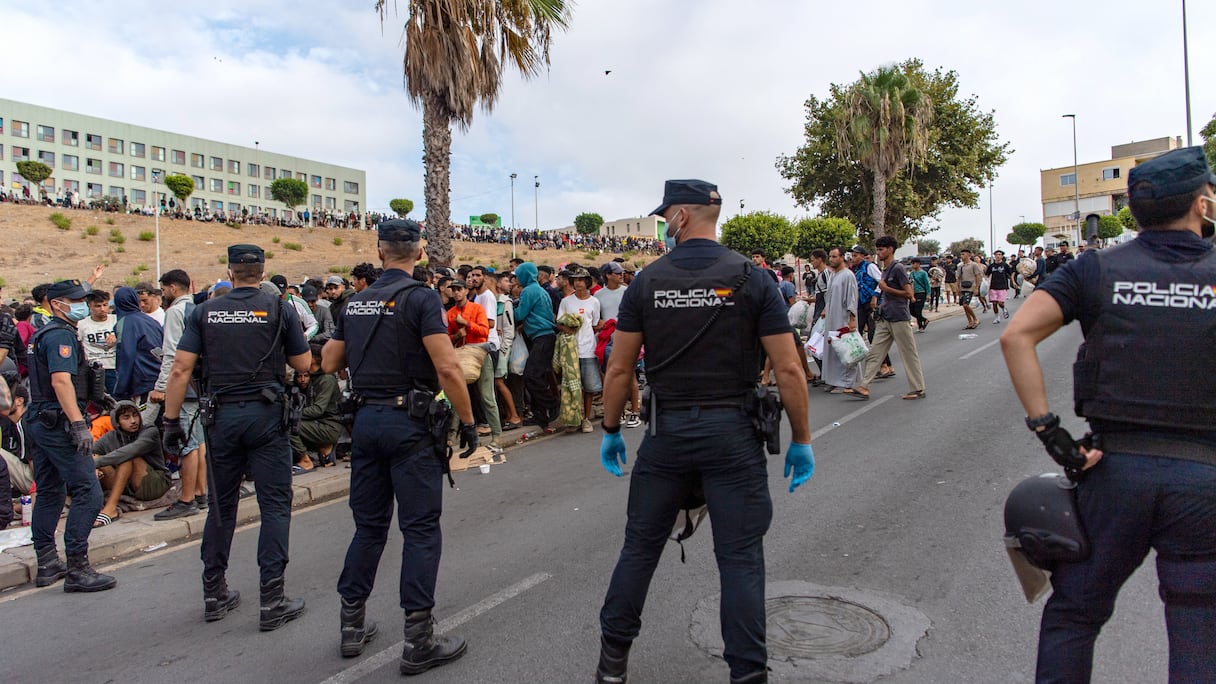
Promise kept. Pedro Sánchez had pledged before Congress to make public the information Spanish authorities had at their disposal regarding the mass arrivals in Ceuta. On Wednesday, the government followed through.
Nearly 40 documents, notes and communications produced between July 1 and August 1 were thus made public. They came from the National Intelligence Center (CNI), the Armed Forces Intelligence Center, the National Police and the Civil Guard. The dossier also includes several exchanges between the CNI, the Government Delegation in Ceuta and a Civil Guard unit.
Presented as an exercise in transparency, the release has nevertheless failed to put an end to the controversy. The dossier had barely been made public before two conflicting interpretations took hold in the Spanish media.
Read also : Spain to open Ceuta files with Morocco already in the dock
The first focused on passages concerning the conduct of the Moroccan forces, presenting them as signs of supposed permissiveness on Rabat’s part. The second targeted Pedro Sánchez’s government, the speed of its response and the fact that some of the information was never turned into an official alert.
Exchanges dated July 29, the eve of the arrival of tens of thousands of people, found themselves at the center of the controversy. They referred to calls circulating on social media urging people to enter Ceuta illegally during the Throne Day celebrations. Two groups with a combined total of 180,000 followers were also mentioned.
That figure was quickly brandished as proof that the Spanish authorities had been warned of the scale of the events to come.
La Moncloa Sets the Record Straight
A few hours after the dossier was released, the Spanish government sent a clarification to the EFE news agency aimed at putting an end to that interpretation.
La Moncloa maintains that the CNI never issued an alert about a mass arrival in Ceuta. The July 29 communications merely flagged calls circulating on Facebook and WhatsApp encouraging people to try to enter the city during the Throne Day celebrations.
Above all, the government disputes the interpretation of the figure of 180,000 followers. This was not an estimate of the number of people likely to take part in the operation, but merely an indication of the potential audience for the messages circulating on social media.
Read also : Ceuta Crisis: A double standard Moroccans can no longer accept
According to La Moncloa, some therefore confused the size of online groups with an estimate of the number of people expected at the border. Nothing in the documents, the government says, made it possible to anticipate a mobilization comparable to that of July 30 and 31.
The government also stresses that the CNI issued no official alert through the channels provided for in its chain of command. Neither the prime minister, nor a minister, nor any other member of the government was directly notified.
The information was passed on via WhatsApp and during telephone exchanges with the office of the Government Delegation in Ceuta and the Civil Guard’s Special Central Unit No. 3. La Moncloa believes that the choice of these channels shows that Spanish intelligence had not assigned the information the degree of seriousness that some media outlets are now attributing to it.
Had the CNI identified a real and imminent risk of a mass arrival, it would have activated official procedures and passed the alert up its chain of command, the government insists. Nothing of the sort happened.
José Manuel Albares defended the same interpretation in Brussels on Wednesday, following meetings with several European officials. “To my knowledge, no report had warned of anything on such a scale,” the Spanish foreign minister said.
Albares added that Frontex officials had assured him that their satellite surveillance systems had likewise detected no unusual activity at the border. “There was nothing to suggest that anything out of the ordinary was about to happen,” he said.
The day therefore ended much as it had begun, with yet another voice joining the political and media cacophony surrounding Ceuta in Spain. The documents meant to establish what the authorities knew and when they knew it immediately fed competing narratives about Morocco, Spanish intelligence and Pedro Sánchez’s government’s handling of the crisis.
