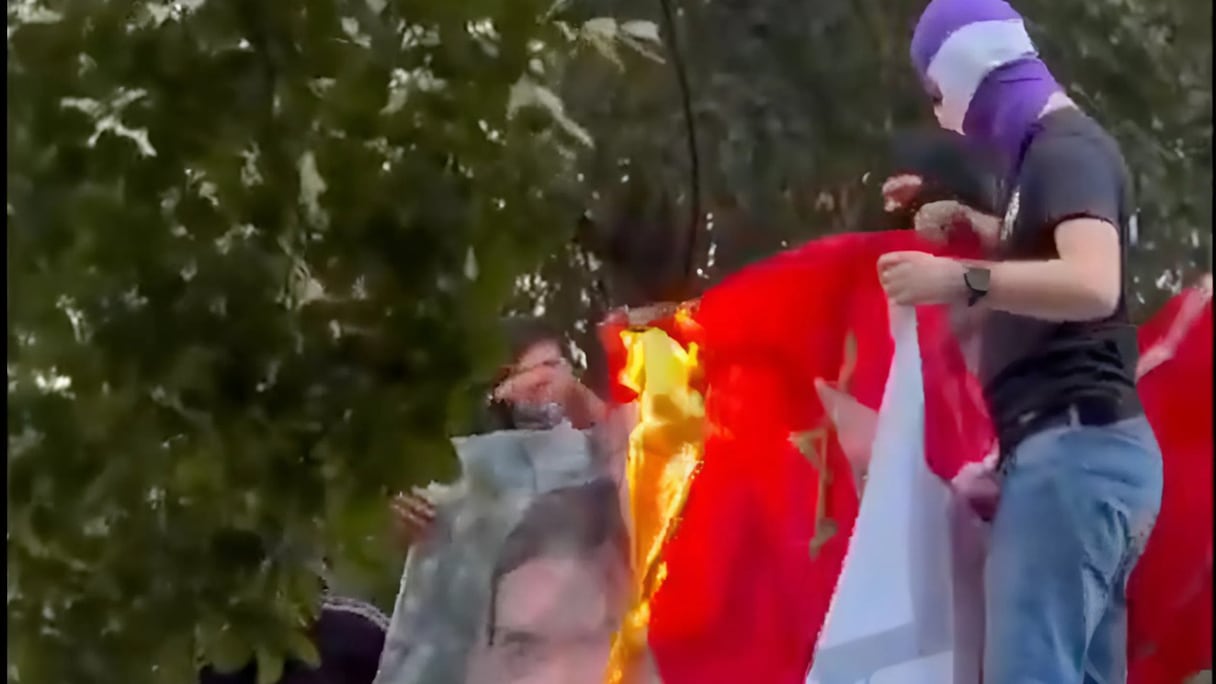
Madrid was once again the scene of an attack on Moroccan national symbols, this time with football providing the backdrop.
Before the Champions League match between Real Madrid and Inter Milan on Tuesday, September 8, individuals identified as members of Ultras Sur burned a Moroccan flag and posters depicting Spanish Prime Minister Pedro Sánchez.
Images shared by several accounts specializing in ultras movements show the group gathered near the Santiago Bernabéu as the flag and posters were consumed by flames. The individuals behind the action presented it as a show of support for Ceuta.
However, supporting a political position or expressing solidarity with a city cannot be equated with setting fire to the official symbols of a neighboring country. The first act is part of political debate; the second turns that debate into a xenophobic provocation directed against Morocco, offending millions of Moroccans.
A line some chose to cross
Inside the Bernabéu, thousands of supporters waved Ceuta and Spanish flags while chanting, “Ceuta is not for sale, Ceuta is defended.” Signs carrying the message “All with Ceuta” were also distributed, according to the Spanish daily AS.
The mobilization had already spread to other Spanish stadiums. At Son Moix, Mallorca supporters displayed Spanish flags during the match against AD Ceuta. Cádiz and Valladolid players came onto the pitch wearing shirts expressing their support. Real Betis displayed Spanish and Ceuta flags at La Cartuja, while a banner reading “Courage to Ceuta” was unfurled at Nuevo Mirador in Algeciras.
Outside the Bernabéu, however, Ultras Sur took this mobilization in a completely different direction. By burning the Moroccan flag, the group crossed the line between openly supporting Ceuta and deliberately attacking Morocco.
It is also worth recalling that Ultras Sur was banned from the Santiago Bernabéu by Real Madrid more than 10 years ago due to its history of violence, racism, and use of neo-Nazi symbolism. The group officially represents neither the club nor all of its supporters.
In February 2026, Real Madrid itself took action against one of its members who had performed a Nazi salute inside the stadium, ordering his immediate expulsion and condemning any expression that incites “violence and hatred in sport as well as in society.”
A second attack in less than a week
The incident is all the more serious because it was not an isolated act. On September 2, Pedro Chaparro and Gonzalo Martín, president and vice president, respectively, of the far-right movement Democracia Nacional, tore up a Moroccan flag outside the Congress of Deputies during a gathering linked to the situation in Ceuta.
Mohamed Nabil Benabdellah, secretary-general of the Party of Progress and Socialism, strongly condemned the act. He described it as a “provocation” aimed at creating “division, tension, and unease between the Spanish and Moroccan peoples.”
Six days later, another flag of the Kingdom was publicly targeted in Madrid. This repetition points to a reality more worrying than a simple succession of provocations. Moroccan symbols are becoming targets for ultra-right groups exploiting the political climate surrounding Ceuta to normalize increasingly open displays of hostility toward Morocco.
Racism Spanish football has failed to eradicate
That same evening, sections of the stands chanted “Every Jew I see, I hit” and “A Christian Spain, not a Muslim one.” The first slogan directly threatens physical violence against individuals because of their Jewish faith, while the second aims to exclude an entire community from Spain based on its religion.
These images, notably shared by the Mexican daily Récord, are already circulating internationally. These were not merely instances of supporters getting carried away or slogans shouted in the heat of a match; they were unequivocal expressions of antisemitism, Islamophobia, and calls for violence, uttered in front of cameras watched worldwide.
“Judío que veo, judío que pateo” 😬
— DIARIO RÉCORD (@record_mexico) September 9, 2026
Ojito al mensaje de los hinchas del Madrid. pic.twitter.com/baVXlknMWk
The context in which these incidents are occurring is highly significant. Spanish football has grappled with a serious problem of racism and intolerance for years. Insults targeting Vinícius Júnior in several stadiums ultimately led to judicial intervention.
In 2024, Spain issued its first conviction for racist insults made inside a stadium, following attacks against the Brazilian player at Mestalla. LaLiga further recalls that in May 2025, five supporters were convicted of a hate crime for insults directed at him in Valladolid.
More recently, during the friendly match between Spain and Egypt played in April 2026 at the RCDE Stadium in Cornellà, parts of the stands chanted “Whoever does not jump is Muslim” and booed the Egyptian national anthem.
This incident drew strong political condemnation and reignited the debate over the inability of Spanish sports institutions to eradicate racist and Islamophobic behavior.
This hostility is now expanding its targets. The serious attacks against footballers based on their skin color and against national teams or supporters due to their religion are now compounded by an offensive against a neighboring country, its flag, and by extension, the large Moroccan community living in Spain.
The situation is particularly worrying as Spain and Morocco prepare to co-host the 2030 World Cup with Portugal. An event presented as a symbol of ties between continents cannot accommodate complacency toward groups that turn stadiums and their surroundings into showcases for hatred.
At this stage, neither the Spanish authorities nor the Anti-Violence Commission has publicly announced any measures following these incidents. This silence is all the harder to understand given that two attacks on the Moroccan flag have taken place in Madrid in less than a week.
