There is one detail of crucial importance in the speech delivered before the Congress of Deputies by Spanish Prime Minister Pedro Sánchez that went virtually unnoticed in the media, no doubt because it does not fit the narrative that has been taking shape for several weeks.
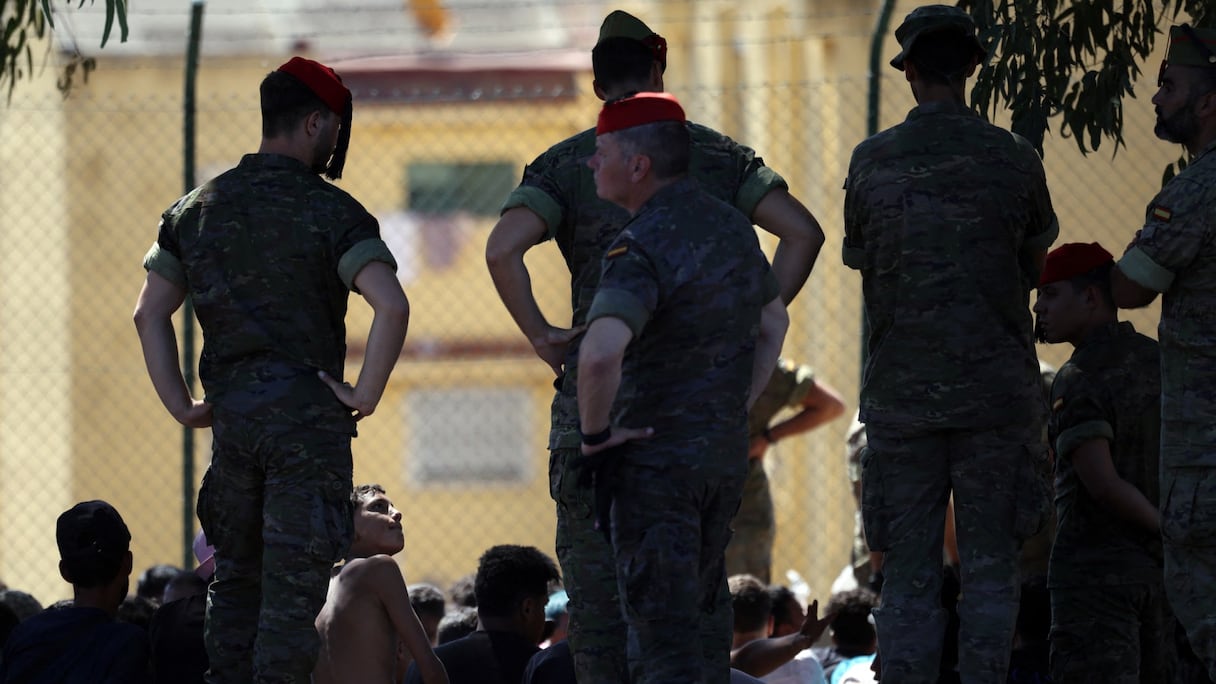
Pedro Sánchez explained that the Spanish security forces deployed at the Ceuta border chose to temporarily ease their containment measures when confronted with an influx of thousands of people attempting to enter the city, many of them via the breakwater. According to him, trying to contain a crowd of such magnitude by force could have caused a tragedy, with deaths and numerous injuries.
In other words, faced with the dilemma of keeping the border sealed at all costs or averting a human tragedy, the Spanish forces chose the latter. “And I, as prime minister and as a Spanish citizen, say that they did the right thing,” Sánchez declared. More than that, he praised the conduct of the Spanish security forces, describing as “courageous and intelligent” their decision to “defend human life” rather than prioritize protecting the border.
If, then, we consider this decision legitimate, reasonable, “intelligent and humane” when taken by the Spanish security forces, why not at least give Morocco the benefit of the doubt and consider the possibility that its own security forces faced exactly the same dilemma?
That is precisely what I argued on August 2. Morocco found itself facing two options. The first: use force against thousands of people gathered simultaneously in an extremely confined space, at the risk of causing deaths and hundreds of injuries. Added to that would have been the considerable damage such scenes could have inflicted on the country’s image in the eyes of international public opinion and human rights organizations.
The second: with its security forces overwhelmed, temporarily ease the containment measures in order to avoid a potentially bloody confrontation. Then cooperate with Spain to facilitate the return of those who had crossed the border.
And that is precisely what happened afterward. Of the 72,000 people who crossed the border into Ceuta, around 90% returned to Morocco within 48 hours. Is that the behavior of a state seeking to bring about the collapse of the Spanish security services or blackmail the Spanish government, as numerous commentators and analysts have argued? How could a state supposedly determined to bring about the collapse of a city’s security services simultaneously cooperate immediately with its government to facilitate the return of the overwhelming majority of the migrants, thereby neutralizing the very instrument it had supposedly used to achieve that objective?
That accusation would have far more substance if Morocco had refused to cooperate with the Spanish authorities. Yet precisely the opposite happened. How can one explain that a state supposedly seeking to weaponize migration against Spain reached an agreement with the Spanish interior minister as early as July 30, just as the mass influx into Ceuta was beginning, to strengthen coordination in dealing with these flows? That same day, the two governments committed to “examining and implementing measures for the repatriation, as quickly as possible, of all those who entered Ceuta illegally.”
From the very first hours of the migration crisis, several Spanish government officials repeatedly praised Rabat’s cooperation, among them Interior Minister Fernando Grande-Marlaska, Foreign Minister José Manuel Albares and Pedro Sánchez himself. On August 1, Marlaska said that cooperation with Morocco “made it possible to turn the situation around in 24 hours. Morocco poses no threat, either to Ceuta or to the rest of Spain. It is an absolutely reliable partner.”
Three days later, Marlaska said that of the 72,000 people who had crossed the border into Ceuta, around 70,000 had already returned to Morocco, once again emphasizing “the good cooperation between the two countries.”
«Morocco therefore seems to have only two options: use excessive force against migrants, accepting all the human and reputational consequences such a decision could entail, or be branded an enemy of Spain for refusing to do the dirty work that the Spanish forces themselves consider they should not have to do in the name of ‘courage, intelligence and humanity.’»
— Samir Bennis
During his appearance before Congress on September 3, Sánchez was even more explicit. He said that without Morocco’s cooperation, it would have been impossible for the Spanish government to secure the return of around 50,000 people in the first 24 hours and 63,000 people within 48 hours. Sánchez explained that “close coordination was established with the Moroccan authorities, without which it would have been impossible, illegal and also logistically” unfeasible to carry out those returns, adding that this was “one of the fastest return processes ever carried out in Europe’s recent history.”
The question therefore remains: if Morocco’s objective was to use migration to bring about Ceuta’s collapse and put pressure on Spain, why did it cooperate from the very first day to neutralize, in barely 48 hours, the effects of the very operation it had supposedly organized?
An Unacceptable Double Standard
What is particularly difficult to accept in Morocco is precisely this double standard. It is considered perfectly understandable that a few hundred Spanish officers could have been overwhelmed by thousands of people and decided not to use force that might have caused a tragedy, yet the possibility that Moroccan forces could have faced a comparable situation is dismissed out of hand. Morocco, by contrast, is implicitly expected to guarantee an absolutely impenetrable border, even in the face of a crowd of such magnitude and regardless of the human cost such a decision might entail.
For Spaniards, Moroccan security forces must, at all costs, stop migration flows toward Ceuta and Melilla, regardless of the human consequences this may entail or the damage it could inflict on Morocco’s image. Any decision based on considerations similar to those that the Spanish prime minister himself described as “humane, courageous and intelligent” is interpreted in Madrid as an expression of malicious intent on Morocco’s part to harm Spain’s interests, blackmail it or revive its claims over Ceuta and Melilla.
Morocco therefore seems to have only two options: use excessive force against migrants, accepting all the human and reputational consequences such a decision could entail, or be branded an enemy of Spain for refusing to do the dirty work that the Spanish forces themselves consider they should not have to do in the name of “courage, intelligence and humanity.”
Yet there is a historical precedent in this regard that we should not forget. Between late September and early October 2005, several successive mass assaults on the fences of Ceuta and Melilla were carried out by hundreds of sub-Saharan migrants. Several people were killed and many others injured. Morocco was then subjected to extremely harsh criticism from the Spanish media, non-governmental organizations and international human rights organizations for using force against migrants.
Those events considerably damaged Morocco’s image and left it on the defensive over human rights for a long time. They also coincided with a particularly sensitive period for Rabat over the Sahara issue, when numerous organizations were using the human rights issue precisely to increase international pressure on Morocco.
It therefore seems legitimate to ask whether that precedent also weighed on the decisions taken by Moroccan forces on July 30 and 31. If Morocco uses force and people are killed, it is accused of brutality and human rights violations. If, on the contrary, it chooses not to use force against a crowd that overwhelms its security deployment, that decision is automatically interpreted as proof that it deliberately opened the border to blackmail Spain.
It is precisely this double standard that outrages many Moroccans. We cannot accept that the same behavior should be regarded as prudent and humane when adopted by Spanish forces but suspicious or deliberately hostile when adopted by Moroccan forces.
At heart, what persists is a profoundly asymmetrical view of the relationship between the two countries. Spain reserves the right to act according to its own circumstances, constraints and interests, while Morocco is expected systematically to act in accordance with what Spain considers appropriate, even when doing so may impose a considerable human, political or reputational cost on our country. And when Morocco acts according to its own assessment of its interests and the situation on the ground, accusations of blackmail, pressure or hostile strategy immediately follow. This is the double standard that Moroccans cannot accept, and that our Spanish friends should take on board if they genuinely intend to build a relationship between equals, based on understanding and mutual respect.