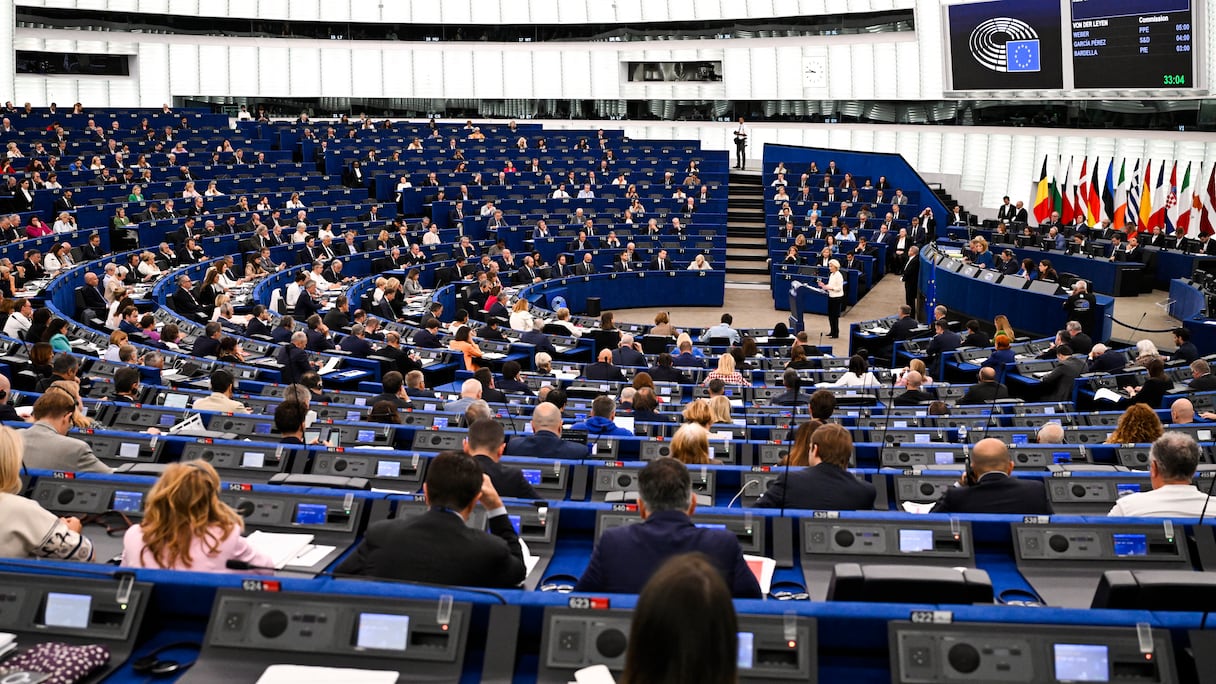
The European Parliament has adopted a non-binding resolution sponsored by the European People’s Party on the mass entries into Ceuta. The text passed by 339 votes to 225, with 16 abstentions, thanks to a majority made up primarily of the right and the far right.
The PP immediately presented the vote as European-level confirmation of its accusations against Morocco. Several Spanish media outlets went further still, claiming that the European Parliament had held the Kingdom responsible for an “invasion” and an operation of “hybrid warfare.” Yet that is not exactly what the resolution says.
The text is severe. It criticizes the Spanish government’s actions, presents the regularization policy as a supposed “pull factor,” calls for faster returns and demands greater cooperation from Morocco on migration and border control. But it does not identify the Moroccan state as the perpetrator of this “hybrid warfare,” does not state that Moroccan authorities organized the entries and provides no evidence of a planned operation against Spain.
“Morocco” and “hybrid warfare” do indeed appear in the same document, but they are never connected by a direct accusation. The PP and some media outlets subsequently made that connection themselves, elevating an interpretation that the European Parliament itself never formulated into an institutional conclusion.
A Harsh Resolution, but No Perpetrator Named
The wording adopted by the European Parliament deserves to be read carefully. In the official summary published by the institution, MEPs condemn the “mass irregular crossings into Ceuta” and denounce “the instrumentalization of irregular migration as a tool of hybrid warfare against the territorial integrity of an EU country.”
The resolution refers, in the same text, to entries “from Morocco” and to “hybrid warfare,” but it never formulates the decisive sentence. It does not say that Morocco instrumentalized migration, that Moroccan authorities planned the crossings or that the Kingdom launched a hybrid attack against Spain.
The distinction is far from purely semantic. Saying that the movements originated on Moroccan territory establishes their point of departure. Saying that those movements were organized, deliberately facilitated or used as a means of pressure would, by contrast, attribute a political decision to the Moroccan state. The first point is beyond dispute. The second requires evidence and the establishment of responsibility—neither of which is contained in the text.
The very structure of the resolution confirms this distinction. When it refers to Morocco, it calls on its authorities to “respect their responsibilities and commitments” regarding border management, returns and migration cooperation. It does not call on them to “take responsibility” for having organized the events. The responsibilities incumbent upon a partner country do not automatically amount to an acknowledgment of guilt for specific events.
The European Parliament also warns that preferential access to the European market and funding should be conditional on effective cooperation. The political and economic pressure is clear. It does not, however, amount either to a decision to suspend aid or to a challenge to the Association Agreement with Morocco. Vox amendments calling for the immediate suspension of funding and of that agreement were, moreover, rejected, as El País noted in its account of the vote.
The same precision is required when it comes to returns. The European Parliament calls for the swift return of people who “do not have the right to remain in the Union,” including unaccompanied minors, while expressly stating that such returns must be carried out in full compliance with European and international law. It therefore does not endorse the automatic return of everyone who entered Ceuta, nor does it eliminate the individual assessment of possible claims for protection.
The PP Supplies the Missing Subject
Alberto Núñez Feijóo had already drawn his own conclusions before the European Parliament had even voted. “Morocco’s aggression continues,” he said, before holding the Kingdom responsible “by action or omission.” That certainty came with a slight caveat, introduced by the PP leader himself when he acknowledged that he was speaking “while knowing that information is still missing.” The information may have been missing, but apparently not the conclusion. The resolution did not turn any of these assertions into established fact. The European Parliament had left the accusation without a subject; the PP supplied one.
After the vote, the People’s Party’s interpretation became even more expansive. Feijóo called the text a “historic document” and claimed that it supported the “immediate” return of everyone who had entered Ceuta irregularly. “When it says everyone,” he explained, that would include Moroccan nationals, third-country nationals and accompanied minors, according to remarks reported by Europa Press.
Yet the resolution does not demand the indiscriminate return of “everyone.” It calls for the return of “all those who do not have the right to remain in the Union” and specifies that this must be carried out in full compliance with European and international law. In Feijóo’s reading, the legal condition disappears, leaving only the word that best serves the PP’s narrative.
Parliament also rejected Vox amendments seeking the immediate suspension of all European funding for Morocco and a freeze on the Association Agreement. The adopted text therefore did not endorse the rupture demanded by the far right. Feijóo nevertheless proclaimed that Spain was now “better armed diplomatically” because it had “Europe behind it.” In this case, that Europe was a right-wing majority that had not approved everything the PP and Vox had demanded.
The contradiction extends to diplomacy. Feijóo portrays Morocco as responsible for an aggression that “continues,” while asking the European Union to mediate so that the Kingdom accepts returns. A few days earlier, he had placed Morocco, alongside France, among Spain’s most strategic neighbors and announced that it would be the destination of his first foreign trip if he became prime minister.
It is perfectly possible to regard a country with which one has disagreements as strategic. It is more difficult to accuse it of an ongoing aggression, acknowledge that the available information is incomplete, immediately seek its cooperation and then present as definitive confirmation of that entire narrative a resolution that does not establish its responsibility.
The PP did not need the European Parliament to reproduce every one of its accusations. It was enough for the document to contain the words needed to reconstruct them after the fact.
From Political Interpretation to Headlines Presented as Fact
Some of the media coverage dispensed with these qualifications altogether. In its Spanish edition, Euronews ran the headline “European Parliament holds Morocco responsible for the ‘invasion’ of Ceuta,” and claimed that the text directly identified the Moroccan authorities “as responsible” for the situation. That sentence does not appear in the European Parliament’s official summary.
Cadena SER, for its part, stated that the resolution “points to Morocco” and calls on it to “assume its responsibilities.” The institutional wording is different. The text calls on the Moroccan authorities to respect the responsibilities and commitments incumbent upon them as a partner in the areas of border and migration management.
Not all Spanish media engaged in the same simplification. RTVE described a resolution that regards Ceuta as the target of a hybrid attack and calls on Morocco to respect Spanish sovereignty and fulfil its border-control obligations. El País referred to a warning addressed to Morocco, while noting that Vox’s most radical proposals had been rejected.
A recurring pattern emerges from some of the headlines. An interpretation advanced by the PP is presented as though it reproduced the resolution verbatim. The missing subject is inserted into the headline, and an obligation to cooperate becomes responsibility for organizing the events. There is no need to falsify a quotation to alter its political meaning. Sometimes it is enough simply to finish the sentence that the institution itself chose to leave unfinished.
When the European Parliament Explicitly Accused Morocco
To gauge the true significance of the 2026 resolution, one need only look back five years. On June 10, 2021, following another mass entry into Ceuta, the European Parliament adopted a text whose title left no room for interpretation. It explicitly referred to “the use of minors by the Moroccan authorities in the migratory crisis in Ceuta.” The resolution passed by 397 votes to 85, with 196 abstentions.
The contrast with the 2026 text is difficult to ignore. This time, Parliament denounces “hybrid warfare,” refers to entries taking place “from Morocco” and calls for cooperation from the Moroccan authorities. But it does not state that Morocco organized, directed or encouraged the operation. The ambiguity, therefore, cannot be explained by some diplomatic convention preventing the European Parliament from naming the Kingdom directly. When it wanted to do so, it did.
Presenting the vote as a condemnation issued by “Europe” also obscures the political majority that made it possible. The resolution was sponsored by the European People’s Party and adopted thanks to decisive support from forces to its right.
The EPP supplied 142 votes in favor. The European Conservatives and Reformists added 69, Patriots for Europe 66 and Europe of Sovereign Nations 22. The three groups to the right of the EPP therefore contributed 157 votes between them. Without their support, the resolution would not have surpassed the 225 votes cast against it.
The roll-call results show a deeply divided Parliament. The Social Democrats cast 108 votes against the text, without a single vote in favor. The Greens opposed it by 43 votes to one, while all 35 members of The Left who participated in the vote rejected it. Renew Europe split, with 27 votes in favor, 31 against and five abstentions.
There was therefore no European consensus against Morocco. A clearly identifiable political majority formed around the EPP, the conservative right and the various components of the far right, with support from part of the liberal bloc. The distinction is essential, because the content of a resolution cannot be separated from the coalition that drafts it, amends it and ultimately adopts it.
This new European political configuration has now found another arena in Spain. The PP moved its confrontation with Pedro Sánchez to Strasbourg before returning with a resolution carrying the authority of Europe. Morocco occupies an important place in the document, but much of its political thrust is aimed at the Spanish government, its migration regularization policy, its handling of warnings and its strategy on returns.
Here lies one of the vote’s central paradoxes. The PP presents it as a European condemnation of Morocco, when its result also constitutes—and perhaps above all—a European rebuke of Sánchez. Spain’s right took its domestic battle before a European Parliament that has shifted to the right and found there the majority it needed.
The resolution gives each camp something it can brandish as a victory. The PP secures a rebuke of Sánchez and the ability to associate Morocco with the expression “hybrid warfare.” Vox succeeds in inserting mechanisms allowing funds to be suspended and recovered in cases of insufficient cooperation but fails to secure the immediate termination of all funding or a freeze on the Association Agreement. The European Parliament hardens its language on borders. And some media outlets find, in the proximity of the words “Morocco” and “hybrid warfare,” a headline more categorical than the resolution itself.