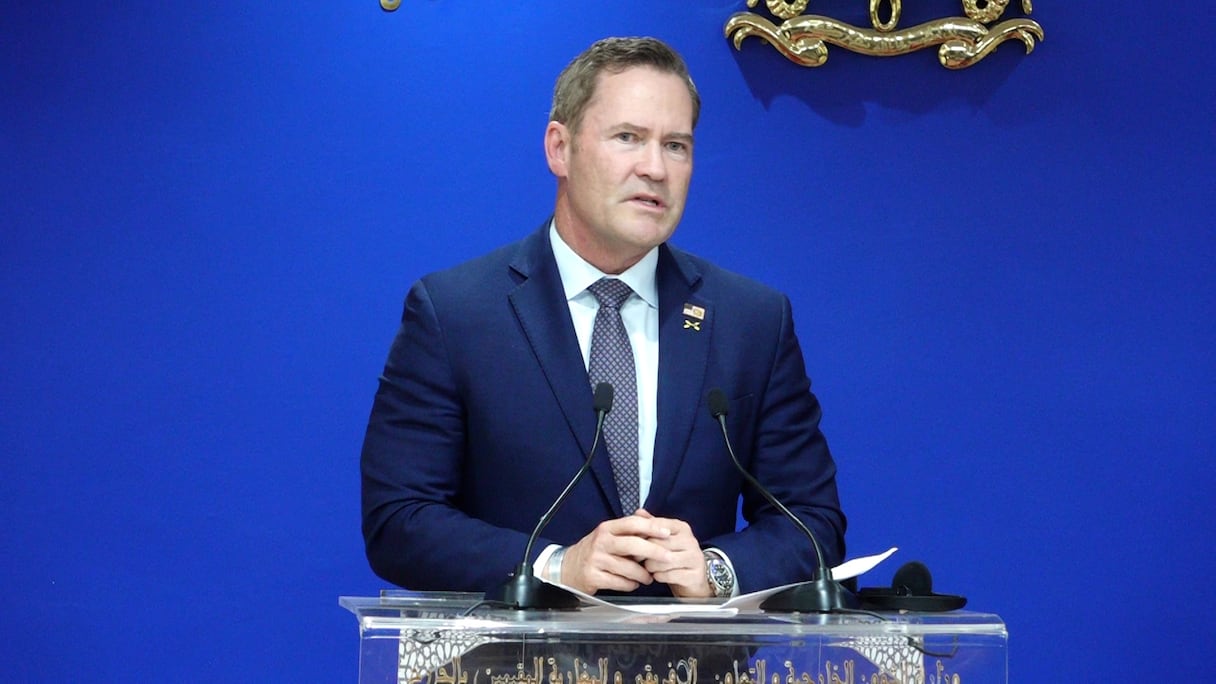
Two weeks after Russia’s veto at the Security Council, and a day after MINURSO began its withdrawal in earnest, US Ambassador to the United Nations Mike Waltz reiterated his country’s support for Moroccan sovereignty over the Sahara and the autonomy plan, standing alongside Nasser Bourita. He praised the Kingdom’s restraint and commitment to the ceasefire. The central message of Waltz’s visit to Rabat on Tuesday could be summed up in one sentence: the veto of the US-drafted resolution has done nothing to alter Washington’s position. “So today, Foreign Minister, I am here and delighted to be here to reaffirm President Trump’s commitment to His Majesty that the United States recognizes Moroccan sovereignty over Western Sahara,” the American ambassador declared at a joint press conference with Foreign Minister Nasser Bourita.
The US diplomat revisited in detail the sequence of events that led to the deadlock at the Security Council. He began by recalling that the talks conducted beforehand under American leadership had made it possible to advance “unprecedented rounds of talks with senior officials at the foreign minister level from Morocco, Algeria, Mauritania, and of course, representatives of the Polisario,” through “multiple rounds of discussions in Madrid and Washington, D.C.” Those rounds, he said, addressed “many of the outstanding issues in terms of autonomy, local governance, resources, transition.” He added: “All of the things that would need to occur to resolve this dispute were all on the table and discussed in a robust way.”
It was on that basis, he continued, that “in October, the United States presented a new resolution to the United Nations Security Council that would have established Morocco’s autonomy proposal as the basis for negotiations, and paved the way towards peace and advanced a peace process in Western Sahara.” According to Waltz, the resolution would have advanced a process backed by dozens of countries that “have agreed that autonomy is the realistic solution and the only solution moving forward.”
“Unfortunately, after weeks of negotiations, we took input from over half a dozen countries, we gained the support of 11 members of the Security Council, but unfortunately, the proposal and the resolution was vetoed,” he lamented, without naming Russia.
Read also : MINURSO withdrawal: Ivanko sets January 31 deadline and outlines the stages of departure
On MINURSO’s departure, Waltz said he had met Alexander Ivanko, the former Special Representative now overseeing the mission’s liquidation. The UN, he explained, is preparing to “demobilize and move both the 158 unarmed observers and their equipment properly and safely back to their home countries.” He thanked Morocco for its cooperation and noted that the mission had “also received a letter from the Polisario assuring their safety.”
He then delivered what was perhaps the clearest indication of the purpose of his visit: “We remain resolved that the process has to move forward. The United States will continue working with all parties and with the United Nations, as appropriate, towards a lasting settlement.” In other words, the end of the UN framework does not, in Washington’s eyes, spell the end of the political process. Instead, that process would now continue under direct American leadership, building on the talks held in Madrid and Washington.
Polisario must face up to its responsibilities
The ambassador explicitly praised Rabat’s conduct since the veto. “We are grateful to Morocco for its continued restraint and its commitment to maintain the ceasefire,” he said. He called on Polisario “to rejoin that ceasefire, to honor it in full, and to demonstrate a commitment to peace.” “This is a moment for calm and focus. It’s a moment for renewed diplomacy and for cooler heads to prevail,” he urged, adding that “everyone must resist any temptation to return to violence.”
A former military officer, Waltz drew on his own experience to reinforce his warning. The people he had encountered “across Africa and elsewhere,” he said, had taught him that “violence often offers the illusion of some type of quick victory or a step forward, but it never delivers and it never lasts.” “Again, I just can’t state more plainly and clearly: a return to hostilities will only deepen the suffering, it will harden divisions, and it will condemn yet another generation to needless conflict, death, and loss. All parties must refrain from provocations and escalation, and we must remain committed to the ceasefire. And I know that will be the case here from the government of Morocco,” Waltz insisted.
The American representative also stressed the humanitarian dimension. “And as President Trump has said, the status quo is unacceptable,” he recalled, before describing the plight of families in the Tindouf camps in Algeria, a situation the UN High Commissioner for Refugees had described as “untenable.” “Generations now have grown old in those camps. Their children and their grandchildren suffer from anemia, malnutrition, stunted growth, with no prospects for better lives. That must change. We owe it to the next generation to prevent another generation from languishing, and for the UNHCR to find a viable solution,” he declared.
Read also : Experts: MINURSO’s departure could open a new chapter in the Moroccan Sahara issue
He concluded with a pledge to persevere: “Just finally, just know this: the United States, and particularly President Trump, will not let up. We will continue to push, continue to press, until we achieve a lasting peace.”
Bourita: Two schools of thought on the dispute
Nasser Bourita, who spoke first, described Mike Waltz as “an important partner” who has “always distinguished himself by the depth of his thinking and his candor.” He credited Waltz with playing “a major role” in the search for “a face-saving solution for everyone, one from which all sides can emerge as winners.”
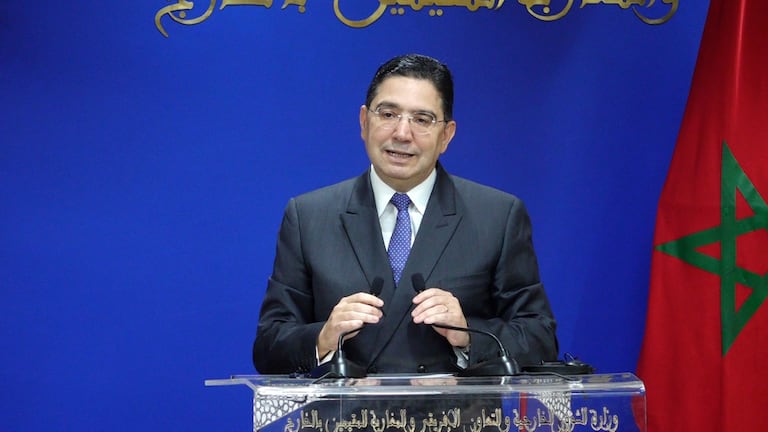
The minister then offered his interpretation of the veto, drawing a distinction between two opposing camps. “Today, there is a divide between two schools of thought,” he said. “There are those who want to resolve this dispute and alleviate its humanitarian consequences, its impact on stability and the opportunities it has cost North Africa. And there are those who want to preserve the status quo, to keep the situation frozen, perpetuating humanitarian suffering, tensions and the squandering of opportunities for regional integration and economic development,” he explained.
Confronted with this new situation, namely MINURSO’s departure, Morocco’s top diplomat described a development that “Morocco and His Majesty the King have approached with responsibility and wisdom.” He then set out the Kingdom’s commitments: maintaining the ceasefire, ensuring MINURSO’s orderly withdrawal and remaining engaged in a political process “built on clear foundations.” On that last point, Bourita laid down the parameters. “The only basis is the autonomy initiative presented by Morocco, and the only possible outcome is autonomy that respects Moroccan sovereignty and the territorial integrity of the Kingdom of Morocco.”
The foreign minister summed up the thinking behind the work undertaken with Washington over the past two years, under the guidance of the King and President Trump: “The status quo serves no one’s interests and cannot continue. A solution to this dispute has become inevitable, and the way forward is clear: no solution outside Moroccan sovereignty, and no solution outside autonomy.”
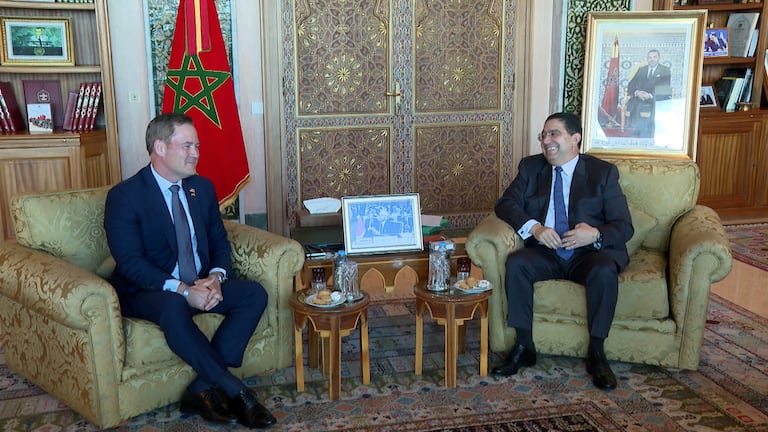
Bourita placed the Sahara issue within the broader context of a relationship that has become one between “two allies who share common values, common interests and converging visions.” He spoke at length about the exchange of messages between the two heads of state last July, which had provided “something of a roadmap” for the years ahead, covering “defense industries, advanced technologies, minerals, artificial intelligence and superintelligence, as well as energy.” These fields, he stressed, “require trust, ambition and leadership,” three qualities that are already in place.
On the economic front, the minister recalled that the free trade agreement had “increased trade between our two countries sevenfold since it was signed in 2004″ and that 150 American companies operate in Morocco, particularly in energy and technology. “We need to strengthen this free trade agreement and deepen our economic ties further,” he said.
He described security and military cooperation as “exemplary,” recalling Morocco’s designation as a major non-NATO ally in 2004 and the importance of the African Lion military exercise, preparations for whose next edition, scheduled for May, began on Tuesday. Finally, he highlighted Morocco’s participation in the Peace Council initiative launched by Donald Trump. The Kingdom is a “founding member,” has been “among the first contributors” and is taking part “militarily, in humanitarian efforts and through training” in the stabilization and reconstruction of the Gaza Strip. The Middle East, the Palestinian question, relations with Israel and the Sahel were also expected to feature in the subsequent discussions.
Beyond the statements themselves, the timing gives this visit its significance. By coming to Rabat just as MINURSO is packing up and leaving, Washington is signalling that the vacuum left by the United Nations will not become a diplomatic vacuum. Both officials delivered essentially the same message: the status quo is untenable, autonomy under Moroccan sovereignty is the only framework, and the ceasefire must hold. And the American representative issued a direct appeal to Polisario to exercise restraint.
