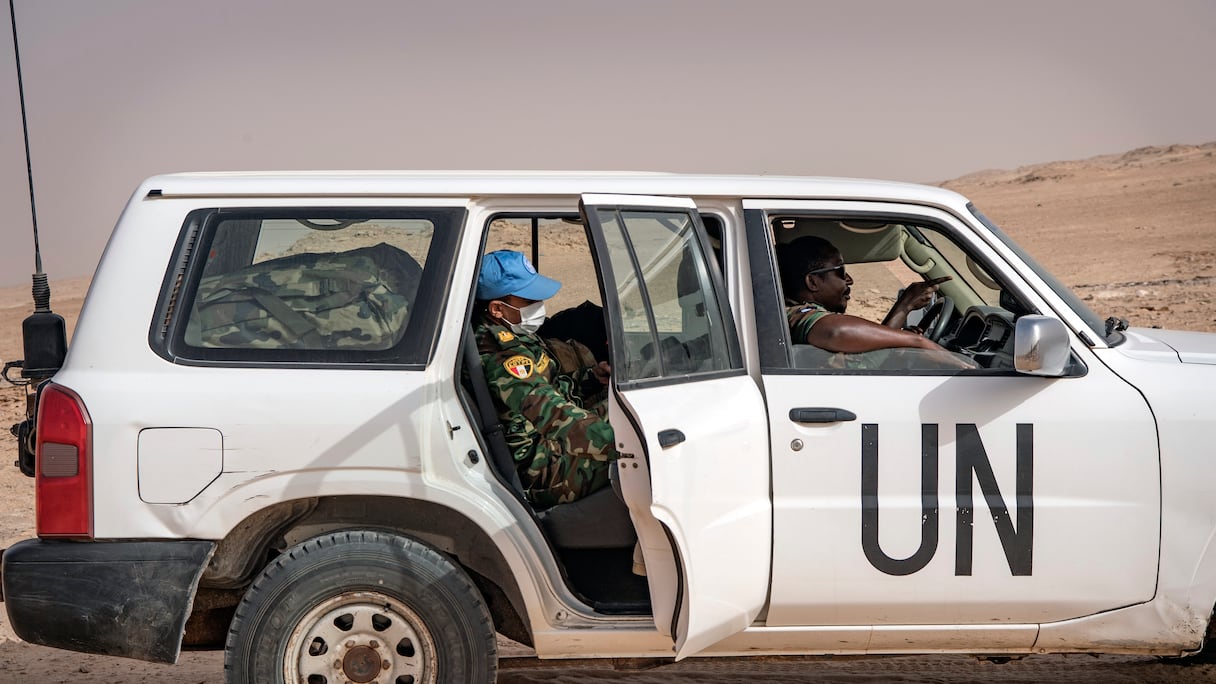
A major geopolitical development has taken place largely outside the international spotlight. While attention elsewhere was focused on other issues, the United Nations Mission for the Referendum in the Moroccan Sahara (MINURSO) came to an end, opening a new chapter in a long-stalled dispute. An in-depth analysis published in The National Interest, a leading online publication covering foreign policy, national security and defense, examines the deeper dynamics behind the issue. Written by Brett D. Schaefer and Liam Karr, the article carries an unmistakable title: “It Is Long Past Time for the UN to Leave Western Sahara.”
The authors’ backgrounds are worth noting. Brett D. Schaefer is a senior research fellow at the American Enterprise Institute (AEI). His work focuses on multilateral treaties, peacekeeping operations, the United Nations system and international organizations. He previously served as a senior research fellow at the Heritage Foundation, sat on the UN Committee on Contributions and worked with the United States Institute of Peace (USIP), in addition to experience at the US Department of Defense.
Liam Karr leads the Africa team for AEI’s Critical Threats project. A specialist in sub-Saharan Africa, particularly Somalia and the Sahel, he holds degrees from the University of Notre Dame in political science, history, Arabic and international security studies.
For the two authors, MINURSO’s end was largely overshadowed by the political turmoil of the period, “lost in the media frenzy surrounding the 2026 US midterm elections and the drawn-out process of selecting the next UN secretary-general.” One thing, however, is clear: after 35 years, MINURSO came to an end because the UN Security Council could not agree on renewing its mandate.
Read also : End of MINURSO: António Guterres formally begins winding down the mission
While the mission’s end has raised concerns about instability, Schaefer and Karr take a pragmatic view. Rather than serving as a safeguard against chaos, UN peacekeeping had become a sterile exercise in preserving the status quo. After more than three decades, the operation “was not helping create conditions conducive to a political solution, but instead providing an excuse to avoid one.”
A mission that had outlived its purpose
Brett D. Schaefer and Liam Karr’s analysis suggests that MINURSO’s disappearance, far from being an outright catastrophe, could shake up decades of diplomatic inertia. By removing the cover provided by a UN structure that had become little more than a shield for freezing the conflict, the mission’s end offers an opportunity to rethink the political path forward and explore more pragmatic ways to resolve the dispute.
This is all the more significant given that geopolitical momentum has shifted in Morocco’s favor. Through effective diplomatic lobbying, Morocco has managed to weaken support for the self-proclaimed Sahrawi Arab Democratic Republic (SADR) across the African continent. This diplomatic shift accelerated in 2020, when the United States formally recognized Moroccan sovereignty over the Sahara. Schaefer and Karr make the US administration’s position clear: “An independent Sahrawi state is not a realistic option for resolving the conflict and… genuine autonomy under Moroccan sovereignty is the only viable solution.” The US recognition was accompanied by a strong call to begin negotiations on that basis alone.
The international community, meanwhile, has had to acknowledge the continuing lack of realism surrounding the referendum option. Many African and European countries have followed suit by backing Morocco’s autonomy plan, first proposed in 2007, and formalizing that support through the opening of consulates in the territory. The authors point to UN Security Council Resolution 2797 of 2025 as a reflection of this shift. The resolution calls on “the parties to engage in these discussions without preconditions, taking the Moroccan Autonomy Initiative as a basis, with a view to achieving a definitive political solution.” It also recognizes “that genuine autonomy could represent the most realistic outcome.”
Read also : MINURSO is not the first UN mission to be shown the door
In October 2026, the United States sought to formalize this shift by demanding that autonomy under Moroccan sovereignty become the sole basis for negotiations. Washington was “right to push for a change to the status quo,” the analysis argues. But Russia’s veto blocked the compromise. With no agreement in the Security Council, the mission came to an end, triggering sharply different reactions: Morocco welcomed the outcome, while Algeria, identified in the analysis as the source of the deadlock, expressed regret.
For the authors, continuing the UN mission no longer made sense. It had become an expensive and fruitless bureaucratic routine that offered “no positive outcome” and “no longer reflected the position of the United States or that of a growing part of the international community, including many African states.”
Citing US Ambassador Mike Waltz, the analysis describes maintaining the status quo as “inhumane,” arguing that it “condemns another generation to displacement and suffering” without providing a genuine safeguard against war. “The presence of 158 UN peacekeepers and 201 civilian personnel in Western Sahara has not served as a deterrent to hostilities, but as a convenient excuse to avoid them,” the two experts write.
By ending this entrenched structure, Washington is betting on a revival of direct diplomacy. Without MINURSO, the diplomatic landscape could face a much-needed shock, putting pressure on Algeria and the Polisario Front to finally engage in substantive negotiations.
“One can only hope that the end of MINURSO will encourage [the parties] to make serious efforts to resolve the conflict with US support. History teaches us that renewing MINURSO’s mandate would not have achieved this goal,” the American publication concludes.
