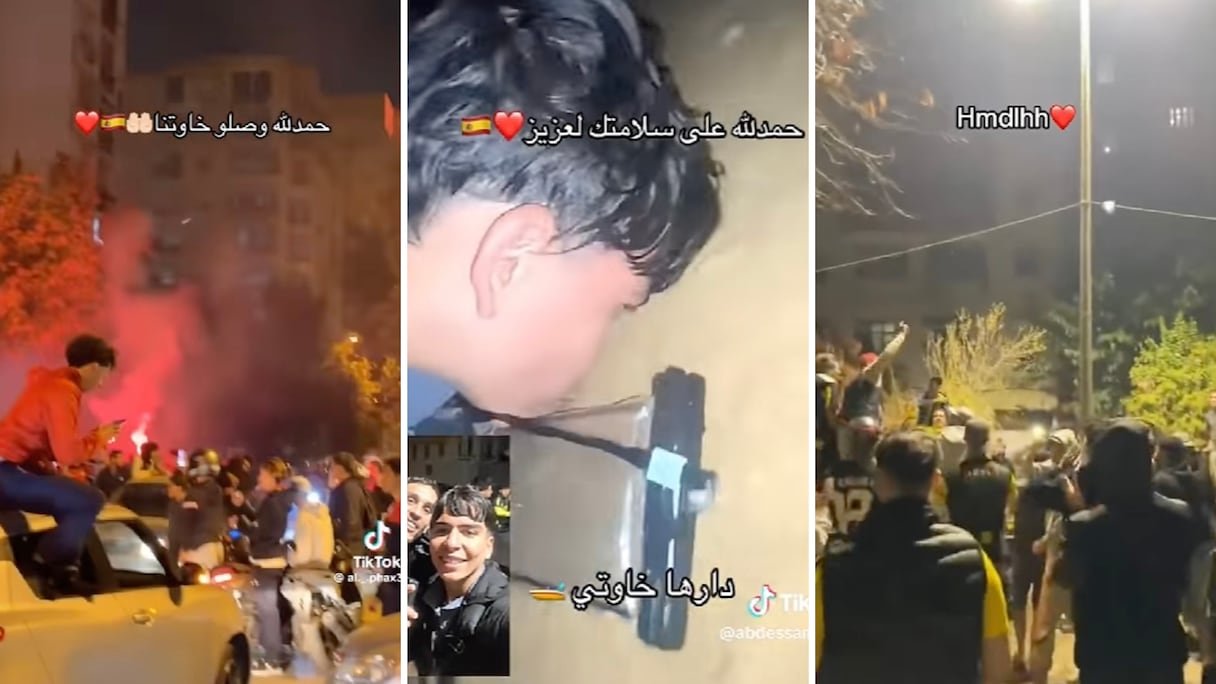
The videos were filmed at night and posted on social media. They show young people shouting with joy beneath apartment blocks, while messages flash across the screen: “Thank God, our brothers have arrived.” The 14 young men had set off from Bordj El Kiffan, formerly known as Fort-de-l’Eau, east of the capital. For several days, their families had heard nothing from them. Then came the news: they had reached the Spanish coast. The neighborhood celebrated as though Algeria had won the Africa Cup of Nations.
The significance of this jubilation deserves to be understood. In a country that prides itself on its gas and oil wealth, an entire town celebrates the fact that its children have managed to leave. They are not celebrating a degree, a job or a home. They are celebrating a night crossing in a motorboat, and the fact that those who made it survived.
According to Frontex, the European Border and Coast Guard Agency, the Western Mediterranean was the only major migration route into Europe to record an increase during the first nine months of 2026: approximately 18,300 detected irregular border crossings, up 26% from a year earlier. Frontex is unequivocal: Algeria remained the main country of departure for sea crossings, with Algerians accounting for the largest share of detected nationalities.
On the route to the Balearic Islands, Algerians are almost alone. Between January 1 and October 31, 2026, 7,188 people reached the archipelago aboard 399 boats, according to Spanish Interior Ministry figures reported by La Voz de Ibiza. That is 14.5% more than in 2025. At this rate, Ibiza and Formentera are receiving the equivalent of an entire Algerian neighborhood every two months.
Read also : Gas through pipelines, young people by sea: Algeria becomes Spain’s leading source of irregular migrants
The International Organization for Migration had already revealed the scale of the phenomenon. During the first four months of the year, Algerians accounted for 42% of migrants arriving in Spain via the Western Mediterranean, nearly twice the proportion of Moroccans (22%), as Le360 reported. The same report highlighted another, less conspicuous figure: interceptions by the Algerian navy had fallen by 37% year on year. Departures are rising; interceptions are falling.
The harragas who make it across are only part of the story. Others never arrive. Spanish NGO Caminando Fronteras recorded 507 deaths and disappearances on the Algerian route alone between January and May 2026, a 54% increase on the previous year, according to the Periódico de Ibiza. That amounts to one death every seven hours. For the first time, the Algerian route has become the deadliest of all those leading to Spain.
While Bordj El Kiffan was celebrating, other families were still waiting. On October 29, the Alarm Phone emergency network reported that 20 people who had departed from Boumerdès on October 26, bound for the Balearic Islands, were missing. No further news of them had been made public since.
The crossing also comes at a price. After dismantling a people-smuggling network, Spanish police established that each prospective migrant paid between €8,000 and €10,000. At the exchange rate prevailing in Algiers’ Port-Saïd Square, that amounts to between 2.2 million and 2.8 million dinars, the equivalent of several years on the minimum wage. Families sell jewellery, cars and sometimes plots of land to finance a son’s departure.
Faced with this exodus, Algeria’s rulers remain silent. No official figures on departures, no tally of the missing, not a word from the president. State media prefer to talk about “achievements” and mining projects. The only available figures come from Madrid, Brussels and Spanish NGOs. The regime has decided that what goes uncounted does not exist.
The young people of Bordj El Kiffan, however, know how to count. They know what a salary in dinars is worth, how much a smuggler charges and how many of their friends have never returned. Their jubilation is not recklessness. It is a vote—the only one they are allowed to cast.
