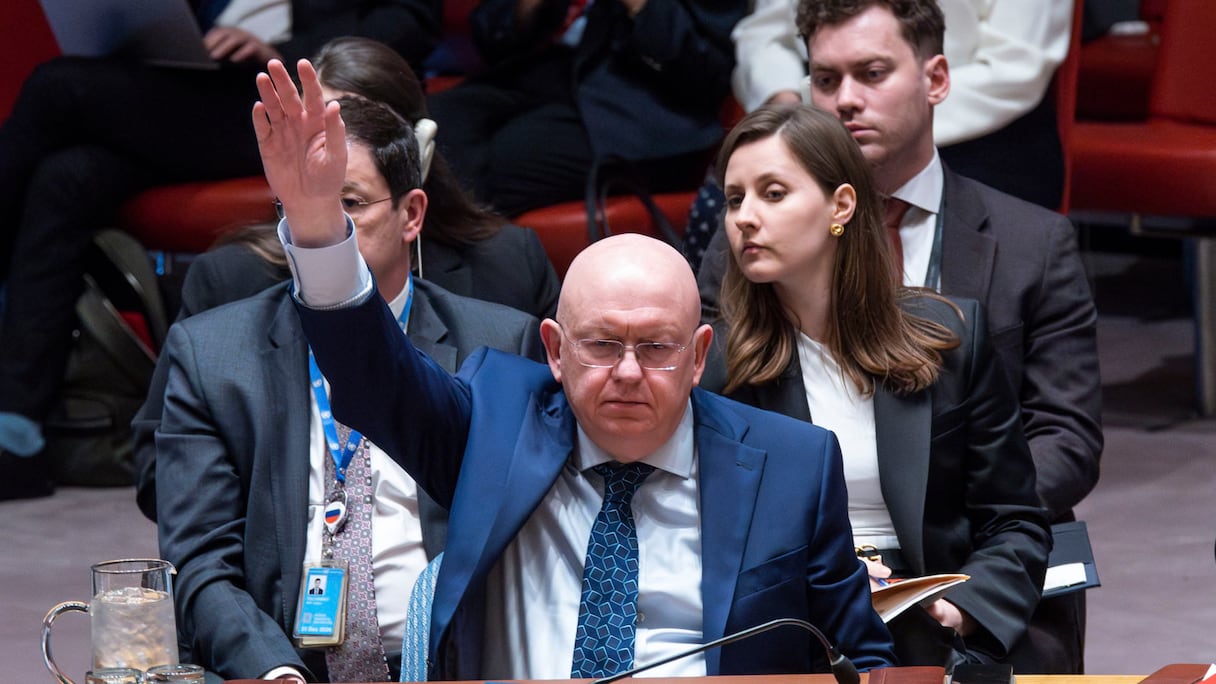
Procedural in nature, the plenary meeting held at the United Nations General Assembly on Tuesday, November 10, was remarkable for the way it displayed to the world the full extent of the support Morocco enjoys for its national cause. Convened under Resolution 76/262 following the Russian Federation’s veto at the Security Council on October 30, which prevented the renewal of MINURSO’s mandate, this procedural meeting quickly became a platform for vindicating Morocco’s position. The debate exposed the diplomatic isolation of Algeria, the real force behind the October 30 deadlock, while confirming overwhelming international support for the autonomy plan under Moroccan sovereignty as the only realistic, lasting and pragmatic solution to the regional dispute over the Sahara.
Opening the debate, Anna Evstigneeva, Russia’s Deputy Permanent Representative to the United Nations, attempted to lend Moscow’s decision a veneer of legitimacy. The Russian diplomat argued that the US-drafted resolution departed “radically” from the objective of a balanced settlement. Defending the veto as a “mechanism of deterrence and correction,” she justified Russia’s obstruction on the grounds that it was necessary to restore the status quo and maintain strict equidistance between the parties.
Was that enough to convince anyone? Hardly. Amid its open confrontation with the United States, Russia opposes initiatives spearheaded by Washington, the designated penholder of Security Council resolutions on the Sahara, almost as a matter of course. Moreover, this calculated move was aimed squarely at accommodating Algeria, the creator and principal military and financial backer of the Polisario, as well as a longstanding and major purchaser of Russian weaponry. The result: MINURSO’s disappearance after its mandate was not renewed.
While Russia’s maneuver was driven by imperial calculations, Algeria’s response exposed a profound sense of diplomatic anxiety. Algeria’s Deputy Permanent Representative to the United Nations delivered a disjointed and vehement intervention, betraying unmistakable dismay at the irreversible advances secured by the Kingdom. Clinging desperately to obsolete concepts, he denounced an alleged attempt to “legitimize occupation through a fait accompli,” endlessly repeating slogans about self-determination—meaning a referendum—while pretending to deny his own country’s role as a central party to the conflict. The weakness of the Algerian delegation’s arguments and its accusatory tone stood in stark contrast to the diplomatic maturity displayed elsewhere.
One of the most striking takeaways from the plenary was that the two protagonists behind the Russian veto were represented by deputy ambassadors. Equally revealing was the tiny number of countries that aligned themselves with Algiers through Moscow. Only a handful of states ventured to defend the Polisario’s outdated rhetoric. Namibia continued to invoke a “moral debt” to the separatist front. South Africa focused its remarks on dogmatic adherence to African Union and UN resolutions on decolonization—though which resolutions remain a mystery. Timor-Leste invoked its own historical experience to demand a referendum.
These rare interventions sounded like distant echoes of the past, utterly disconnected from present-day political and territorial realities.
A groundswell of support
Beyond this small pocket of dissent, the overwhelming majority of interventions amounted to a resounding endorsement of Morocco, affirming its sovereignty over its Southern Provinces and establishing the autonomy plan as the sole guiding principle for a political solution.
US Ambassador to the United Nations Mike Waltz delivered a series of uncomfortable truths for defenders of the status quo. “Hope is not a strategy for establishing peace,” he began, describing the pursuit of a referendum as an unrealistic option sustained for decades by “wishful thinking.” Recalling that successive senior UN officials had already sounded the alarm over the practical impossibility of holding such a referendum, the American ambassador insisted that “the referendum is a smokescreen; it is a fiction.” Waltz forcefully reaffirmed unwavering US support for Morocco’s autonomy plan, calling it the “only viable path to peace,” while welcoming the high-level negotiations initiated under the auspices of the US presidency.
Europe spoke with one voice in support of Morocco’s diplomatic momentum. Speaking on behalf of the EU, its member states and candidate countries, representative Stavros Lambrinidis recalled that “genuine autonomy represents a more realistic solution” and called for constructive engagement on the basis of Morocco’s proposal. French Ambassador Jérôme Bonnafont delivered an impassioned defense of Morocco’s position. “The present and future of Western Sahara lie within the framework of Moroccan sovereignty,” he declared unequivocally, reiterating that Morocco’s 2007 autonomy initiative constitutes “the sole basis for achieving a just, lasting and negotiated political solution.”
He also made a point of praising Morocco’s enormous efforts to promote economic and social development in its Southern Provinces. Speaking with one voice, the Nordic countries—Denmark, Finland, Iceland, Norway and Sweden—expressed deep regret over the Russian veto, which jeopardizes regional stability, while emphasizing the need to adapt to “realities on the ground.”
Unwavering solidarity
The Gulf states offered unreserved and unequivocal support for Morocco’s sovereignty over the Sahara. Speaking both on behalf of the Gulf Cooperation Council (GCC) and in his national capacity, Bahrain’s representative, Jamal Fares Alrowaiei, reaffirmed the “firm and historic position” supporting Morocco’s sovereignty and territorial integrity. Alrowaiei stressed that all Gulf states regard the autonomy initiative as the only serious and credible basis for bringing the dispute to a close.
Read also : Experts: MINURSO’s departure could open a new chapter in the Moroccan Sahara issue
Africa, too, overwhelmingly backed Morocco’s vision, demonstrating that the Kingdom’s deepening ties across the continent are bearing fruit. Côte d’Ivoire enthusiastically welcomed the autonomy initiative, describing it as a “compromise solution consistent with international law and Security Council resolutions.” Guinea-Bissau reiterated its categorical support for Moroccan sovereignty, highlighting Morocco’s sustained commitment to peace and prosperity across the continent. Equatorial Guinea echoed that position, praising the credibility and realism of Morocco’s plan. Madagascar likewise called for support for the political process on the basis of the Moroccan autonomy proposal.
A sense of responsibility
Beyond the strictly political aspects, the interventions were marked by emphatic praise for the Kingdom of Morocco and its exemplary conduct on the ground despite the crisis triggered by the Russian veto. Several delegations warmly commended Morocco’s approach, noting that it continues to scrupulously observe the ceasefire and exercise remarkable restraint.
Moreover, representatives of GCC countries, France and numerous African states explicitly congratulated Rabat on its exemplary and orderly facilitation of the evacuation of MINURSO personnel. This smooth cooperation stands in stark contrast to the obstruction and threats emanating from Polisario militias east of the defensive wall. On that same Tuesday, November 10, the Polisario Front officially declared a “state of general mobilization.”
Although the General Assembly convened to fulfill a strictly procedural requirement arising from the Russian veto, the exercise provided an international platform on which the overwhelming global consensus around Morocco’s sovereignty over the Sahara emerged with unmistakable clarity. The meeting demonstrated that Morocco’s national cause no longer depends on the shadowy maneuvers of the Security Council. It now enjoys the backing of an overwhelming majority of nations that see the autonomy plan as the only path towards peace, development and stability for the entire region. As Morocco’s representative Omar Hilale declared during the meeting, the Sahara “was, is and will always remain Moroccan.”
