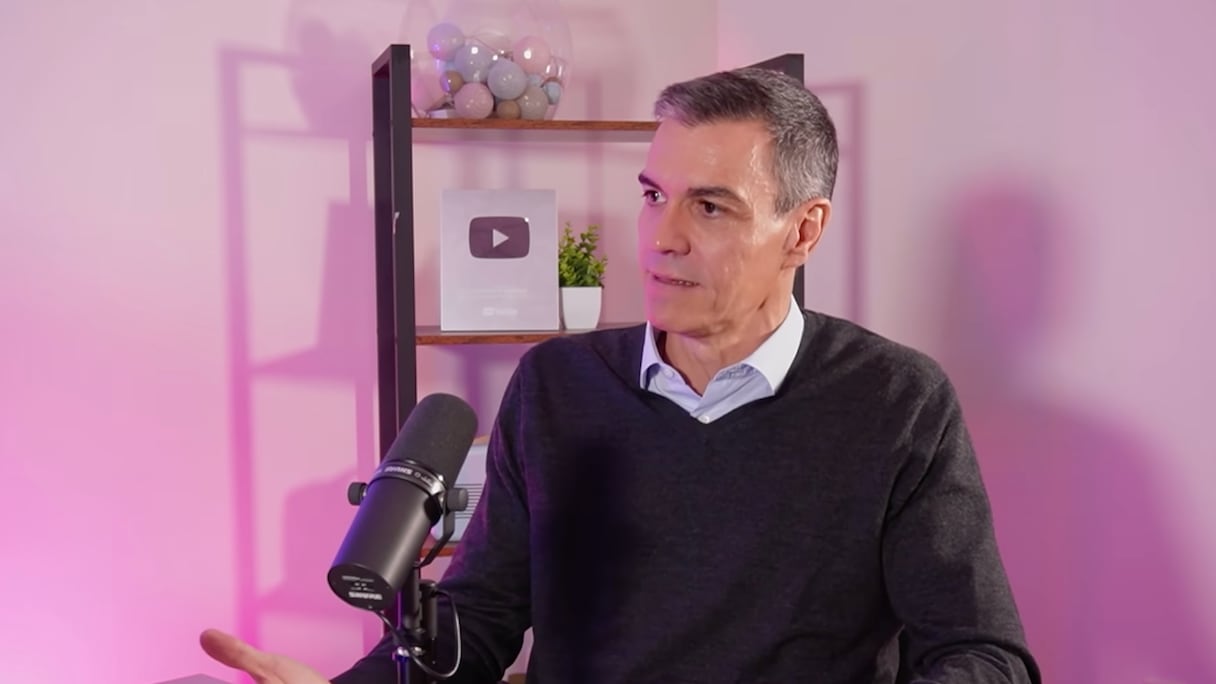
Pedro Sánchez is standing firm. For the Spanish prime minister, the autonomy plan proposed by Morocco remains the most realistic path towards a political settlement of the Sahara issue. And he firmly rejects any suggestion that Madrid’s support for the initiative was the result of some arrangement with Rabat.
Asked about Spain’s change of position and the suggestion that Madrid had surrendered a bargaining chip “without getting anything in return,” the Socialist leader categorically dismissed the notion of a “transaction.” Instead, he presented the decision as a deliberate political choice, driven by the search for a way out of a “dispute that has dragged on for half a century.”
During the interview, broadcast on Sunday, November 8, by the Spanish podcast Memorias de Pez, which covered geopolitics and international affairs among other subjects, Sánchez pointed out that several countries had reconsidered their approach after decades of deadlock. “An autonomy solution for Western Sahara within Morocco could be the most realistic solution,” he said.
The Spanish prime minister also stressed the need for his country to continue playing an active role in resolving the dispute. In his view, supporting Morocco’s autonomy plan does not mean abandoning the other dimensions of the issue. “Spain remains the largest provider of humanitarian aid to the refugee camps,” he said, referring to assistance for people living in the Tindouf camps.
Sánchez also discussed the talks his government has initiated on granting access to Spanish nationality to people originating from the Sahara. He described these various initiatives as “tools” enabling Madrid, in coordination with the United Nations, to “participate actively in the solution.”
A Spanish decision reinforced by shifting international positions
For Pedro Sánchez, Madrid’s support for the Moroccan plan is therefore not a concession negotiated as part of bilateral relations. Rather, it forms part of a broader diplomatic shift, born of the recognition that approaches pursued for several decades have failed to break the deadlock.
Nor is this position new. As early as March 2022, the Spanish government made a major policy shift by formally recognizing Morocco’s autonomy plan as “the most serious, credible and realistic basis” for reaching a solution. Four years later, Sánchez is holding to that position in an international landscape that has changed considerably.
United Nations Security Council Resolution 2797 has strengthened the Moroccan initiative’s standing in the political process. The text calls for negotiations to be conducted on the basis of the autonomy plan proposed by Rabat and emphasizes that genuine autonomy under Moroccan sovereignty could constitute the most realistic solution to the dispute. The resolution was adopted with eleven votes in favor, none against, and three abstentions.
Read also : Moroccan Sahara: Nasser Bourita explains what the end of MINURSO’s mandate means
This shift is also reflected in the positions adopted by several major powers. The United States recognizes Morocco’s sovereignty over the Sahara and supports the autonomy plan as the foundation for a political solution. France, for its part, considers that the present and future of the territory lie within the framework of Moroccan sovereignty and that autonomy provides the framework within which the issue must be resolved. The United Kingdom has also endorsed the Moroccan initiative, describing it as the most credible, viable and pragmatic basis for achieving a lasting solution.
Spain, the territory’s former administering power, has maintained since 2022 that Morocco’s proposal represents the most serious, credible and realistic basis for settling the dispute.
It is against this backdrop that Pedro Sánchez’s remarks take on their full significance. By rejecting the notion of a “transaction” with Rabat, the Spanish prime minister is challenging the interpretation that Madrid unilaterally relinquished a bargaining tool without receiving anything in return.
His argument rests on a different diplomatic reality. Morocco’s autonomy plan has gradually established itself as the principal reference point for international discussions, backed by major powers and now occupying a central place within the framework established by the Security Council.
Sánchez is therefore announcing no new shift in Spanish diplomacy. He is defending a decision consciously taken in 2022, now reinforced by an international realignment that lends greater weight to Morocco’s proposal.
