The exchange took place on November 5, during the daily press briefing by UN Secretary-General spokesperson Stéphane Dujarric, according to the official United Nations transcript. A correspondent asked what Staffan de Mistura, the Personal Envoy for the Sahara, would do now that MINURSO was being wound down. The spokesperson replied that the UN remained committed to supporting the parties in their efforts to reach “a mutually acceptable political solution that provides for the self-determination of the people of Western Sahara, should they so wish.”
The wording deserves closer attention. For decades, self-determination stood at the heart of the UN’s vocabulary on the Sahara and at the heart of Algiers’ strategy. It was presented as a given, an unavoidable step, almost an end in itself. On November 5, it became a hypothetical possibility, dependent on the wishes of those it is supposed to concern. The language is no longer about a right to be exercised but a possibility to be considered.
Read also : MINURSO withdrawal: Ivanko deals with Rabat, leaves Algiers’ puppet on the sidelines
This is no accidental turn of phrase. It marks the culmination of a shift set in motion by the Security Council a year ago. Adopted on October 31, 2025, Resolution 2797 stated that that “genuine autonomy under Moroccan sovereignty could constitute a most feasible solution”. It retained the principle of self-determination, but within the framework of a negotiated settlement, rather than a referendum that nobody in New York talks about anymore. The UN has not abandoned self-determination. It has changed its meaning: populations may express their views on a proposed settlement; they are no longer being asked to choose between independence and everything else.
For Algiers, this is bad news. The Algerian regime has turned self-determination into a dogma. It invokes the principle at every podium, in every statement and in every speech by President Tebboune. It is supposedly in the name of this principle that Algeria has armed, financed and hosted the Polisario for fifty years. Yet the word on which this entire edifice rests has just lost its capital letter. In New York, it is now uttered only in the conditional.
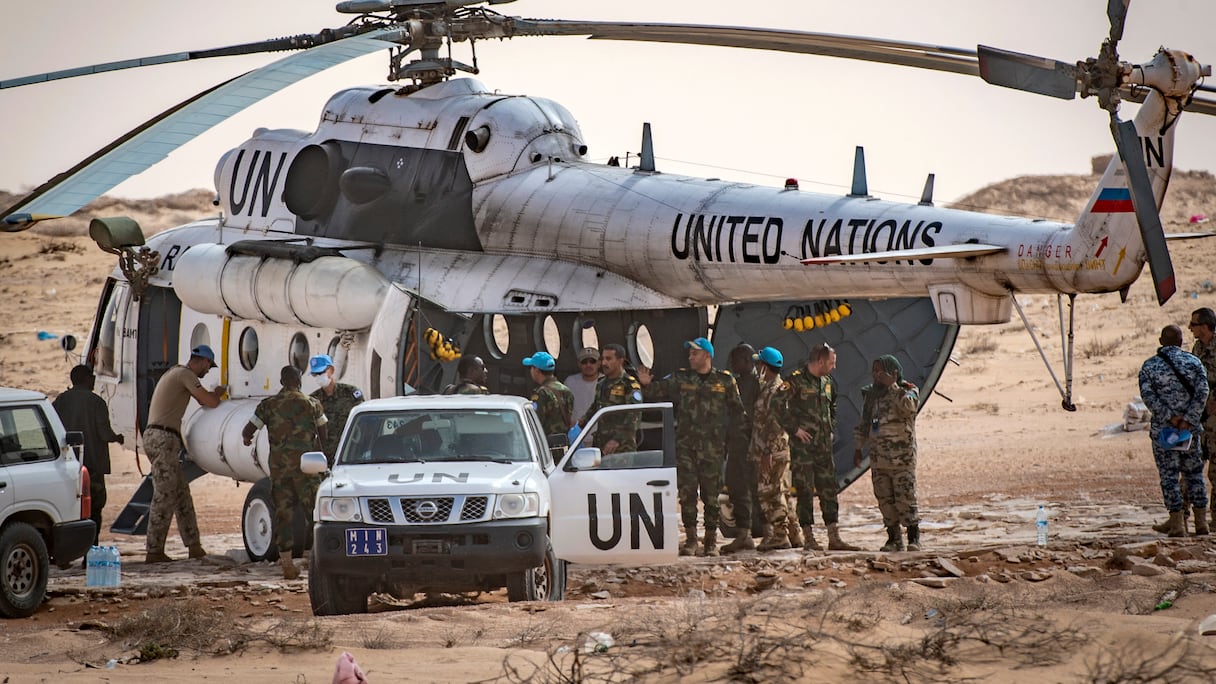
Algeria had already lost MINURSO, dismantled following Russia’s veto on October 30. Now it is losing the vocabulary as well. With no mission on the ground, no referendum on the horizon and self-determination now subject to a “should they so wish,” little remains of Algeria’s doctrine on the Sahara. Only the Personal Envoy, Staffan de Mistura, remains. Stéphane Dujarric confirmed that he “continues his work” from Brussels. Asked about his future after António Guterres leaves office at the end of the year, the spokesperson replied that he had “no idea” who the next secretary-general would be or what decisions would be made regarding senior officials.
Morocco, for its part, has nothing to fear from the word. Its autonomy plan, presented in 2007, provides for the status of the Southern Provinces to be submitted to consultation with the populations concerned. Self-determination, understood in this sense, has never been an obstacle for Rabat. It was an obstacle only in the version promoted by Algiers: a referendum designed to produce yet another state in the Maghreb, under Algerian tutelage.
Read also : MINURSO: UN details the mission’s closure, with 340 personnel leaving and 13 sites to be handed over
For autonomy is not the opposite of self-determination: it is one of its concrete expressions. International law has never reduced self-determination to independence. The United Nations General Assembly’s 1970 Declaration on Friendly Relations among States (Resolution 2625) recognizes several ways of exercising it: the establishment of a sovereign state, free association or integration with an independent state, but also “the emergence into any other political status freely determined by a people.” The question, however, is whom we are talking about. There is no “Sahrawi people,” and there never has been. There are Sahrawi populations, tribes of the South bound for centuries to the Alaouite throne by ties of allegiance, who are part of the Moroccan people just as much as the Riffians, the Soussis or the Doukkalis.
The “Sahrawi people” is a convenient construct, born in the 1970s to serve Algiers’ designs: a people was needed to justify a state, and a state was needed to put “a stone in Morocco’s shoe.” Autonomy responds to reality, not to this narrative. It allows the populations of the South to manage their own affairs, with their regional parliament, their executive and their resources, within the nation from which they come. That is precisely what international law envisages when it speaks of “any other political status freely determined.”
Resolution 2797 says nothing different: it presents autonomy as the “most feasible” solution while calling for a settlement that “provides for self-determination.” For the Security Council, the two go hand in hand. It is Algiers that has hijacked the principle and reduced it to a single outcome: the independence of a people it invented itself.
Three words were therefore enough. Spoken without fanfare, at the end of a press briefing, between a question about Jericho and the arrival of a guest who had come to speak about Nepal. This is often how the UN buries doctrines: without ceremony, in the passing turn of a phrase.
