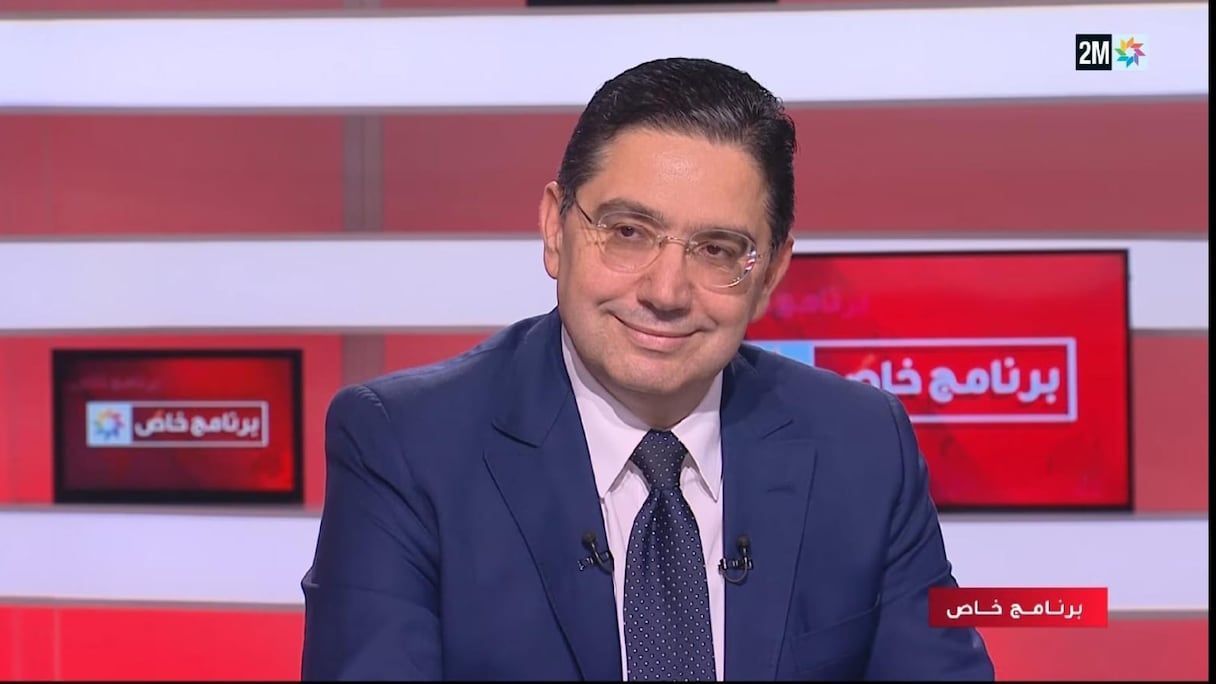
Foreign Affairs, African Cooperation and Moroccan Expatriates Minister Nasser Bourita spoke on Saturday, October 31, during a special program broadcast on 2M. He discussed the end of MINURSO’s mandate.
“From managing the situation to changing it”
Bourita placed the announcement within the framework of the royal doctrine on the Sahara. “Let us recall what His Majesty the King has repeatedly said about the Sahara issue in recent years: we must move from managing the situation to changing it,” he said.
The minister explained what this approach means in practice. “This is not just a slogan or a concept. It is a daily practice and a set of clear instructions,” he said. Management, he explained, means “having rules of the game and trying to achieve results within that framework.”
He noted that these rules date back to another era, as the conflict has lasted nearly five decades. “Change means that, before getting to work, we must first ask whether these rules are still valid, whether they are moving things in the right direction or whether they are actually creating the problem,” he said.
Read also : Russia’s veto, or the unintended favor it did Morocco
A resolution that had to be “decisive”
The principle was clear: this year’s resolution had to settle the matter. “The clear principle was that this year’s resolution had to be decisive. Decisive in the sense that it would build on Resolution 2797 and clearly define all the parameters the United Nations would work with: What is the basis for negotiations? What is the outcome of those negotiations? Who should be involved? What is the humanitarian situation in Tindouf? It had to be clear, without the slightest ambiguity. That was our starting point, and that was the basis on which we worked,” he said.
The minister said Morocco had known for some time that Russia might oppose the draft. Rabat was then faced with a choice. “Should we see this as a threat, manage it, weaken the resolution and give Russia what it wants so that the resolution can pass? Or should we say that this may be an opportunity to review the rules of the game, those of the Security Council and of MINURSO?” he asked.
He warned against trying to deal with every disagreement one by one. “Should we say, ‘Remove this word,’ ‘Add that word,’ ‘Weaken this,’ ‘Reduce that’?” he said.
Morocco chose the other path. “Perhaps what Russia wants to do is not a threat but an opportunity to review some of the rules of the game that have prevented the process from reaching its conclusion,” he explained.
In his view, the resolution was decisive in changing the rules of the game, rather than in the wording of the text, where a comma could be removed or a sentence added. “So this was not a surprise,” he said.
No going back
Asked whether this development represented a setback, Bourita rejected that interpretation. The first reason, he said, was the momentum built up over recent years. “It is irreversible. There is support from the major powers that are members of the Security Council, and we saw how 11 countries voted in favor, including three permanent members,” he said. He added that the momentum in Africa, the Arab world and Europe was also irreversible.
The second reason, he explained, was that the circumstances in which MINURSO had been created no longer existed. “There was a context that no longer exists today. We have not gone back 35 years. We have turned the page,” he said.
The minister also described how discussions on the resolution had unfolded. “Discussions on the resolution began three weeks ago. Everyone understood that UN resolutions are not essays; they are messages. If we want to send a message, it must be clear. Adding words creates ambiguity, and the current momentum no longer allows for that,” he said.
According to Bourita, the aim was to produce a clear text that would remove certain elements inherited from the past, “including MINURSO’s very name and the future of the political process.” He welcomed the fact that this approach had found support among Security Council members, “including European, Arab and African countries.”
Read also : MINURSO is not the first UN mission to be shown the door
Russia’s veto and Moscow’s strategy
The minister explained how he viewed Moscow’s position. “As part of Russia’s strategy, it wanted to put forward a technical resolution. But the response was: ‘No, you want to keep things at a standstill,’” he said.
He described the U.S. veto of the Russian draft as a choice between two approaches. “Do we want momentum toward a solution based on autonomy under Moroccan sovereignty, or do we want to use the old rules to maintain the status quo?” he asked.
Bourita declined to dwell on Moscow’s motives. “We can look for them in the international geopolitical context and in regional balances (...) But what matters today is that this gave us an opportunity and opened the way to correct important aspects of the rules of the game inherited from an outdated period,” he said.
He also said Morocco had made no attempt to persuade Moscow to change its position. “We did not waste our time. We did not even try to convince them. I met Lavrov on the instructions of His Majesty. We understood the situation and asked ourselves: why insist?” he said.
The minister placed responsibility for the mission’s end on Moscow. “Not adopting a decision means that MINURSO no longer has a mandate. This means that the one who cast the veto is the one who brought the mission to an end,” he said.
He also pointed to what he called “a strange coincidence.” Of the roughly 16 United Nations peacekeeping missions, he said, only one is headed by Russia: MINURSO, “the very mission it brought to an end.”
Bourita also stressed that “Morocco was not the one that chose the veto.” He said the Kingdom had built its strategy “on the assumption that there would be a double veto, leading to the absence of a mission... and that each party would have to assume its responsibility.”
Read also : Sahara: Despite Russian veto, US draft reveals growing support for Morocco’s autonomy plan
MINURSO, an “anachronism”
Bourita went on to explain why, in his view, the mission had become unnecessary. He began with its name. “The ‘R’ no longer makes any sense today,” he said, referring to the word “Referendum” in MINURSO’s name.
He cited Staffan de Mistura, who said in his latest briefing that the United Nations was unable to organize such a referendum. “Since 2000, there has been no one within MINURSO working on this issue. For two decades, the mission has had no component dedicated to this matter,” he said.
The minister described what he saw as a clash between two realities. “There is momentum toward autonomy and the strengthening of Moroccan sovereignty, yet we continue to write the name MINURSO every day, with its ‘R’ for referendum still there. This is the first anachronism: the incompatibility between a reality and rules inherited from another era,” he said.
Bourita then recalled the role of a peacekeeping mission. “It is a mechanism that compares a commitment with actual practice and behavior. It is there to say: ‘This side violated the agreement,’ or ‘This side did not violate it,’” he explained.
But since the events in El Guerguerat in 2020, he said, “the Polisario, with Algeria’s support, has said it is no longer committed to the ceasefire.” He added that the Polisario had repeatedly informed the UN secretary-general of this position in writing.
“For six years, MINURSO has no longer had this role. As an observer of the ceasefire, what am I supposed to observe if the ceasefire no longer exists because one side has unilaterally withdrawn from it?” he asked.
He also provided figures on the mission’s presence. “How many people are there in this mission monitoring the other side? Forty-three people, spread across six centers, an average of five or six people per center. They do not go out at night, and they are not given the means to move around. This has become part of the status quo, not part of the solution,” he said.
Those 43 personnel are stationed east of the berm, out of a total of 157, he added. “The rest are on our side, just behind the berm, in Laayoune,” he said.
According to Bourita, the Polisario told these observers six years ago that it no longer respected the ceasefire. He said the clashes that have taken place since then had changed nothing. The mission, he added, “was not a deterrent.”
He also accused some parties of using the mission for their own purposes. “A group of people used MINURSO as cover to hide behind. We have seen that some people have already started crying now, the separatists who are there. They say MINURSO must stay. So it was being used as cover,” he said.
What changes on the ground
The minister outlined the practical consequences of the end of the mission’s mandate. “The non-renewal of MINURSO’s mandate clearly means that the mission’s presence in the Kingdom’s southern provinces, particularly through its teams, vehicles, equipment and symbols, must come to an end in the coming days,” he said.
He referred to the departure of personnel and the removal of equipment and symbols. “There are MINURSO symbols, there is the United Nations flag, and these will be taken down. This will bring about a major change on the ground,” he said.
He used a simple example to explain the change. “When you go to Laayoune, you will no longer see those vehicles bearing the UN logo. Just as you do not see them in Rabat or Casablanca, you will no longer see them in Laayoune,” he said.
He added that the authorities would no longer be required to report certain operations to MINURSO’s military team leader.
A technical process will now begin, he announced. It will involve the Security Council and the UN Department of Peace Operations. Morocco will also discuss the matter with the UN Secretariat.
The end of the signs that make the issue international
Bourita explained what gives the Sahara issue its international dimension. He identified three elements: “First, MINURSO. Second, the Security Council meetings, at least twice a year. Third, the camps.”
He said he was looking at the issue in terms of images, as a journalist would when seeking to illustrate the Sahara file.
“What happened yesterday, as confirmed by the Royal Cabinet statement, is a change in the first two of these three images,” he said.
He linked this development to the King’s speech last year. “The path toward closing the file has begun. The clock is ticking toward closing the file and putting an end to its international character,” he said.
Bourita recalled that the UN Charter gives the Security Council responsibility for maintaining international peace and security. The Sahara file was on the Council’s regular agenda, with two meetings each year to renew the mission’s mandate or hear the secretary-general’s report.
“That will no longer be the case. There will be no more briefings or reports,” he said.
He stressed the significance of this change. “We will not meet on October 30 because there will be no decision. That is also a major change. That sword will no longer hang over us. Countries made extensive use of that deadline,” he said.
In his view, the impact of the end of the mandate on the rules of the game could be just as significant as the resolution itself.
An exemplary withdrawal
The minister said Morocco would manage the mission’s departure responsibly.
“Morocco is a responsible country. His Majesty’s diplomacy is based on moderation and wisdom. Morocco believes in peacekeeping and has its own soldiers serving in the Democratic Republic of the Congo and the Central African Republic. It respects peacekeeping operations and the people who work in them,” he said.
He announced that the Kingdom would provide the time, resources and logistical support needed for the withdrawal. “This will be an exemplary operation. It will not be an expulsion,” he said.
He described Morocco as “a country of peace, a country of responsibility, an honorable Kingdom.” Regarding the timetable, he said MINURSO’s mission would end after midnight.
The ceasefire remains in place
Bourita stressed that Morocco’s commitment to the ceasefire remained unchanged, referring to the Royal Cabinet statement.
“Morocco remains committed to the ceasefire and to respecting it. This is important because the ceasefire is a political and legal commitment. A UN mission is only a mechanism for monitoring it,” he said.
“The departure of the mission does not mean the end of the ceasefire,” he insisted. He recalled that the parties’ political, legal and diplomatic commitment to the ceasefire dates back to September 6, 1991.
The minister said Morocco’s relationship with the United Nations remained strong. “The Kingdom still considers the United Nations an umbrella within a defined framework. But there are also other forums and there may be other initiatives,” he said.
He also left the door open to continuing the process under new conditions. “Staffan de Mistura is welcome under new rules. If those rules are not sufficient, Morocco is free to choose the path and the framework it wants,” he said.
Another institution he addressed was the UN General Assembly’s Fourth Committee. “It has no veto power. The side that has support gets the resolution. Today, the international reality and the trend are clear. There is strong support for a path based on autonomy that respects Moroccan sovereignty. These national positions taken by countries must be reflected in the Fourth Committee,” he argued.
Tindouf and refugee status
Bourita also addressed the situation in the camps. “The situation in the camps today raises questions for everyone. Tindouf is the oldest refugee camp administered by the United Nations High Commissioner for Refugees. It has been there for 50 years,” he said.
He criticized the length of time people had remained in refugee status. “Refugee status is temporary and exceptional. Someone who is born a refugee and dies a refugee — that is what the Algerians have imposed on the people of Tindouf,” he said.
The minister suggested that Algeria was directly responsible for the deadlock. “Yesterday, 11 countries said where we want to go. Only one side, and the country that pushed it, have a problem. That state, which pushed Russia to use its veto or benefited from it, is responsible for MINURSO’s departure. It is responsible for the Security Council no longer holding its regular meetings. It is responsible if the political process comes to a halt until its parameters are clearly defined,” he said.
He concluded that “Morocco is in a win-win situation.”
The autonomy plan remains the reference point
Bourita reaffirmed the central role of the autonomy plan. “The autonomy plan initiated by His Majesty the King and Morocco’s active forces, through the consultation process launched in 2007, remains the reference for states and for a solution at the international level. It is a proposal on the table, a final proposal,” he said.
He added, however, that the plan requires interlocutors and a framework for negotiations. This, he said, was why the Royal Cabinet statement referred to suspending the process until its parameters had been defined.
“Are we going back to 1991? His Majesty the King’s vision is one of change: changing parameters that no longer fit the current reality. There are many of them, because this file has evolved over time like a mille-feuille of contradictions. Today, the time has come for clarity,” he said.
Bourita also recalled the work carried out over the years under the King’s leadership. He cited the positions taken by the United States in 2020, Spain in 2022 and France in 2024, as well as those of Germany and the United Kingdom. He also mentioned African, European, Asian and Arab countries.
“The gains are there and will continue, because that is the daily reality of the Sahara file. Countries express positions and turn them into action. There are investors, consulates opening and visits taking place,” he said.
In his view, Resolution 2797 completed this process. “It came to confirm the momentum that already existed among countries,” he said.
He argued that the major powers that had followed the issue from the beginning, namely France, Spain and the United States, had taken a position and would continue in the same direction.
“The diplomatic momentum launched by His Majesty the King will continue, through recognition of sovereignty, support for autonomy and foreign investment,” he said, adding that “international relations are relations between states.”
He then turned to the situation on the ground. “Morocco is at home in its Sahara. International support exists,” he said.
Bourita recalled the development drive in the southern provinces, including major projects, infrastructure and efforts to attract investment. He urged people to look at what was happening on the ground rather than focusing on written texts.
“Texts can be reversed. They can change. Reality does not change. Let us not look at what is written in the texts. Let us look at what is happening on the ground today,” he said.
Algeria’s reaction
Bourita pointed to what he described as several contradictions in Algeria’s position.
“Algeria was on the Security Council, and I remember that it did not vote in favor of Resolution 2797. It is therefore strange to see a state that does not support a resolution and then goes on to defend it,” he said.
The minister added that Algeria knew what the consequences would be of a resolution that did not renew MINURSO’s mandate. According to him, Algiers was now expressing regret over those consequences.
He also addressed the Algerian press. For the head of Moroccan diplomacy, “this is the time for seriousness, not maneuvering.” Neither the regional nor the international context, he concluded, called for maneuvering on these issues.
