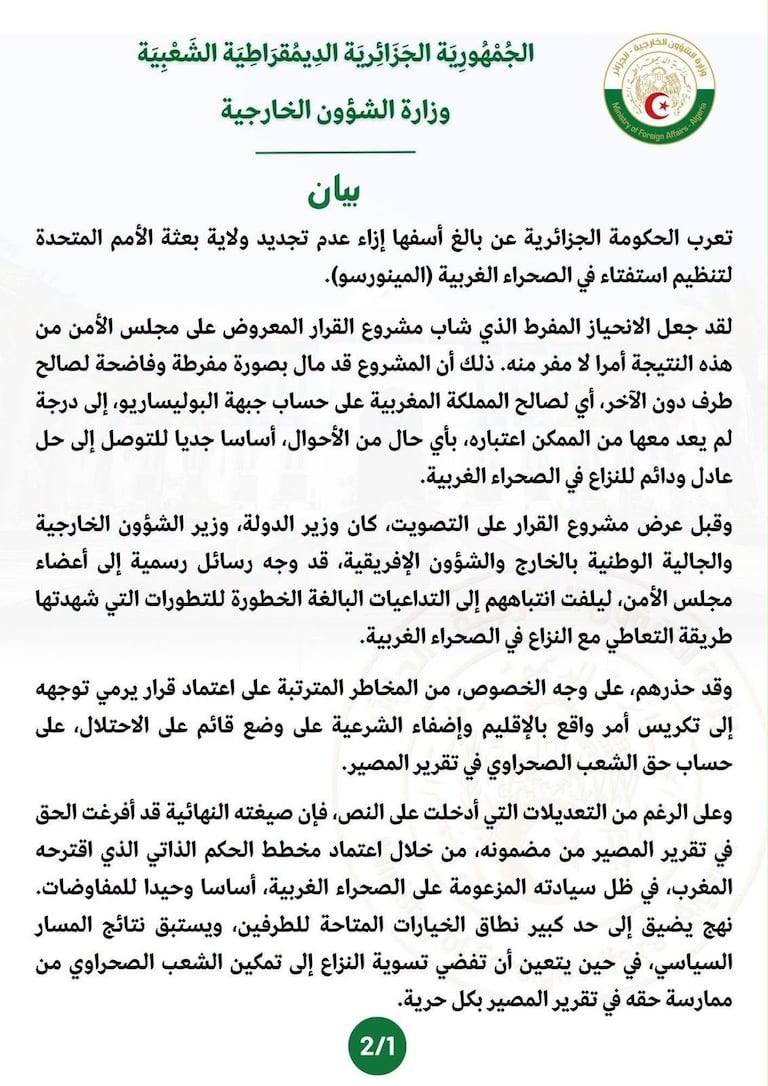
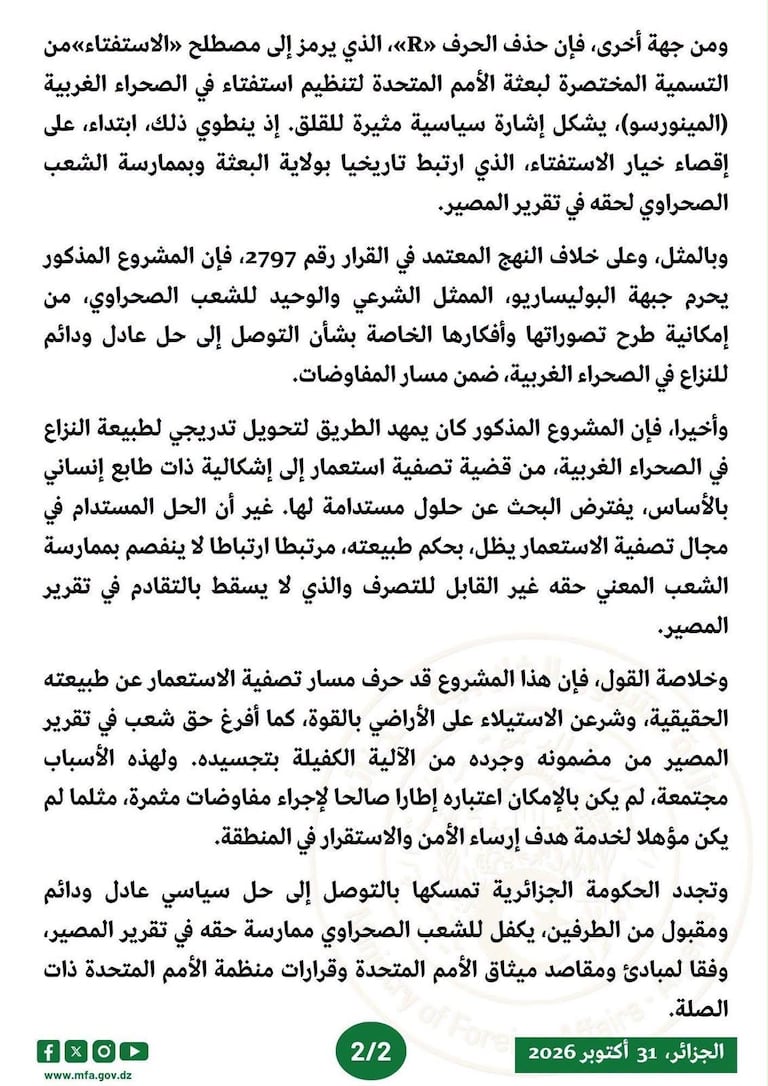
Dated October 31 and issued in Algiers, the two-page statement opens with a sentence that the Algerian press had avoided writing: “The Algerian government expresses its deep regret over the non-renewal of the mandate of the United Nations Mission for the Organization of a Referendum in Western Sahara.” Just a day earlier, some Algerian newspapers had described the vote as a “monumental setback” for Washington and a “historic precedent.” The Foreign Ministry, by contrast, acknowledged a loss.
The statement is quick to identify the culprit. It says the “excessive bias” in the US draft resolution “made this outcome inevitable.” According to Algiers, the text leaned “excessively and flagrantly” in Morocco’s favor, “at the expense of the Polisario Front,” to the point that it could no longer serve as “a serious basis” for a solution. The statement adds that Algerian Foreign Minister Ahmed Attaf had sent official letters to Security Council members before the vote, warning them that the draft sought to “consolidate a fait accompli” and “legitimize a situation based on occupation.”
The argument, however, deserves to be followed through to its conclusion. If the US draft was so flawed that its failure was “inevitable,” someone still had to make it fail. The Security Council did not reject it: eleven of its 15 members supported the text, according to the UN’s official account of the vote. It was Russia’s veto that brought it down. Yet the Algerian statement mentions neither Russia nor its veto, nor the alternative draft Moscow subsequently put forward, which received only three votes. Ahmed Attaf’s letters to all 15 Council members therefore persuaded only one elected member, Somalia. The statement says nothing about that either.
This silence is no oversight. It allows Algiers to lament MINURSO’s end without explaining how it happened. Algerian diplomacy had stepped up its efforts to secure Moscow’s support in the weeks leading up to the vote. It obtained the veto it had sought. But that veto produced precisely the outcome Algeria now says it regrets: without a resolution, the mission has no mandate. The statement thus attributes to Washington an outcome made possible by Russia’s vote.
This diplomatic campaign also makes clear, if further proof were needed, who the real party to the conflict is. For 50 years, Algiers has presented itself as a mere “neighboring country” committed to the right of peoples to self-determination. But who wrote to each of the 15 Security Council members before the vote? Algeria’s foreign minister. Who went to Moscow to seek a Russian veto, even sending the prime minister there on the eve of the vote? The Algerian government. Who spoke on behalf of the Sahrawis before the Council? Algeria’s ambassador. And who issued the official statement the following day drawing conclusions from the vote? Algeria’s Foreign Ministry. The Polisario, for its part, had only to offer its thanks. In this sequence of events, Algiers devised the strategy, negotiated and delivered the commentary. The Polisario followed. That is the very definition of a proxy.
The grievances set out in the statement reveal much about what Algeria is actually concerned about. The ministry describes the removal of the letter “R” for “referendum” from the mission’s name as “a worrying political signal” that would amount to ruling out the referendum option. It accuses the US text of denying the Polisario, which it calls the “sole legitimate representative of the Sahrawi people,” the opportunity to put forward its own ideas. Above all, it argues that the draft seeks to gradually transform the conflict “from a decolonization issue into a problem that is essentially humanitarian in nature.” This is a clear reference to the draft’s call for the UN refugee agency, UNHCR, to register the populations in the Tindouf camps, an operation Algeria has refused to allow for decades.
Read also : Sahara: Moroccan Parliament schedules extraordinary session after UN Security Council meeting
The paradox is complete. The Algerian government feared a text that would make autonomy the sole basis for negotiations. Yet Security Council Resolution 2797, adopted in October 2025 and already placing autonomy at the center of a settlement, remains in force. No veto has overturned it. The Algerian statement concludes that the US draft “was not fit to serve the objective of establishing security and stability in the region.” The mission Algeria wanted to preserve, meanwhile, no longer exists.
The statement ends with a declaration of principle: the Algerian government “reaffirms its commitment” to a “just, lasting and mutually acceptable” political solution that guarantees the self-determination of the Sahrawi people. It speaks of a solution “acceptable to both parties,” Morocco and the Polisario, as though Algeria itself were not one of them. The statement only undermines that fiction. It was a state, not a movement, that campaigned among Security Council members, sought the support of a major power and issued its assessment of the vote. Resolution 2797 also explicitly included Algeria in the process. The Polisario, for its part, thanked Russia. Algiers thanked no one.
Regrets serve little purpose now. Algeria fought to prevent the “R” for referendum from disappearing from MINURSO’s name. It achieved considerably more than that: by pursuing a Russian veto, it actively helped erase every letter of the mission.
