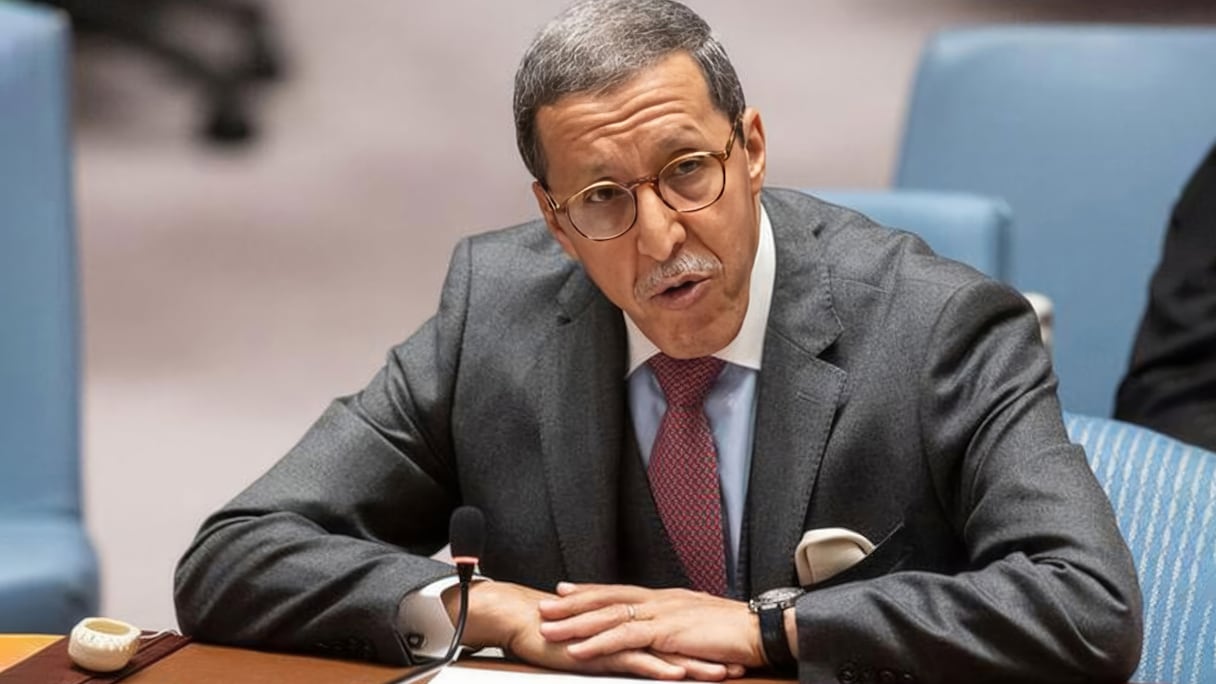
Omar Hilale had not planned to speak at Friday’s Security Council proceedings on the Sahara resolution. But after his Algerian counterpart, Amar Bendjama, addressed the Council, the Moroccan ambassador decided to respond.
“I wasn’t prepared to speak, nor had I intended to, for one simple reason. For years, this resolution was adopted without either of the two parties, Morocco and Algeria, being present. Today, that tradition has been broken. But I’m very grateful to my brother, the Algerian ambassador, for deciding to speak,” he said.
For Hilale, the intervention presented an opportunity he could not pass up. “Because at least here, before the Security Council, the whole world will know who is responsible. Above all, it will see Algeria’s claim that it is not a party, has no interest in the matter, is not concerned and is merely an observer for what it is,” he added.
Read also : Sahara: Three votes out of 15 reveal the true extent of Algeria’s support at the UN
Hilale then challenged his Algerian counterpart’s standing to address the Council in such terms. “I’d like to ask you, Mr. Ambassador: In what capacity are you doing this? Are you here to lecture the Security Council? To preach to its members?” he asked.
He pressed on, listing the subjects on which Algeria purported to speak with authority. “You talk about international law? Self-determination? The humanitarian situation? What rights are you talking about? The United Nations has 193 members,” he said.
Hilale then pointed to what he saw as the contradiction at the heart of Algeria’s position. “And only one of them takes it upon itself to intervene, take sides, call for a vote against a resolution, steer the debate and sometimes play the victim or speak on behalf of others,” he said.
“A full-blown indictment”
In Hilale’s view, the Algerian ambassador had not come to defend his country’s position. He had come to put others on trial. “Allow me, Madam President, to respond to some of the points raised by my brother, the Algerian ambassador. His intervention was a full-blown indictment,” he said.
He then spelled out who was in the dock. “It wasn’t a defense of their position. It was an indictment of the Security Council, of the country that drafted the resolution and of those who chose to support it. He gives the impression that Algeria alone has the law on its side and that anyone who opposes Algeria or takes a different position is acting outside the law,” he said.
Hilale was unsparing in his assessment. “Mr. Ambassador, the international community has had enough of your lectures on history and law. Quite simply, your speech is pompous, but it has no legal substance,” he declared.
He then turned to Algeria’s most uncomfortable subject: the Tindouf camps. “And I’ll show you why. You talk about international law and respect for humanitarian law. For 50 years, the UN refugee agency has been asking for the people living in the Tindouf camps to be registered,” he said.
The ambassador went on to describe a situation without parallel anywhere in the world, “where the host country has formally refused, in writing, to allow that registration. Why? Because those camps are home to Malian refugees, Nigerien refugees and Algerians.”
Hilale countered Algeria’s resistance with an offer: let the registration take place, and Morocco would accept the results. “And we say—and I repeat it here before this esteemed Council—let the UN refugee agency register and identify these people. If the figure turns out to be one million, Morocco will accept it,” he said.
He then challenged Algeria’s claim to be defending refugees. “You cannot claim to defend people you call refugees while at the same time preventing them from being recognized as refugees and properly identified by the UN refugee agency,” he said.
Read also : After Russia’s veto, four scenarios for the Sahara—and none brings back the referendum Algiers wants
Hilale invoked the 1951 Refugee Convention, which Algeria itself frequently cites. “You spoke about protection. You cited the 1951 Convention. That Convention obliges you, as the host country, to allow the UN refugee agency to do its work,” he reminded Bendjama.
“Protection doesn’t fall from the sky. International protection comes with rules. And the first requirement is registration and identification. Not for some political purpose, but to establish how many children, how many women and how many young people there are, so that international humanitarian aid can be properly assessed,” he explained.
For Hilale, Algeria’s continued refusal to allow registration had immediate consequences. “Yet even that isn’t being done. You’re depriving these people of protection, while lecturing us about refugees’ rights,” he said.
“The Tindouf camps, ladies and gentlemen ambassadors, are the only refugee camps in the world where the host country has surrendered its sovereignty and authority and handed them over to an armed separatist group,” he charged.
“Inside the camps, there is no Algerian authority. There is no state sovereignty. And that is simply to allow the Polisario to do as it pleases: recruit people, put children through military exercises and send them out to carry out military harassment,” he said.
Hilale contrasted Algeria’s stated concern for refugees with conditions inside the camps. “So, Mr. Ambassador, you cannot claim to be the refugees’ advocate or defender while denying them their most basic rights. And there’s more. Refugees in the Tindouf camps cannot leave,” he said.
He went on to describe the restrictions he said they faced. “They have no freedom of movement. They cannot settle elsewhere. They cannot return to the Moroccan Sahara,” he insisted.
Fifty years of stalemate: Hilale challenges Algiers
“And yet Morocco has been calling for years, if not decades, for anyone who wishes to return to be allowed to do so, with international guarantees and the assistance of the UN refugee agency,” he recalled.
Hilale then accused Algeria of blocking their return, calling its position an anomaly in international practice. “They cannot return because Algeria says they may do so only once a political solution has been reached. Once again, it is the only country hosting refugees that prevents them from going home,” he said.
He then turned to the question of what Algeria was offering instead of the status quo. “And at the same time, they come here and tell us that autonomy cannot be the political solution. That negotiations cannot deliver a political solution. Well, what can?” he asked. He went on to condemn what he described as half a century of paralysis. “You want the status quo? It’s already been 50 years. You admitted that yourself, Mr. Ambassador, my dear brother,” he said.
Hilale then offered what he considered the obvious alternative. “I agree with you. Let them return to Morocco. Let them return to the Sahara. Let them go to Spain, Europe or elsewhere in Africa. But don’t deny them that freedom,” he said.
Continuing his argument, the Moroccan ambassador cited UN figures raised by the American delegation. “US Ambassador Waltz spoke about food conditions in the camps, citing statistics—not American statistics, but United Nations figures—that worry us and sadden us,” he said.
He then took aim at Algeria’s military priorities. “The Polisario is well supplied with weapons, but there isn’t enough food, there aren’t enough classrooms, and there isn’t enough housing to shelter people from the desert heat, the rain or the winter cold,” he said.
“One final point. You made a shameful comparison. And you used the word shameful yourself. So let’s compare the Moroccan Sahara with Palestine,” he said.
He also drew a contrast between the right to demonstrate in the two countries. “At least in Morocco, there are demonstrations in support of the Palestinian people every week. In Algeria, those demonstrations are banned,” he said.
Hilale then turned the Algerian ambassador’s criticism back on him. “You come here, Mr. Ambassador, to lecture us about Palestine, yet you forget to allow your own people to speak out,” he said pointedly.
He went on to acknowledge the efforts of those working behind the scenes. “As I was saying, comparing Palestine with the Sahara is shameful. Who has sent humanitarian aid? Who has sent field hospitals? Who is working towards a peaceful settlement and negotiations? Who is bringing the different sides closer together?” he asked.
He contrasted those efforts with what he portrayed as empty rhetoric. “Not those who make speeches about Palestine, but those who work quietly, respectfully, behind the scenes,” he said.
Addressing Bendjama directly, Hilale returned to the basic principle of refugee protection: displacement should not become permanent. “The point about refugees, my brother from Algeria, is that no refugee camp, no refugee situation, is meant to last forever. The aim is that one day, women and children can return to their families or their villages,” he said.
“And that is what the negotiations are intended to achieve: allowing these people to return home rather than remain hostages to Algeria’s political agenda and to an armed separatist group with links to international terrorism,” he charged.
Hilale ended by thanking the United States for drafting the resolution and the countries that had supported it. “I will conclude, Madam President, by thanking the United States, which drafted the resolution. I also want to thank every country that voted for it. This text was the product of hours upon hours of negotiations,” he said.
“Morocco made enormous concessions to reach a text we had hoped everyone could accept. Unfortunately, that was not the case,” he concluded.
