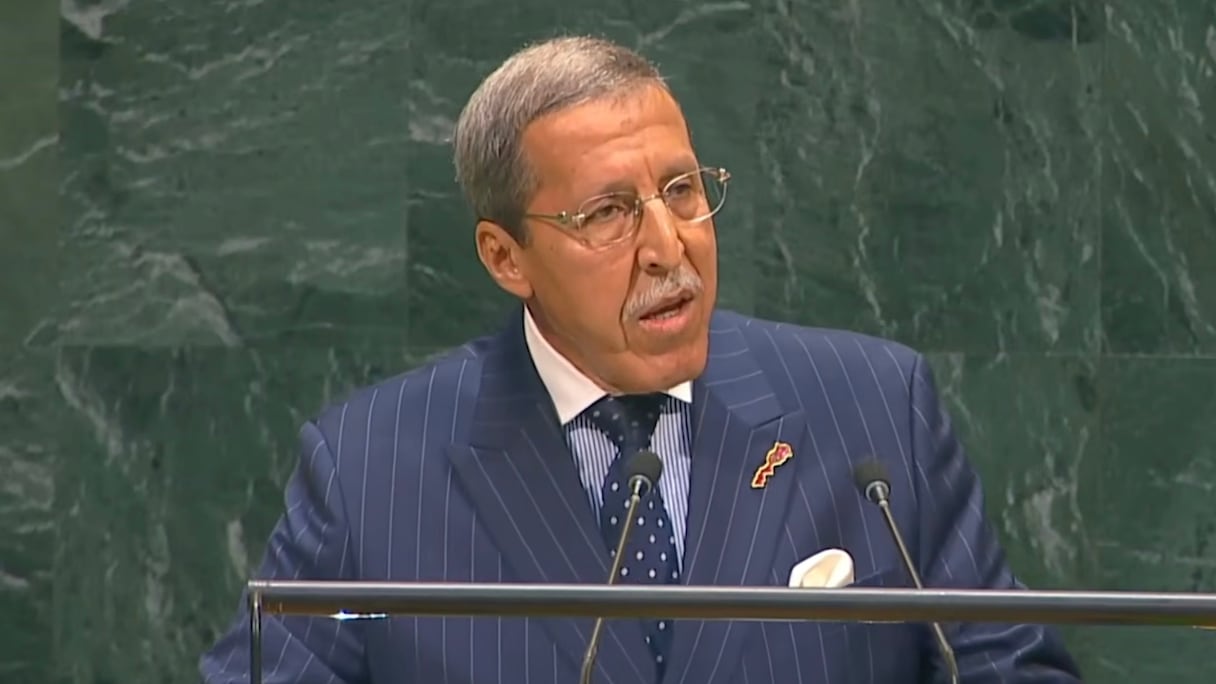
The United Nations General Assembly met on Tuesday, November 10, to debate the Russian veto that deprived MINURSO of its mandate on October 30. As Le360 previously explained, the session will have no legal effect. MINURSO will not be resurrected, and its dismantling will continue.
Yet the very convening of the meeting amounts to a rebuke. If all 193 member states were summoned, it was because a single permanent member had blocked a text supported by eleven of the Security Council’s fifteen members. The mechanism was created precisely for this purpose: to make clear that a veto is not the international community’s final word, but an exception whose use must be justified. On November 10, those who sought the veto had to explain their position publicly before an international community that had already made its own position clear.
Read also : Sahara: Omar Hilale tears apart Algeria’s case at UN Security Council
It was against this backdrop that Omar Hilale, Morocco’s Ambassador and Permanent Representative to the United Nations, took the floor, opening his address with what he called a “preliminary question”: “Why are we here? Certainly, we are here because, on October 30, a veto was cast against a landmark resolution that would have paved the way for the definitive settlement of the regional dispute over the Moroccan Sahara on the basis of the autonomy initiative under Moroccan sovereignty,” he declared.
For the diplomat, the blocked text nevertheless had an impact. “Despite this veto, the political significance of this resolution resonated beyond the Security Council. And the eleven countries that supported it sent a loud and clear message to the international community,” he stressed, before summing up that message: “The status quo and the deadlock have become unacceptable. Quite simply because a political solution is within reach.”
The ambassador then chose not to revisit the substance of the text itself. “I will not dwell on the resolution, particularly the prospects that this vetoed resolution would have opened up. Quite simply because Ambassador Mike Waltz has just explained them to you in detail, including all the measures whose implementation was prevented by this veto,” he said.
“The veto is not the cause of the deadlock; it is its consequence”
There was, however, no question of indulging in lamentation. “Morocco has not come before you this morning to criticize or lament a veto but to reaffirm an immutable historical reality,” Omar Hilale declared. He continued: “The Sahara was Moroccan before October 30. The Sahara is even more Moroccan after October 30, and the Sahara will remain Moroccan until the end of time.”
What remained was to identify the source of the impasse. “The veto is not the cause of the deadlock or the current impasse. It is its consequence,” the diplomat stated unequivocally, citing a Moroccan proverb: “The causes are many, but the root cause is one.” He then named that cause: “The political stance of a neighboring country, Algeria.”
In his view, the sheer duration of the dispute speaks volumes. “When an impasse lasts more than 50 years, it is no accident. It is a strategic choice. It is a political decision,” he declared, adding: “It is a refusal to resolve a problem. So this deadlock has its underlying forces, its actors and its address.”
Read also : Sahara: Three votes out of 15 reveal the true extent of Algeria’s support at the UN
The ambassador then laid out the structure of his indictment: “Six questions and answers that will leave no ambiguity about Algeria’s primary responsibility for perpetuating this regional dispute, but above all for perpetuating the humanitarian tragedy in the Tindouf camps, where 30,000 of our Sahrawi brothers and sisters have suffered for half a century.”
The first question went to the heart of Morocco’s proposal: why does Algeria fear autonomy under Moroccan sovereignty? “Morocco has put forward a developed and detailed autonomy plan as the sole and exclusive basis for settling this dispute under the Kingdom’s sovereignty. Whether they like it or not, this is the status that the parties, Algeria and the Polisario, discussed in detail in Washington, in Madrid and again in Washington,” the ambassador recalled.
The diplomat was keen to specify just how far those discussions had progressed. “Every element of this status was discussed, documents were prepared. Understandings were reached—I would not say agreements were concluded, but there were areas of convergence,” he explained, revealing in the process that “Algeria even proposed settling the DDR issue through a bilateral agreement with the United Nations.”
Algiers: “Observer” or party to the dispute?
Omar Hilale then turned to etymology. “Autonomy and self-determination share a common root, “auto,” from Latin, meaning “oneself.” To determine one’s own future, manage oneself, govern oneself, and administer oneself,” he explained. “And that is what this autonomy status has offered and continues to offer. Autonomy is self-determination in action,” he concluded on this point.
The second question was why Algeria refuses to acknowledge its status as a party to the dispute. “Quite simply because doing so would mean recognizing that the key to the deadlock lies in Algiers. An observer, as Algeria claims to be, does not propose partitioning a territory in disregard of the very populations it claims to defend,” Morocco’s representative replied.
He continued in the same vein, returning to the Security Council meeting. “An observer does not break a 35-year-old rule by forcing its way into the Security Council meeting on October 30, 2026, to witness the veto and present its position. An observer does not threaten Security Council member states with withdrawing from the political process if they vote in favor of the resolution drafted by the American penholder,” he declared.
Nor was the Polisario spared. “Everything it possesses is provided to it: the Tindouf camps on Algerian soil, under the sovereignty of a sovereign state, weapons, financial resources, campaigning and diplomatic support,” Omar Hilale listed.
The diplomat also pointed to a discrepancy between the movement’s public statements and its conduct at the negotiating table. “When the Polisario says no in the press, it does not say no during the sessions we attended in Washington and Madrid. When the Polisario says no, it is Algiers speaking,” he observed, before summing up: “Algiers does not observe this dispute. Algiers orchestrates it.”
Then came the third question, concerning the very acronym of the UN mission: why does Algeria cling to the “R” in MINURSO? “Because that R is the last alibi for the status quo. And I thank Ambassador Mike Waltz for detailing all the developments that led, in practice, to the abandonment of the R, by successive Secretaries-General, Personal Envoys and Security Council resolutions alike,” the ambassador declared.
Tindouf: “A refugee who is not counted is a refugee who does not count”
To support his argument, Omar Hilale drew on the UN’s history of handling the dispute. “I would like to recall that, as early as 2000, former Secretary-General Kofi Annan had acknowledged the referendum’s deadlock. The Security Council removed it from the language of its resolutions, which have not invoked it for two decades,” he recalled.
Hence his pointed formulation: “That R, the famous R for referendum, no longer stands for referendum. It stands for refusal to reach a definitive settlement of this dispute,” he declared.
The fourth question shifted the debate to humanitarian concerns: why has Algeria opposed registering the populations of the Tindouf camps for half a century? “Quite simply because counting means being held to account for figures that nobody in the world has known for 50 years. Even UNHCR does not know how many people are there, nor do the other UN agencies,” the diplomat replied.
Being held to account, he specified, also meant answering “for the diversion of humanitarian aid, confirmed by a report from the UN High Commissioner for Refugees as well as by the European Union’s OLAF.” And also “for violations of the most basic human rights, further confirmed by the closure of the camps and the refusal to allow special procedures mandate holders and human rights committees to visit them,” he added.
Hence his memorable pronouncement: “A refugee who is not counted is a refugee who does not count,” Omar Hilale insisted.
The fifth question followed directly from the previous one: why does Algeria reject durable solutions? “Quite simply because Algeria fears the camps will empty as refugees voluntarily choose to leave,” the ambassador suggested.
He outlined the three options available to the populations concerned: “Either return to the motherland, Morocco; or integrate locally—I do not think Algeria will allow them to integrate; or choose a third country as another destination.”
The diplomat then emphasized how long the situation had endured. “No refugee situation is meant to last indefinitely, unless it becomes a form of diplomatic commerce. Four generations have been born under the tents and scorching heat of Tindouf,” he lamented. “They were born refugees, they are living as refugees today, and they risk dying as refugees in the Tindouf camps,” he continued.
His assessment grew harsher still. “This is a humanitarian tragedy that has lasted half a century, for which Algeria bears political responsibility. Everywhere else in the world, a camp is merely a place of transit. In Tindouf, it has become a hostage situation,” Omar Hilale charged.
The sixth and final question concerned representation: why does Algeria fear extending the Personal Envoy’s consultations to Sahrawis in the Southern Provinces, the Sahrawi diaspora and those excluded from representation in the Tindouf camps? “Quite simply because such consultations would put an end to the monopolization of the representation—of the right to represent the people of the Sahara—by an armed separatist group,” he replied.
“In the Southern Provinces, Sahrawis vote regularly, in every election, and freely make their own sociopolitical choices. In Tindouf, others decide for them,” the Permanent Representative argued.
At the end of this series of questions, the ambassador returned to his starting point. The answer to the question “Why are we here?” could, he said, be summed up in “four truths”. The first: “A veto can bring a mandate to an end, but it will change neither history nor Morocco’s sovereignty over its Sahara.”
The second truth brought the six questions back to a single common denominator. “Six questions, one answer. The developed and detailed autonomy plan under Moroccan sovereignty, presented and discussed in detail with the other parties in Washington and Madrid, remains the sole and exclusive solution for the definitive settlement of this regional dispute,” Omar Hilale affirmed.
The third concerned the true identity of the protagonists. “Two parties facing each other in Washington, Madrid and New York. Recently, at the Security Council, who was sitting on either side? Morocco and Algeria,” he pointed out, before adding: “Morocco, which assumes its responsibilities, and Algeria, which evades them.”
The fourth truth served as his final indictment. “The deadlock lies neither in Rabat, which has honoured all its commitments, nor here in New York, where every effort was made, particularly by the American penholder, right up to the last minute, even inside the Security Council chamber, one or two minutes before the Council meeting opened,” he explained. The outcome of those final attempts could be summed up in three words: “In vain. Niet. Nada.”
The diplomat concluded his address with a sentence that encapsulated his entire argument: “The deadlock lies in Algiers, which has, unfortunately, rejected everything — absolutely everything.”
