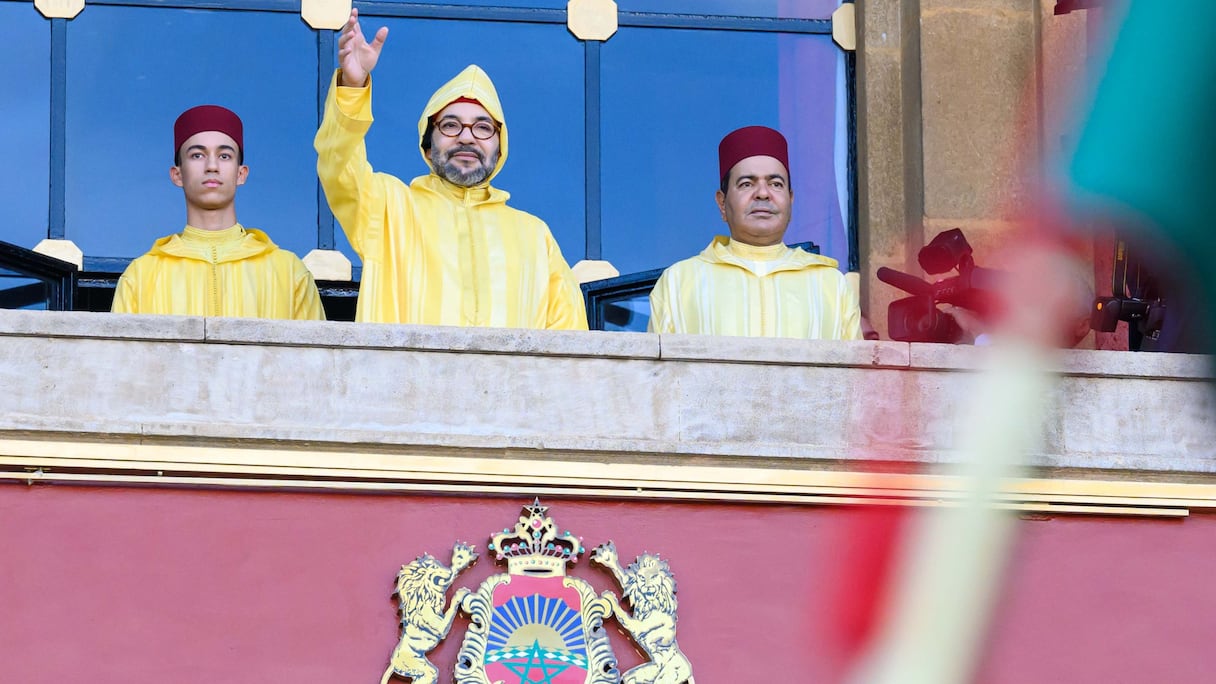
King Mohammed VI, accompanied by Crown Prince Moulay El Hassan, Prince Moulay Rachid and Prince Moulay Ahmed, chaired on Friday in Rabat the opening of the first session of the first legislative year of the 12th Legislature.
Addressing members of Parliament, the King presented a broad agenda for the coming legislative and governmental term, bringing together economic transformation, social inclusion, territorial development and Morocco’s international partnerships.
“I expect this new legislative and governmental term to be a real turning point in advancing Morocco’s ambition as a rising, dependable economic power, making sure we strike a balance between economic growth and greater social and territorial equity,” the King said.
The address placed particular emphasis on translating national development ambitions into tangible improvements in citizens’ lives, with stronger regional institutions, greater economic opportunities for young people and a more active role for the private sector.
It also set out Morocco’s approach to migration cooperation, particularly with Spain, and called for a new framework reflecting the Kingdom’s development priorities and its commitment to mutually beneficial partnerships.
A new phase of economic transformation
The King began by congratulating members of the House of Representatives on the confidence placed in them by voters, describing the opening of the new legislative term as an opportunity to build on the progress achieved across several sectors.
He situated the coming period within Morocco’s longer-term national development trajectory, recalling the country’s historical continuity, its institutional foundations and the diversity of its cultural identity.
“In 2014 I said the following from this podium: ‘As a Moroccan, nothing else is more valuable to me than the sense of belonging to this nation,’” the King recalled.
“That sentiment remains with me today. It is becoming stronger and more deeply rooted with the passing years.”
The King highlighted Morocco’s standing as one of the world’s oldest nations, united under a monarchy with deep historical roots. He also referred to the country’s religious identity, under the Commandership of the Faithful, and its distinctive cultural heritage, enriched by its diverse components.
These foundations, he indicated, form part of a broader sense of national responsibility.
“Pride in one’s homeland, in this case, is not about boasting or self-satisfaction; rather, it is the driving force that turns the sense of belonging into responsibility, and confidence into a national duty.”
The King also highlighted Morocco’s political, diplomatic, economic and social achievements, presenting them as a foundation for the next stage of development.
Against a backdrop of accelerating changes in the global economy, he called for continued reforms and major investment projects to strengthen the Kingdom’s productive capacity and economic resilience.
“Today, in addition to accelerating the implementation of planned infrastructure projects, we must launch a new generation of major strategies, particularly in the fields of water, energy, and food security, industrial takeoff, the digital economy, and artificial intelligence.”
The King also renewed his call to strengthen national strategic reserves and ensure reliable supplies of essential commodities.
“I reiterate my call to accelerate the development of the Kingdom’s capabilities in the field of strategic reserves and to secure the supply of basic commodities.”
Private sector called upon to play a greater role
Alongside public investment and national strategies, the King placed considerable emphasis on the contribution of private enterprise to Morocco’s economic transformation.
He called on businesses to expand their role in investment, innovation, employment and international trade, describing the private sector as an essential partner in the next stage of development.
“I urge our private sector to step up and become a strategic player in our country’s development transformation,” the King said. “I want it to show greater initiative and a keener innovative spirit, and to increase its capacity to create jobs, invest, and export.”
Youth opportunities at the center of public policy
Youth emerged as another central priority of the royal address, with the King calling for young people’s concerns to occupy a more prominent place in government policy and institutional decision-making.
He advocated a comprehensive approach bringing together education, skills development, employment and equal opportunity, with the aim of improving young people’s prospects for economic and social advancement.
“It is particularly important to make sure youth issues are at the forefront of public policies and of the agenda of governance bodies,” the King said.
“To this end, a comprehensive vision guaranteeing equal opportunities and encompassing education, skills development, and economic integration should be formulated.”
The approach outlined in the speech extends beyond employment alone. It links access to education and professional opportunities with young people’s confidence in public institutions and their ability to build stable and fulfilling lives.
“This approach aims to bolster young people’s confidence in the prospects for social advancement, in their nation’s institutions, as well as in the opportunities provided to build a better future—one that guarantees freedom, dignity, and stability.”
Faster decentralization and stronger regional governance
A substantial part of the speech focused on the implementation of advanced regionalization and administrative deconcentration, which the King presented as essential to improving public services and responding more effectively to local development needs.
He stressed that the next stage of development would depend not only on national strategies but also on the ability of local and regional institutions to identify challenges and deliver practical solutions.
“The real challenge for the coming period lies in fieldwork, at the local level, to identify the actual problems facing each region and come up with realistic solutions to them.”
The King linked this approach to integrated territorial development, productive investment and the quality of public services, underlining the importance of bringing decision-making closer to the communities concerned.
“Advancing integrated development, improving public services, and bolstering productive investment are inextricably linked to the process of advanced regionalization and administrative de-concentration.”
He acknowledged, however, that the implementation of these reforms continues to face institutional and administrative difficulties, with consequences for economic and social development programs.
“However, the delays and deficiencies that continue to hinder the implementation of decentralization and administrative de-concentration are adversely affecting economic and social development programs and are impeding the response to citizens’ real concerns.”
The King therefore called for the full implementation of the administrative deconcentration charter, particularly the transfer of powers, personnel and financial resources from central government to the provinces and regions.
“I therefore wish to stress that any further delay or procrastination in the full implementation of the de-concentration charter is unacceptable.”
He also called for the remaining obstacles affecting regional institutions to be addressed through clearer divisions of responsibility and the provision of adequate human and material resources.
The speech placed particular emphasis on establishing a more effective working relationship between central government and the regions, including mechanisms for coordination and contractual arrangements.
“Today, we need to regulate the relationship between the State and the Regions, and to establish mechanisms for coordination and contracting in order to enable the Regions to make decisions and implement projects.”
Migration cooperation with Spain and the need for a renewed framework
Turning to Morocco’s international partnerships, the King highlighted the Kingdom’s commitment to fulfilling its obligations as a responsible and reliable partner, while emphasising the importance of reciprocity.
“The Kingdom has succeeded in consolidating its international standing as a responsible and reliable partner committed to fulfilling its obligations. It expects the same from its partners.”
Migration cooperation occupied a significant place in this part of the address.
The King highlighted the results achieved through Morocco’s balanced approach to migration management, while acknowledging that the existing framework for cooperation requires reassessment in light of recurring challenges.
“The balanced approach adopted by our country to manage the migration phenomenon has produced tangible results.”
“However, we must acknowledge, with all due courage and objectivity, that the current cooperation model in this area has become outdated. The recurring crises are a clear testimony to this.”
The King referred specifically to Spain, noting the considerable development of bilateral relations across several sectors, including cooperation against irregular migration.
“Our partnership with that country has witnessed significant developments in various sectors, including the fight against illegal migration.”
At the same time, he identified legal and judicial difficulties affecting cooperation on the return of unaccompanied minors and fake asylum seekers.
“However, this cooperation is currently facing significant challenges stemming from some obsolete legal provisions and unrealistic judicial rulings,” the King said, adding that these were impeding repatriation procedures and benefiting criminal networks.
The King also addressed the political and media debate surrounding migration cooperation, reaffirming Morocco’s position that its partnership with Spain is founded on sovereign decision-making and voluntary commitment.
“Considering the irresponsible statements and the blatant exploitation of the issue by some political and media circles, I wish to point out that this partnership is a sovereign choice and a voluntary commitment. It will never be subject to any pressure, threat, or blackmail.”
Beyond the existing challenges, the King announced that Morocco would present its partners with a strategic document setting out a new approach to cooperation.
“In this regard, Morocco will present a document to its partners setting out a clear and practical strategic vision that paves the way for a new direction which promotes shared development, economic competitiveness, and regional stability.”
Parliament’s responsibility in the coming legislative term
In closing, the King addressed members of Parliament directly, recalling the responsibilities entrusted to them by voters and the importance of fulfilling their mandate.
He described parliamentary service not simply as an institutional function, but as a commitment to citizens carrying both political and moral obligations.
“As you know, the parliamentary mandate is a political commitment and a moral contract binding you to the citizens.”
The King concluded by expressing his hope that parliamentarians would fulfil their national responsibilities before God, citizens and history.
“May God guide your steps so that you may live up to this national responsibility that you bear before God, the citizens and history,” he said, before closing with a verse from the Quran: “He that does good shall have ten times as much to his credit.”
