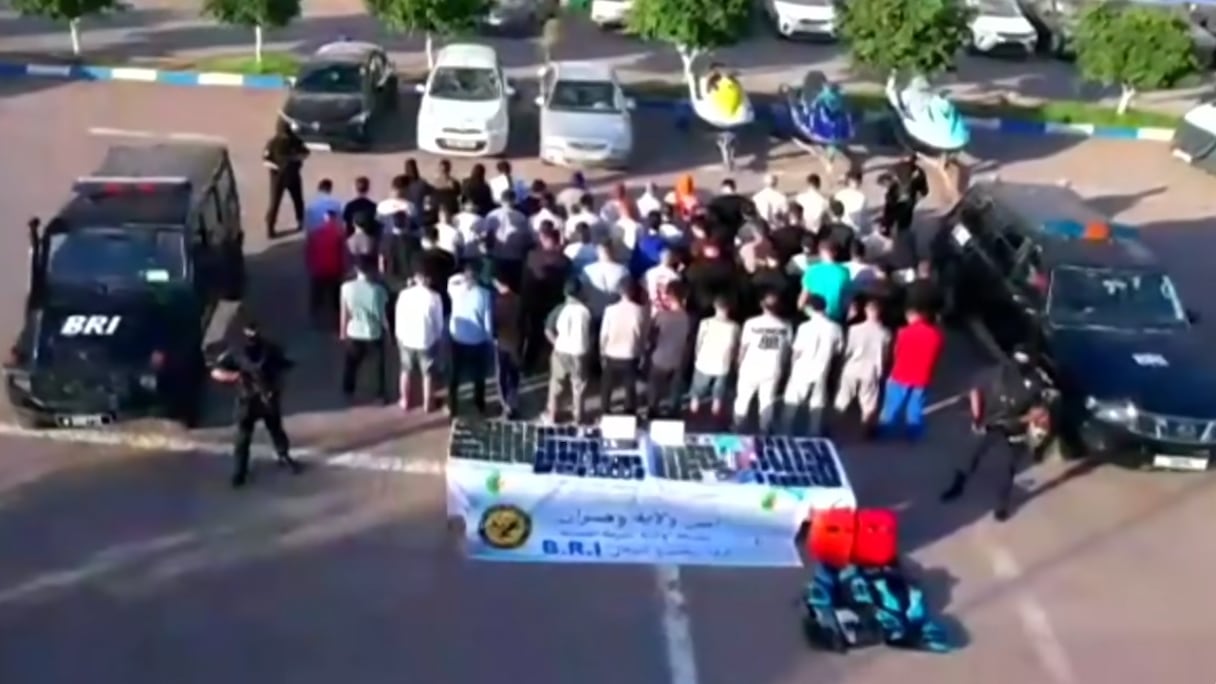
The statement issued on Sunday, October 11, by Algeria’s General Directorate of National Security (DGSN) runs to just a few lines. Sixty-one Moroccan nationals, arrested in Oran in early October, were allegedly “preparing to carry out acts of sabotage threatening public security and order.” The network was supposedly “extremely dangerous.” Its members are said to have flown to Tunis, crossed the border through the mountain trails and forests of El Kala, then made their way to Oran, at the other end of the country.
What acts of sabotage? Against which targets? Using what means? The statement offers no answers. As evidence, it cites Moroccan passports and sums of money in dirhams and euros. In other words, the sort of things one might find in any Moroccan traveler’s pockets. Even AFP, hardly an agency inclined to give Rabat the benefit of the doubt, noted dryly that the DGSN “gave no details of the actions it allegedly planned.”
The scenario strains credulity. Sixty-one saboteurs travelling together, under their real identities, passports in their pockets, crossing Algeria from east to west only to be arrested as a group. That is not how an intelligence service operates. It is, however, how headlines are manufactured.
The real enemy: Moroccans
The Algerian regime never tires of insisting that its quarrel is with the “Makhzen,” never with the Moroccan people. The facts tell a different story. It was against Moroccans that Algeria reinstated visa requirements in 2024. It was at Moroccans that Algerian coastguards opened fire off Saïdia in 2023. And it is Moroccans whom a compliant press portrays day after day as spies, traffickers or foreign agents.
What comes next is already being floated. Reacting to the statement, Algérie Patriotique, the newspaper of the late Khaled Nezzar, a war criminal convicted of crimes against humanity, openly raised the prospect of “expelling all Moroccans residing illegally in Algeria” and launching a “massive and systematic expulsion campaign.” Moroccans have long memories. In December 1975, Boumediene’s regime expelled tens of thousands of Moroccan families overnight, stripping them of their possessions and separating them from their loved ones. Fifty years on, the reflex remains intact.
The fear of late October
The timing is no coincidence. The Security Council is due to adopt a new resolution on the Sahara at the end of October, one year after Resolution 2797 made Morocco’s autonomy plan the basis for negotiations. Just days ago, President Tebboune was telling Algerians that his country would not be “more Sahrawi than the Sahrawis.” His foreign minister, Ahmed Attaf, was lamenting the prospect of the dispute being “reduced to a mere refugee issue.” Unable to change the course of events in New York, Algiers is conjuring up a threat at home. It is an old tactic of regimes in difficulty: when diplomacy fails, manufacture an enemy.
The contrast could hardly be starker. On October 9, addressing Parliament, King Mohammed VI spoke of reforms, young people, decentralization, and partnerships entered into by choice. It was the speech of a head of state looking towards his country’s future. Two days later, Algiers responded with a police statement. Each has its priorities.
A case that cannot be left unanswered
Sixty-one people are now being held on allegations that, so far, remain entirely unsubstantiated. They are entitled to legal representation, a fair trial and consular protection from their country. These rights are not negotiable, whatever the state of relations between Rabat and Algiers. International human rights bodies, from the UN Working Group on Arbitrary Detention to major NGOs, have ample grounds to take up the case. They also have a duty to do so.
The Algerian regime wanted a network of saboteurs. What it has shown, once again, is the depth of its pathological hatred of Moroccans.
