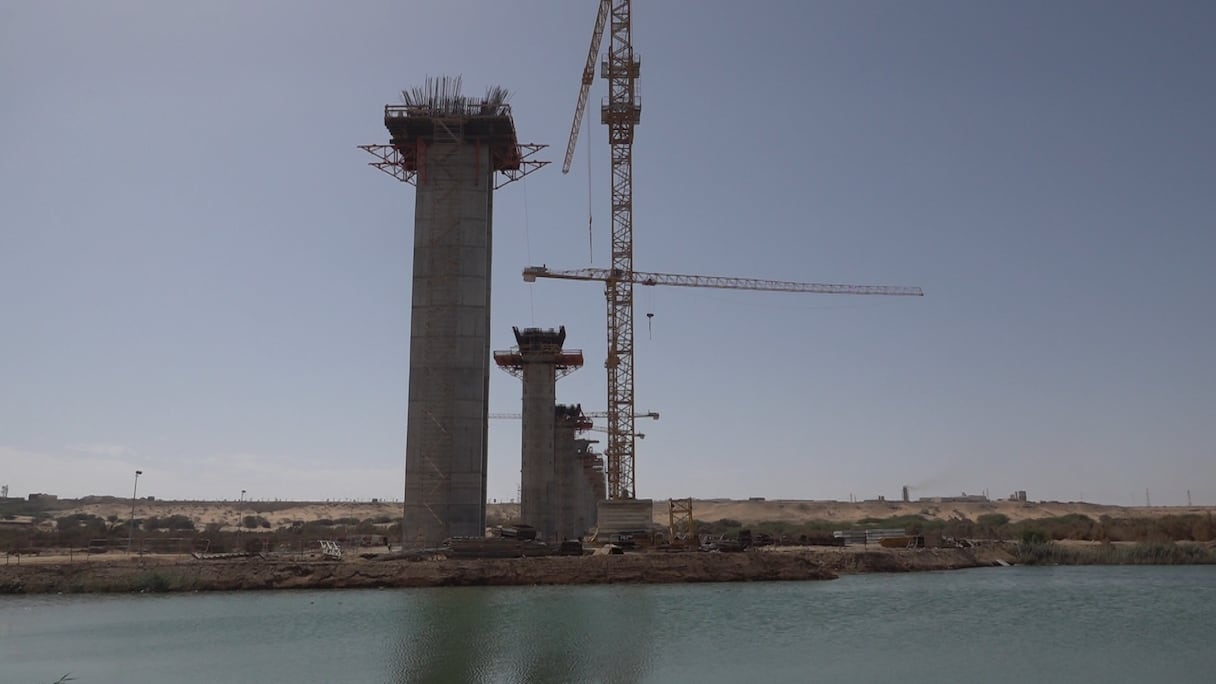
Construction of Morocco’s longest bridge, in Laayoune, has reached 56% completion. Work is continuing around the clock on the project, which has a budget of approximately 1.38 billion dirhams. It falls under the new development model for Morocco’s southern provinces and aims to improve traffic conditions and strengthen connections between the city and surrounding areas.
Beyond the technical challenges and construction deadlines, the project faces a major environmental task: protecting the natural habitat along the Sakia El Hamra River. Its banks support desert vegetation and wildlife, including resident and migratory birds such as flamingos.
On-site teams have introduced specific measures to limit the impact of construction on the ecosystem. Le360 met Mbarek Fancha, central director of the Tiznit-Dakhla expressway project, as he briefed team members on the instructions they must follow before carrying out fieldwork.
Fancha stressed that construction requires constant vigilance to protect the plant and animal species found in the area. Workers receive regular instructions and training on environmentally responsible practices. He also said the project had received approval from the National Environmental Commission, under the monitoring and prevention measures put in place.
Environmental protection has been considered since the bridge’s design stage. The planned spacing between its piers takes the river’s two channels into account to preserve its natural flow. Other measures cover waste management, the collection of oil from construction machinery and noise reduction to limit disturbances to birds and other wildlife.
Read also : Work on Morocco’s longest bridge reaches 56% completion in Laayoune
Mustapha Chrif, the project’s health, safety and environmental manager, said a dedicated “green team” monitors site cleanliness and compliance with environmental rules around the clock, seven days a week.
To control dust, construction tracks and traffic areas are watered regularly. The speed of vehicles and machinery is also capped at 20 km/h to reduce dust emissions and noise.
The project also uses noise-monitoring equipment to measure sound levels around the Sakia El Hamra River. The aim is to minimize disruption to birds moving between the two riverbanks.
Used oil is handled under specific procedures. It is collected in designated areas to prevent spills that could contaminate soil and groundwater. A specialized company then takes charge of its treatment, recycling or recovery, depending on the type of oil.
Chemical waste is collected and stored in designated areas before being transported to authorized facilities. The site also operates a waste-sorting system, with separate containers for household waste, hazardous materials, plastics and metals.
Read also : Laayoune launches over MAD 1 billion in projects to secure drinking water supply
A major project for local mobility
Beyond its environmental requirements, the bridge is expected to play an important role in improving transport around Laayoune. By crossing the Sakia El Hamra River, it will facilitate connections between the city and its northern, western and southern outskirts while helping ease congestion, particularly for heavy trucks and oversized vehicles.
Improved traffic flow is also expected to support economic exchanges and tourism by strengthening links between different parts of the city and surrounding areas.