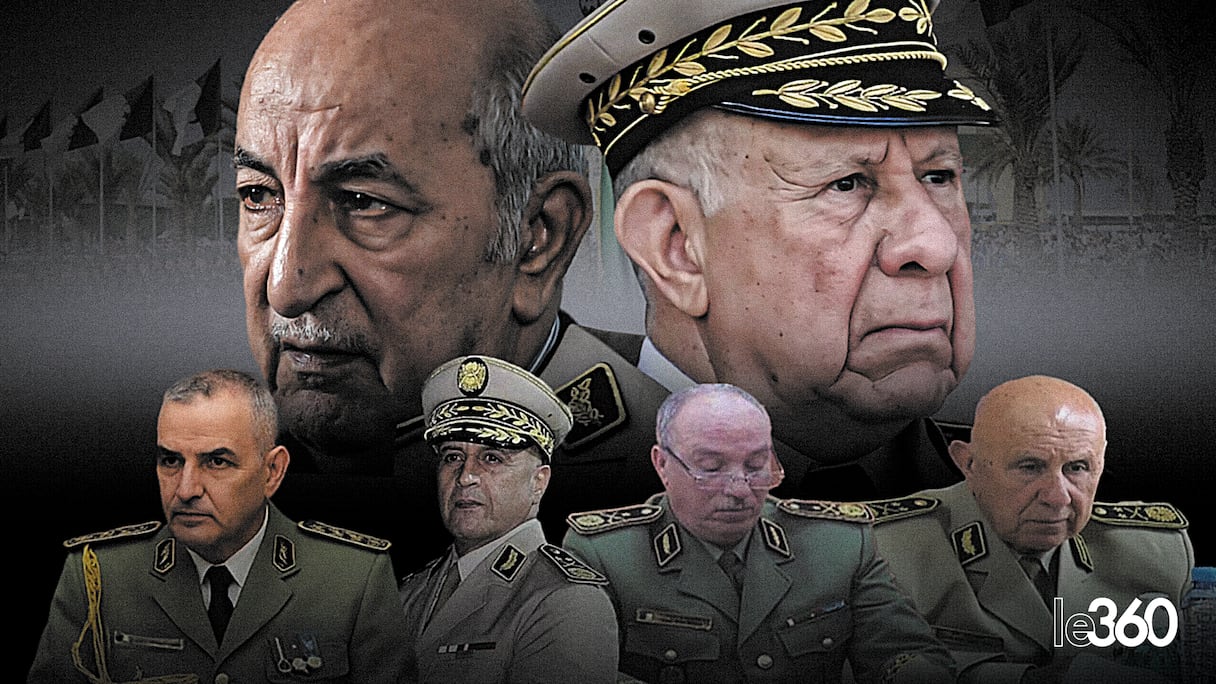
The latest shake-up came on Thursday, October 8, 2026. Saïd Chengriha, Algeria’s army chief of staff and minister delegate for defense since November 2024, formally installed General Ali Sidane as head of the National Gendarmerie. He replaced General Sid Ahmed Bourommana, who had held the job for barely 18 months. The appointment followed two other changes at the top of the military establishment: a new chief of the Central Directorate of Army Security on September 28 and a new commander of the First Military Region, covering Algiers, on October 5.
The gendarmerie: Five chiefs, four jailed or on the run
The revolving door at the gendarmerie tells the story of Algeria’s military purges in miniature. Its commander, General Ghali Belkecir, fled the country in August 2019 and was subsequently sentenced in absentia to 20 years in prison for “high treason.” His replacement, Abderrahmane Arrar, was sacked in July 2020, prosecuted and eventually jailed in Blida in 2023. Noureddine Gouasmia lasted roughly a year before being summoned to the Main Military Investigation Centre (CPMI) in Ben Aknoun in January 2022. Yahia Ali Oulhadj, appointed in August 2021, was removed by Chengriha in mid-April 2025 and also ended up behind bars. Sid Ahmed Bourommana, appointed in April 2025, has now made way for Ali Sidane. An earlier senior gendarmerie officer, Menad Nouba, had already been convicted in connection with the 701 kilograms of cocaine seized in Oran in 2018.
Domestic intelligence: Six chiefs in six years
At the General Directorate of Internal Security (DGSI), Wassini Bouazza was the first to fall. Dismissed in April 2020, he is now being held in Blida. Abdelghani Rachedi took over until July 2022, followed by Djamel Kehal Medjdoub. Abdelkader Haddad, better known as Nacer El Djinn, was appointed in July 2024. He was sacked on May 21, 2025, then arrested and sent to Blida military prison, where several former intelligence chiefs were already being held. His successor, Abdelkader Aït Ouarabi, known as “General Hassan,” had himself been sentenced to five years in prison in 2015 and released from Blida in 2020. He did not last a year in the post. On May 18, 2026, he was replaced by Major General Mounir Zahi.
Foreign intelligence: Seven chiefs, two behind bars
The turnover has been even more relentless at the Directorate of Documentation and External Security (DDSE). Colonel Kamel-Eddine Remili was replaced in April 2020 and later imprisoned. General Mohamed Bouzit, known as Youcef, lasted until January 2021 before being dismissed and jailed. Noureddine Makri, known as Mahfoud, remained in charge until May 2022. Djamel Kehal Medjdoub held the post for just two months, from May to July 2022, while Abdelghani Rachedi lasted even less, from July to September 2022. General Djebbar M’henna, appointed in September 2022, was sacked on September 19, 2024, just 12 days after Tebboune’s re-election. In June 2026, he too was detained at Blida in connection with the Amir DZ affair, involving the abduction of the opposition YouTuber in France in April 2024. His successor, Rochdi Fethi Moussaoui, has also been named in French media reports on the case.
Army security: Five chiefs since 2020
The Central Directorate of Army Security (DCSA), which polices the military itself, has been no exception. Sid Ali Ould Zmirli ran the service from March 2020 until September 2022, when he was replaced amid allegations of a conspiracy. His brother had been arrested for treason. Abdelaziz Nouiouet Chouiter, appointed on September 11, 2022, was out six months later, in March 2023. Mahrez Djeribi remained until December 13, 2025. Ibrahim Abbas lasted just nine months before being replaced by Noureddine Maache on September 28, 2026. Several former heads of the directorate, including Othmane Benmiloud, known as Kamel Kaniche, are now in prison.
The police and the army’s top brass
The same pattern extends to the national police. Khelifa Ounissi was replaced as head of the General Directorate of National Security in March 2021 by Farid Bencheikh, who was dismissed in January 2024, placed under house arrest and then detained by military security in April that year. His successor, Ali Badaoui, appointed on January 8, 2024, was reportedly removed in May 2025.
The upheaval has reached the highest ranks of the army. Major General Mohamed Kaïdi, head of the Operations and Preparation Department and widely regarded as the military’s de facto number two, was dismissed in November 2021, detained and later placed under house arrest. Major General Ammar Athamnia, commander of the land forces since 2020, was replaced by Mostefa Smaili on November 20, 2024, just 48 hours after Chengriha joined the government. In January 2025 came the forced retirement of General Ben Ali Ben Ali, the army’s longest-serving senior officer. On February 23, 2025, air defense commander Mahmoud Laaraba was also dismissed.
When fear becomes the chain of command
These figures are more than a tally of personnel changes. They reveal an army in which no appointment offers security and few senior officers can expect to leave through ordinary retirement. Any intelligence chief taking office today knows that his predecessors may be in prison, in exile or under house arrest. He knows he may have only months in the job. And he knows that a rumor, a report from a rival agency or a sudden change of heart at the top could be enough to bring him down.
In such a system, loyalty counts for more than ability. Senior officers are no longer serving an institution so much as trying to survive it. Initiative becomes a liability. Bad news stays buried. Officers cultivate powerful protectors and gather compromising material on their rivals. Some intelligence chiefs have taken office fresh out of prison; others have gone from their desks straight into a cell. The distance between commanding a security service and being detained by one has become alarmingly short.
A command structure brought to a standstill
The damage is practical as well as institutional. An intelligence agency that changes its director every ten months cannot sustain long-term investigations or build lasting trust with foreign counterparts. Each incoming chief begins by purging his predecessor’s allies, reshuffling departments and reopening old files. With every handover, another layer of institutional knowledge is lost.
The failures keep mounting. A domestic intelligence chief moves from his office to a cell in Blida within weeks. Intelligence officers are convicted of trying to obtain the president’s medical records. An attempt to abduct an opposition figure on French soil escalates into a diplomatic row. These are not isolated mishaps. They are signs of a security establishment whose agencies devote more energy to watching one another than to identifying genuine threats.
A danger to Algeria and its neighbors
At the heart of this instability lies a struggle between rival factions at the top of the state. Every appointment becomes another contest between the presidency and the military high command; every dismissal sends a message to the opposing camp. The purges are not designed to reform the institution. Their purpose is to remove potential rivals and install loyalists, until the next round begins.
An army run on fear is an army that cannot be relied upon to act predictably. It is more likely to seek enemies abroad to unite ranks it has itself divided, and more prone to hasty decisions. Algeria spends more on defense than any other African country and borders a Sahel region already gripped by crisis. The consequences of this instability therefore reach far beyond Algeria itself.
General Ali Sidane has just taken command of the gendarmerie. Few men will be more familiar with the fate that befell those who held the job before him.
