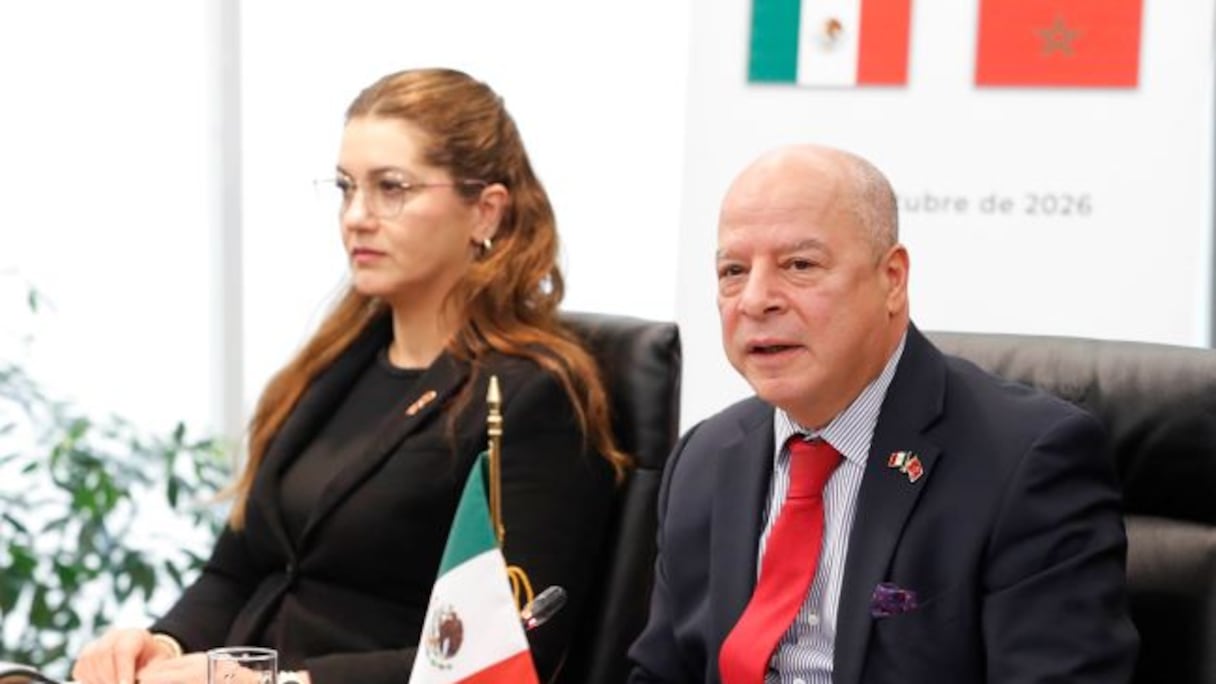
The Moroccan Sahara took centre stage at an October 19 meeting between Morocco’s ambassador to Mexico, Abdelfattah Lebbar, and Mexican Senate President Higinio Martínez Miranda. Beyond reviewing bilateral ties and opportunities for cooperation, the Moroccan diplomat delivered a clear political message: Rabat wants Mexico to gradually bring its position into line with countries that support Morocco’s autonomy initiative.
“Morocco hopes that Mexico will gradually move its position closer to that of a growing number of countries supporting the Moroccan autonomy initiative,” Lebbar said. The wording was measured, but the message was unmistakable. The ambassador argued that such a shift would strengthen political trust between the two countries and help them realize the full potential of their cooperation.
The appeal comes as several Latin American governments have endorsed Morocco’s autonomy plan or recognized Moroccan sovereignty over the Sahara. Chile and Paraguay are among the countries that have recently expressed support for Rabat’s position.
Mexico, meanwhile, continues to maintain diplomatic relations with the self-proclaimed Sahrawi Arab Democratic Republic (SADR). As support for Morocco grows, Mexico’s stance increasingly stands apart from the diplomatic direction taken by several of its Latin American partners.
Resolution 2797 marks a turning point in the political process
Lebbar also pointed to the significance of UN Security Council Resolution 2797, adopted on October 31, 2025, which marked a major advance for Morocco’s position on the Sahara. By establishing Morocco’s autonomy initiative as the basis for negotiations and identifying genuine autonomy as the most feasible outcome to the dispute, the resolution gave fresh momentum to the political process. For the ambassador, that development, together with growing international support for Morocco’s plan, gives Mexico further reason to reconsider its position and build a closer political relationship with the Kingdom.
Lebbar therefore called on Mexico to gradually reconsider its position on the Moroccan Sahara, following the lead of the many countries that have already endorsed the Kingdom’s autonomy proposal.
The Sahara remains a central issue in Morocco’s relations with foreign partners. Any closer relationship with Mexico will inevitably have to take account of the country’s position on Morocco’s territorial integrity.
From parliamentary visits to deeper cooperation
Much of Lebbar’s address focused on ways to strengthen cooperation between Morocco and Mexico.
The ambassador began by congratulating Higinio Martínez Miranda on his election as Senate president and thanking him for agreeing to the meeting. He described it as an opportunity to reaffirm the friendship and mutual respect between two countries separated by geography but connected, in his view, by ancient civilizations, rich historical traditions and dynamic societies.
Lebbar recalled a series of parliamentary exchanges in recent years. In 2022, Olga Sánchez Cordero, then president of the Mexican Senate, travelled to Morocco with a delegation of senators. Two years later, Enaam Mayara, then president of Morocco’s House of Councillors, visited Mexico, where he was received by Senator Ana Lilia Rivera, who headed the Senate at the time.
For Lebbar, these visits demonstrated a shared commitment to strengthening parliamentary diplomacy. He invited Martínez Miranda to make a working visit to Morocco when his schedule permits.
The aim would be to deepen political dialogue, encourage the exchange of experience and identify new opportunities for cooperation, laying the foundations for a relationship that is “more structured, ambitious and results-oriented.”
The ambassador also highlighted a symbolic gesture between the two institutions. In response to a request from the Mexican Senate, Morocco donated an ornamental fountain to be installed at the Senate’s headquarters. Lebbar expressed hope that it would soon be unveiled in Martínez Miranda’s presence as a “lasting symbol” of friendship between the two peoples.
Business, phosphate fertilizers and new economic opportunities
On the economic front, Lebbar called for the business delegations exchanged in recent years to begin delivering concrete projects.
He recalled a 2023 visit to Morocco by a delegation of Mexican business leaders headed by Francisco Cervantes. He also cited a visit by Moroccan businesspeople in 2024, followed by an economic mission to Mexico in September 2025 led by Chakib Alj, president of the General Confederation of Moroccan Enterprises (CGEM).
Read also : Sahara: Why Mexico, Uruguay and other Latin American states still cling to separatism
Several sectors were identified as particularly promising, including renewable energy, the automotive industry, agribusiness, infrastructure, logistics and technological innovation.
Lebbar placed particular emphasis on Morocco’s position as one of the world’s leading producers and exporters of phosphate fertilizers. He said that strength could open new avenues for cooperation with Mexico in agricultural fertilization, productivity improvements, knowledge transfer and the development of solutions tailored to the needs of the agri-food sector.
The ambition is to move beyond meetings between business representatives and establish more regular, practical cooperation. The ambassador presented the complementary strengths of the two economies as an opportunity to expand trade and encourage new investment.
Culture and universities as bridges between the two countries
Cultural ties also featured prominently in the ambassador’s remarks. Lebbar recalled Morocco’s participation as guest of honour at several events in Mexico, including the International Book Fair at the Juárez Autonomous University of Tabasco, the Sonora Fair, the San Ángel Flower Fair and the Morelia International Book and Reading Fair, held in October.
These events, he said, had given Mexican audiences a broader introduction to Morocco’s heritage, literature, traditions and artistic creativity.
The diplomat also highlighted university cooperation agreements, particularly those concluded with the National Autonomous University of Mexico (UNAM). Such partnerships could encourage academic exchanges, student and faculty mobility, and joint scientific research projects.
He recalled that Enrique Graue, a former rector of UNAM, had received an honorary doctorate in Morocco three years earlier.
For Lebbar, these initiatives show that the relationship extends beyond formal diplomatic contacts. It is also being built through institutions, businesses, universities and personal connections.
Lebbar also recalled the welcome extended to the Moroccan delegation in Monterrey during the World Cup. He described encountering numerous Mexicans wearing Moroccan football shirts, singing, dancing and celebrating alongside Moroccan supporters. “We may be far apart geographically, but our hearts are very close,” he said, adding that Moroccans would not forget the warmth of that reception.
He also expressed hope that Mexican visitors would experience the same Moroccan hospitality during the 2030 World Cup.
Yet beyond the invitations, investment proposals and cultural exchanges, the message to the Mexican Senate was also a diplomatic one. Morocco wants to deepen its relationship with Mexico, while encouraging the country to move closer to Rabat’s position on the Sahara and its autonomy initiative.
