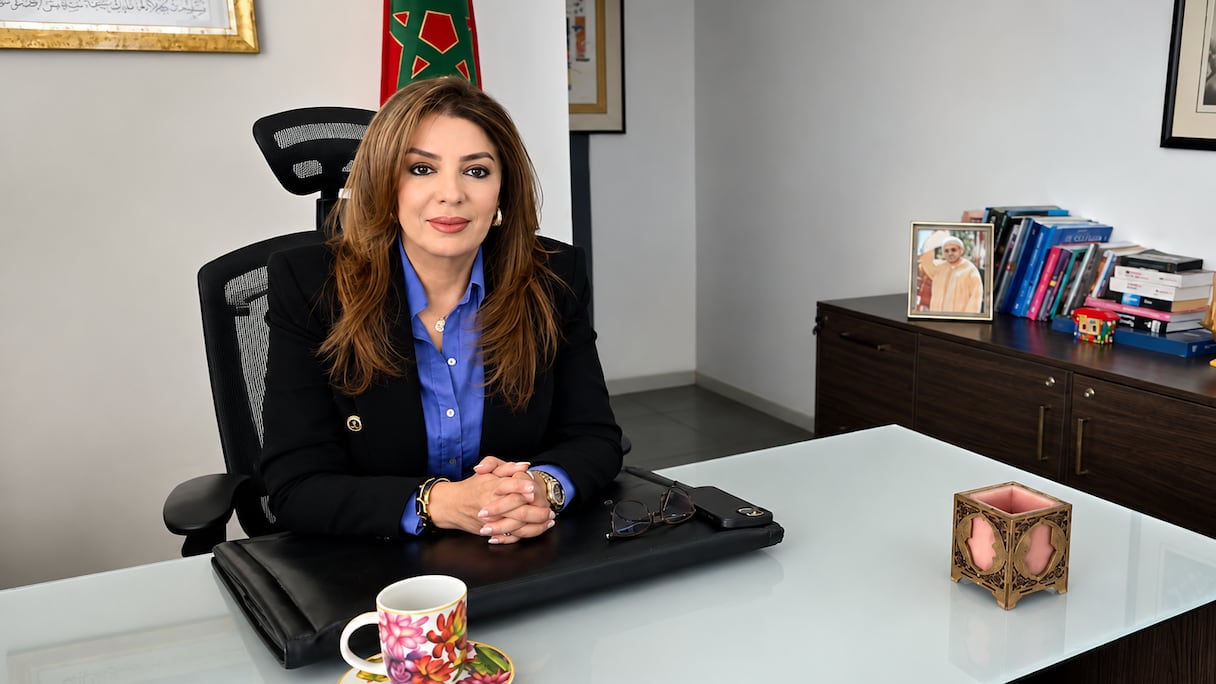
A seasoned diplomat and a distinguished embodiment of the Kingdom’s international engagement in Latin America, Farida Loudaya has headed Morocco’s diplomatic representation to the Republic of Colombia and the Republic of Ecuador for nearly a decade, building over the years solid and lasting bridges with the political class, academia and civil society in these strategically important countries of the subcontinent. In this interview, the diplomat looks back on the victorious outcome of a complex diplomatic sequence: Colombia’s recognition of Moroccan sovereignty over the Sahara. She unpacks the key drivers behind this historic change of course, structured around three fundamental axes.
The first is the end of an ideological interlude. Colombia’s reversal definitively brings to a close the personal and isolated choices of Gustavo Petro’s outgoing administration, restoring a 50-year bilateral relationship in perfect alignment with the overwhelming support of the Colombian Congress and people. The second is the firm and definitive nature of this recognition. The unequivocal affirmation of Moroccan sovereignty over the Sahara comes with the immediate withdrawal of recognition of the fictitious entity and Bogotá’s commitment, as a member of the UN Security Council, to provide it with no support in international forums. The third lies in the fact that this major diplomatic breakthrough attests to Morocco’s influence and status as a universally respected partner, driven by the King’s vision and paving the way for an unprecedented strategic partnership encompassing the economy, Atlantic connectivity, cultural diplomacy and human ties.
After a prolonged wait, verging on the painful, the outcome has finally come. What is your reaction to the far-reaching reversal Colombia has now made on the question of the Moroccan Sahara, and with such solemnity?
What occurred under the government of Petro, Colombia’s former president, should be analyzed as a strictly circumstantial interlude. This disagreement emerged with his administration and ended with his departure. Historically, the Kingdom of Morocco has always maintained exceptionally close relations with Colombia, particularly under the presidencies of Juan Manuel Santos and Iván Duque, to cite only the period spanning my own tenure.
It will soon be a decade since I had the immense honor of being appointed by His Majesty the King, may God assist Him, as ambassador to the Republic of Colombia and the Republic of Ecuador. From the moment I arrived, our primary mission was to build a lasting and strategic alliance underpinned by half a century of bilateral diplomatic relations. But then came the stance adopted by the outgoing administration, which did not, moreover, reflect a considered government policy, but stemmed solely from President Petro’s personal initiative, guided by his longstanding ideological affinities with the Polisario dating back to his past as a combatant in the M19 movement. His justifications, notably his argument that it was «the only Spanish-speaking nation» in the region, amply illustrate the exclusively personal nature of that choice, made without the slightest consideration for the political and economic repercussions for his country.
What motivated that position?
It was pure ideology. We were confronted with an unusual situation, disapproved of across the entire Colombian institutional and social spectrum. As proof, during 2022 and 2023, we succeeded in securing the adoption of two motions of solemn support for Morocco in the Colombian Congress. These texts, endorsed by an overwhelming parliamentary majority, were intended to demonstrate that Petro’s personal position was shared neither by the political class, nor by civil society, nor by the country’s economic actors.
Today, we must enter a new era without dwelling on the past four years. The decision taken by President Abelardo de la Espriella is profoundly historic. Although diplomatic channels were never formally severed, the formal and explicit recognition of Morocco’s sovereignty by the new Colombian authorities constitutes a major turning point, all the more so given the remarkable speed with which it occurred.
What is particularly striking is the firmness and irreversibility of this sequence: the affirmation of Moroccan sovereignty over the Sahara was immediately followed by the withdrawal of recognition of the pseudo-SADR. It is an unusually forceful move, if one may put it that way…
The methodical sequencing of these developments is essential. First came the official announcement by the Foreign Minister, promptly followed by a statement from the Vice President of the Republic, Mr. José Manuel Restrepo, who was keen to underscore the strategic importance of the partnership with Morocco. He is someone I know particularly well, having worked with him in 2017 when he was rector of Universidad del Rosario, at which time we concluded the first academic agreement between that institution and the International University of Rabat. He subsequently served as Minister of Commerce under President Iván Duque, which allowed us to continue our joint efforts. He is an accomplished statesman, a man of great vision and maturity, with an intimate knowledge of Morocco and a high regard for the Kingdom.
Read also : Sahara: from denial to the brink — how the Polisario’s refusal to negotiate is hastening its own demise
The President is also counting heavily on his contribution alongside Mr. Omar Bula Escobar, Minister of Foreign Affairs, a figure of considerable intellectual stature and a keen observer of international affairs, whose experience and command of geopolitical balances make him a leading figure in shaping Colombia’s new foreign policy.
Did Morocco’s momentum on the Sahara issue play a role in this decision?
The highly significant results we are achieving today stem from the strategic vision of His Majesty the King. Thanks to this royal impetus, Morocco has established itself today as a reliable, influential and universally respected international actor. It is this dynamic that made this remarkable breakthrough in Latin America possible. In this regard, I am delighted to note that both countries under my responsibility, Colombia and Ecuador, have made historic shifts. Ecuador, which once ranked among the Polisario’s strongholds and at the time held a seat on the Security Council, withdrew its recognition, strengthened its ties with Rabat and initiated the process of opening its embassy in Morocco.
«Geopolitically, Latin America, alongside Africa, was once an area of diplomatic vulnerability where recognition of the fictitious entity was widespread. That configuration has been profoundly reversed.»
— Farida Loudaya
The same is true of Colombia. The trigger, carrying considerable symbolic weight, was the royal message sent by His Majesty to President Abelardo de la Espriella following his election. This gesture was deeply appreciated by the Colombian authorities. It was accompanied by the presence of our Foreign Minister, Nasser Bourita, dispatched by the Sovereign as a special envoy to attend the inauguration ceremony. The fact that he was the only African foreign minister present at the event deeply touched our hosts.
Geopolitically, Latin America, alongside Africa, was once an area of diplomatic vulnerability where recognition of the fictitious entity was widespread. That configuration has been profoundly reversed in recent years, to the point that only a very limited number of countries now continue to maintain such recognition.
More precisely, how many countries on the American continent still lend their support to this entity?
Only a handful remain, including Cuba, Nicaragua, Venezuela and Mexico. The landscape has therefore shifted considerably, and the overwhelming majority of states in the region now support Morocco’s position.
In Colombia’s case, we are opening a new chapter in our bilateral relations, on solid foundations and with very strong momentum. The sequence is particularly significant in this respect: the new direction was first publicly announced by senior Colombian officials, in the presence of our Foreign Minister, Nasser Bourita, with a clear and unequivocal affirmation of Morocco’s sovereignty over its Sahara.
The official statement subsequently issued by Colombia’s Ministry of Foreign Affairs enshrined that position and set out its diplomatic consequences. It revolves around three cardinal points: explicit recognition of Morocco’s sovereignty over its Sahara; the immediate freezing of recognition of the pseudo-SADR, bringing all political and diplomatic contact, as well as exchanges of missions, to an end; and Colombia’s unprecedented commitment, in its capacity as a non-permanent member of the Security Council, to provide it with no support in international forums.
We are therefore not dealing with a mere circumstantial declaration, but with a new Colombian doctrine on the question of the Moroccan Sahara, clearly embraced and formally established. Our eyes are resolutely turned toward the future.
Are there tangible guarantees protecting the Kingdom against a possible future reversal in Colombian diplomacy?
For the next four years, corresponding to the term of President Abelardo de la Espriella and his administration, there will be no negative shift to deplore. The course will remain resolutely constructive. Although political dynamics can sometimes fluctuate with ideological changes in government, I firmly believe that the regional dispute over the Sahara will be definitively resolved in the near future. Moreover, Colombia’s presence on the Security Council for a two-year term represents a major strategic opportunity to defend our legitimate interests during this decisive phase.
To make this support lasting, it would seem appropriate to broaden the scope of cooperation to the economic and commercial spheres. What are the immediate prospects?
During the high-level meetings held by our minister with Colombia’s Vice President, Foreign Minister and Minister of Commerce, our interlocutors expressed their desire to include Morocco on the itinerary of their very first strategic international economic mission, thereby establishing the Kingdom as Colombia’s preferred strategic partner on the African continent.
Read also : Terrorism: The US tightens the noose around the Polisario
The priority areas for this enhanced cooperation encompass a substantial expansion of trade flows, the attraction of foreign direct investment, as well as tourism. Colombia views Morocco’s tourism model as a genuine «success story» from which it wishes to draw inspiration.
«Every delegation we accompany to the Tanger Med port comes away deeply impressed. In many minds, there is a before and an after Tanger Med.»
— Farida Loudaya
Moreover, the port and logistics sector is attracting considerable interest. The Tanger Med port complex has now established itself as an essential global benchmark. Colombian decision-makers view Morocco as a strategic platform and the true gateway to the African continent. Every delegation we accompany to the Tanger Med port comes away deeply impressed. In many minds, there is a before and an after Tanger Med. This interest fits squarely within the framework of the Royal Atlantic Initiative aimed at strengthening maritime connectivity, soon to be complemented by the Dakhla Atlantic port. All these elements point to an unprecedented, very high-level bilateral partnership in the years ahead.
This economic dimension naturally brings us to the human and cultural dimension. Although Morocco has a significant Spanish-speaking component, this lever remains underexploited. What avenues should be explored to consolidate these bridges?
The major achievement of which we can be proud is the mutual lifting of visa requirements, which has considerably facilitated the mobility of individuals and businesspeople. Culture, moreover, is a fundamental vector for bringing our countries closer together. In this regard, the appointment of Senator Paola Holguín as Minister of Culture represents an excellent opportunity. A great friend of Morocco, she has consistently defended the national cause in Congress and on the Foreign Affairs Committee. Fascinated by our civilization, she has shared with me her enthusiasm for launching ambitious joint cultural projects. Having such an ally at the head of this ministry is a remarkable guarantee of success.
In light of your ten years of experience at the head of this mission, what levers of action should be activated on the Moroccan side?
When I arrived ten years ago, there was a degree of mutual unfamiliarity and some persistent stereotypes. On the Colombian side, the presence of a woman ambassador sometimes prompted surprised curiosity. On the Moroccan side, Colombia, a country of rare splendor, suffered from an image distorted by certain film productions.
We have worked actively to dismantle these perceptions. Morocco’s invitation as the first country of honor at Expoartesanías, Colombia’s largest handicrafts fair, on the occasion of the 40th anniversary of our diplomatic relations, marked a major turning point. With the support of Maison de l’Artisan, our pavilion provided an exceptional showcase that captivated both the public and the local press.
We subsequently intensified our intellectual and media presence by organizing conferences featuring Moroccan figures, particularly women, in order to raise awareness among younger generations of the Kingdom’s contemporary evolution. Cultural diplomacy plays a decisive role in arousing curiosity, encouraging the wider public to learn more and, ultimately, transforming perceptions of our country.
The 2030 World Cup, which Morocco will co-host, represents a tremendous catalyst. Since visa requirements were lifted, Colombian nationals who visit Morocco have returned delighted by their experience. By stimulating tourism and multiplying human interactions, we will durably consolidate the Kingdom’s prestigious image in Colombia, and Colombia’s in Morocco.
