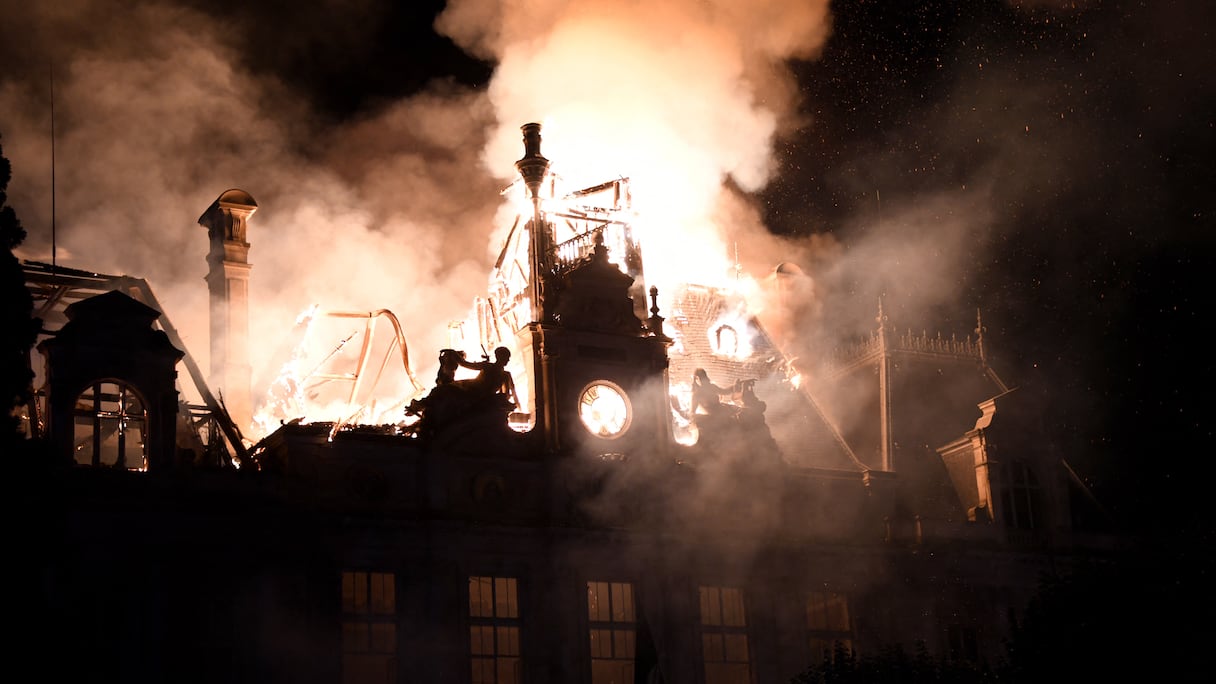
Some articles are so extraordinary that one wishes they were satire. This one appeared at 7:49 a.m. on October 20, on the front page of Algérie Patriotique. Its headline: “Jijel arson attacks ordered from Paris: French-Algerian youth take revenge.” Its argument: the violence that swept through several French cities on October 17 was not an outbreak of disorder but an “act of retaliation.” A “section of the younger generation” from families of Algerian origin had supposedly “deliberately targeted the Republic’s most sacred symbols” to “make France pay for Algeria’s tragedies.”
Follow that reasoning to its conclusion. The fires that ravaged eastern Algeria in late August were supposedly ordered from Paris. That is the theory advanced in a documentary broadcast on October 17 by Algeria’s Ministry of National Defense, which blames exiled opposition figure and YouTuber Amir DZ and shadowy contacts within the French Interior Ministry. Algérie Patriotique takes the argument to its logical conclusion: if France burned the forests of Jijel, then young French-Algerians are justified in burning French town halls. The website calls it “an eye for an eye.” In a normal country, it would be called glorifying terrorism.
The maneuver serves two purposes. First, it absolves the rioters by recasting them as avengers. Second, it turns an entire community—dual nationals—into a target of public anger by attributing to them violence that no investigation has linked to them. For young people whom the writer describes as “constantly harassed and stigmatized,” he could scarcely do worse. Without their knowledge or consent, he casts them in precisely the role the French far right has assigned to them.
The website’s pedigree helps explain its position. Algérie Patriotique was founded and run by Lotfi Nezzar, son of General Khaled Nezzar, the former defense minister and one of the most powerful figures of Algeria’s Black Decade. In August 2023, Swiss federal prosecutors referred the general to the Federal Criminal Court for violations of international humanitarian law, including war crimes, crimes against humanity and the systematic persecution of civilians between 1992 and 1994. His death on December 29, 2023, brought the proceedings to an end before trial. The website that carries his legacy has never broken with the security establishment’s line, relaying its pronouncements without scrutiny.
This is hardly the first time Algiers has waded into France’s domestic tensions. On June 29, 2023, three days after Nahel was shot dead by a police officer in Nanterre, Algeria’s Foreign Ministry issued an official statement. It expressed “shock and dismay” at the “troubling circumstances” of his death, pointedly noted the teenager’s dual nationality and said it trusted the French government to “fully discharge its duty of protection.” Algiers, which tolerates no criticism of how it treats its own citizens, was claiming a right to scrutinize French policing in the midst of a night of rioting.
Eighteen months later, official statements had given way to videos. In January 2025, at the height of the diplomatic crisis between Paris and Algiers, several Algerian influencers living in France, who used TikTok to amplify the Algerian government’s line, were arrested. In Brest, “Zazou Youssef,” who had 400,000 followers, called in Arabic for people to “use weapons on January 1.” On February 24, 2025, a court sentenced him to 18 months in prison for directly inciting an act of terrorism and banned him from French territory for ten years. In Lyon, influencer Sofia Benlemmane, who had targeted opponents of the Algerian regime, told one of them during a livestream: “I hope they kill you.” She received a nine-month suspended sentence.
The case of “Doualemn” says it all. The Algerian national, who lived in Montpellier, posted a video calling for violence. Deported on January 9, 2025, he was refused entry upon landing in Algiers and sent straight back to France. The regime would not take back one of its own citizens. France’s then interior minister, Bruno Retailleau, drew his conclusion: “Algeria is seeking to humiliate France.”
Opposition figures, meanwhile, know the price of speaking out. In April 2024, one of them, Amir DZ, was abducted and held captive in the Paris region. French judicial authorities placed several people under formal investigation, including an Algerian consular official. This is the very man Algeria’s military now accuses of setting Jijel ablaze.
Today, the regime lets its press do the talking. The pattern remains the same: every French crisis becomes an Algerian affair, and every young person of Algerian descent becomes a piece on Algiers’ chessboard. Dual nationals are treated not as French citizens but as a diaspora to be mobilized, a means of threatening Paris whenever relations deteriorate.
That cynicism comes at a price, but it will not be paid by the writers at Algérie Patriotique. It will be paid by the French-Algerians who, on October 17, were at work, at home or taking part in the peaceful march in Paris, and who now find themselves collectively blamed for the burning of Limoges by an Algerian website.
The regime that accuses a YouTuber of setting its forests on fire through WhatsApp applauds those who set fire to town halls across the border. At this point, it is hard to tell who is really playing with fire.
