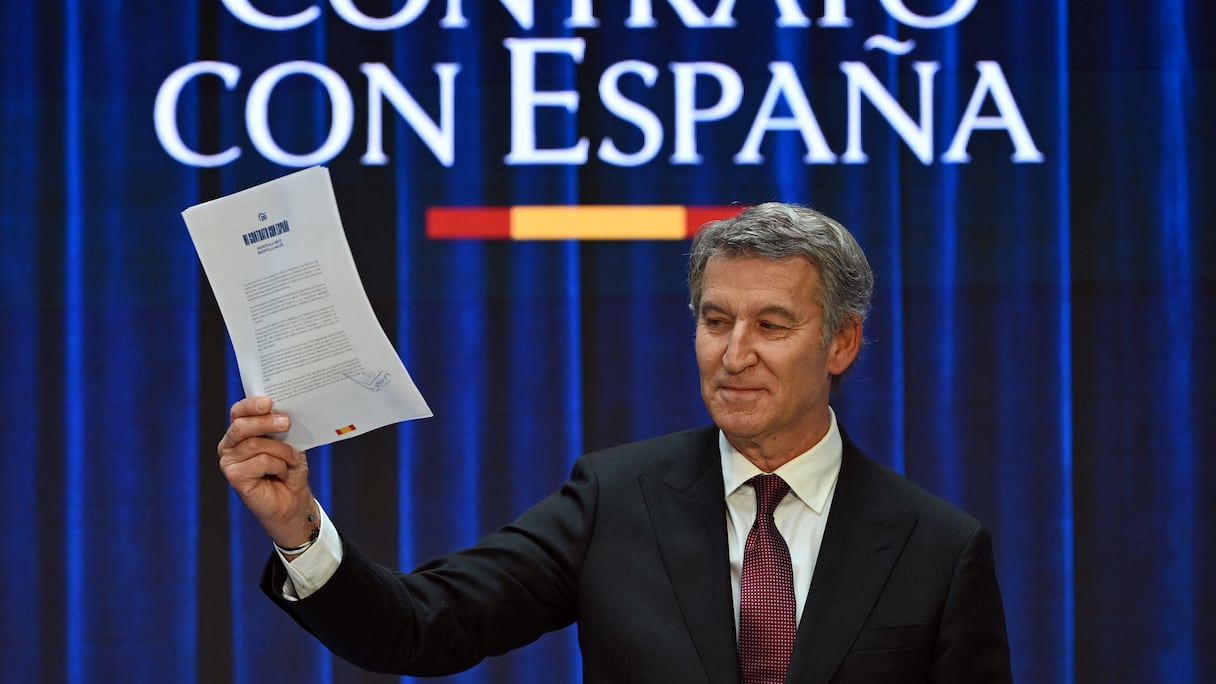
Alberto Núñez Feijóo has once again demonstrated his well-practiced talent for talking at length without answering the question. Asked whether he would consider reversing Spain’s position on the Sahara, the opposition leader gave an evasive answer, to put it mildly. “I will look carefully into the decision that was taken. Spain’s foreign policy is not a matter for one man alone. The Sahara question is of paramount importance to our country. It will therefore be for Congress to establish what commitments Sánchez made and to determine what a future government, should there be one, considers best in light of the situation at the time.”
Foreign policy, Congress, past commitments, a future government—he covered everything except the question he had been asked. Would Feijóo keep Spain’s support for Morocco’s autonomy plan, or not? He invokes the principle that foreign policy “is not a matter for one man alone” to challenge Sánchez’s decision, then carefully avoids saying what his own would be. Rather than clear up the ambiguity, he leaves the matter to Congress and a hypothetical PP government.
There is just one problem with that answer. The People’s Party knows perfectly well what position Spain adopted. It has debated it, fought it and formally demanded its reversal. The party Feijóo has led since 2022 hardly needs anyone to explain what changed. What its leader still refuses to say is whether he would keep that policy in place.
A diplomatic shift the PP knows perfectly well
The question put to Feijóo referred to recognition of Moroccan sovereignty over the Sahara. But the April 2022 joint declaration said no such thing. Spain described Morocco’s autonomy initiative as “the most serious, realistic and credible basis” for resolving the dispute. This was not formal recognition of sovereignty. It was, however, a major diplomatic shift that marked the beginning of a new phase of cooperation between the two countries.
Read also : Morocco to propose new migration cooperation model to European partners
Feijóo was no mere spectator. In March 2022, he called the way Sánchez had announced the change “reckless” and demanded an explanation. Yet the PP leadership did not object in principle to Spain supporting Moroccan autonomy, El País reported at the time.
Two months later, having become party leader, Feijóo met Aziz Akhannouch, then Morocco’s head of government. He assured him of his “loyalty” and declared that the alliance with Morocco was “beyond question.” But when asked whether he supported autonomy for the Sahara under Moroccan sovereignty, he once again dodged the question.
Years later, Feijóo is still playing the same game, only now with more contradictions to explain away. He has plenty to say about the importance of good neighborly relations but remains careful not to say what he would do with Spain’s support for Morocco’s autonomy plan if he came to power. Most remarkable of all is his sudden need to “look into” a decision his party knows well enough to have demanded its reversal in parliament. Feijóo does not lack information. He lacks an answer.
The ‘historic neutrality’ claim meets the historical record
The People’s Party insists that Pedro Sánchez broke with a tradition of Spanish neutrality that the right had upheld consistently for decades. The record, however, makes that claim difficult to sustain.
Under Mariano Rajoy, joint declarations with Morocco in 2012 and 2015 had already welcomed the Kingdom’s “serious and credible efforts.” Admittedly, those formulations did not go as far as the 2022 declaration, which explicitly identified the autonomy initiative as the basis for resolving the dispute. But neither did they suggest that the PP was categorically opposed to closer ties with Morocco. Sánchez himself reminded the Congress of Deputies of those Rajoy-era statements.
The party’s election manifestos tell a similarly shifting story. In 2016, its program still defended the “self-determination of the Sahrawi people.” By 2019, that reference had disappeared. Then, in 2023, under Feijóo, the PP promised “deep and strong” neighborly relations with Morocco and Algeria, alongside support for United Nations efforts towards a “just, lasting and acceptable” solution. There was no promise to reverse the 2022 diplomatic shift. Nor was there any explicit commitment to self-determination. The pledge to undo that policy appeared in Sumar’s manifesto, not the PP’s.
Read also : Ceuta and Melilla: Spain’s PP takes Google’s dotted-line controversy to Brussels
The PP then took its campaign to parliament. In May 2024, it secured congressional approval for a motion urging the government to return to its supposed policy of “active neutrality” and reverse the position adopted in 2022. Yet in November 2025, the same party reached an agreement with Sumar on a proposal calling on the government to reaffirm its commitment to the “right of the Sahrawi people to self-determination” and align its policy with international law and United Nations resolutions. The PP could have defended its own position. Instead, it chose to endorse that one.
In September 2026, PP spokesman Pedro Muñoz Abrines accused Sánchez of having “handed the Sahara over to Morocco,” while insisting that his party had defended “exactly” the same position for forty years. That is difficult to reconcile with the PP’s 2016, 2019 and 2023 manifestos, the policies of Rajoy’s governments and the parliamentary initiatives the party has backed since 2022. Its much-vaunted “historic position” increasingly resembles a label whose meaning changes whenever political circumstances demand it.
Good neighborliness amid threats and ultimatums
This latest attempt to sidestep the Sahara question comes amid increasingly hostile rhetoric towards Morocco. On September 9, speaking in Congress, Feijóo told Pedro Sánchez that if Morocco “started talking,” his government would fall, implying that the Spanish prime minister was somehow beholden to the Kingdom. On October 16, he declared that Morocco’s words and actions had gone “far beyond the bounds of what is acceptable,” promising a response that would be both “calm and firm.” Meanwhile, the PP continued to level accusations of blackmail and a supposed “premeditated occupation” of Ceuta, even though the Spanish government had acknowledged that it had no solid evidence that Morocco had orchestrated the mass arrival of migrants.
Read also : Puigdemont challenges Spanish position on Ceuta and Melilla
Feijóo’s latest interview comes against this backdrop. The conservative leader talks of loyalty while sowing suspicion, calls for dialogue “without restrictions” while suggesting that a future government might reconsider Spain’s position on the Sahara. He does not have to announce a break openly to make his intentions felt. Existing commitments suddenly become negotiable just as the PP appears to need Morocco as an adversary in its election campaign.
The 2022 declaration did not come out of nowhere, nor can it simply be erased by a change of government. Spain formally adopted a position and subsequently reaffirmed it in its bilateral relations with Morocco. Feijóo is free to challenge that position. But he should say so plainly. He cannot insist that Spain’s alliance with Morocco is “beyond question” while suggesting that the major political agreement which helped rebuild it remains open to negotiation. Any reversal would, above all, put Spain at odds with growing international diplomatic support for Morocco’s autonomy plan, reinforced by UN Security Council Resolution 2797.
