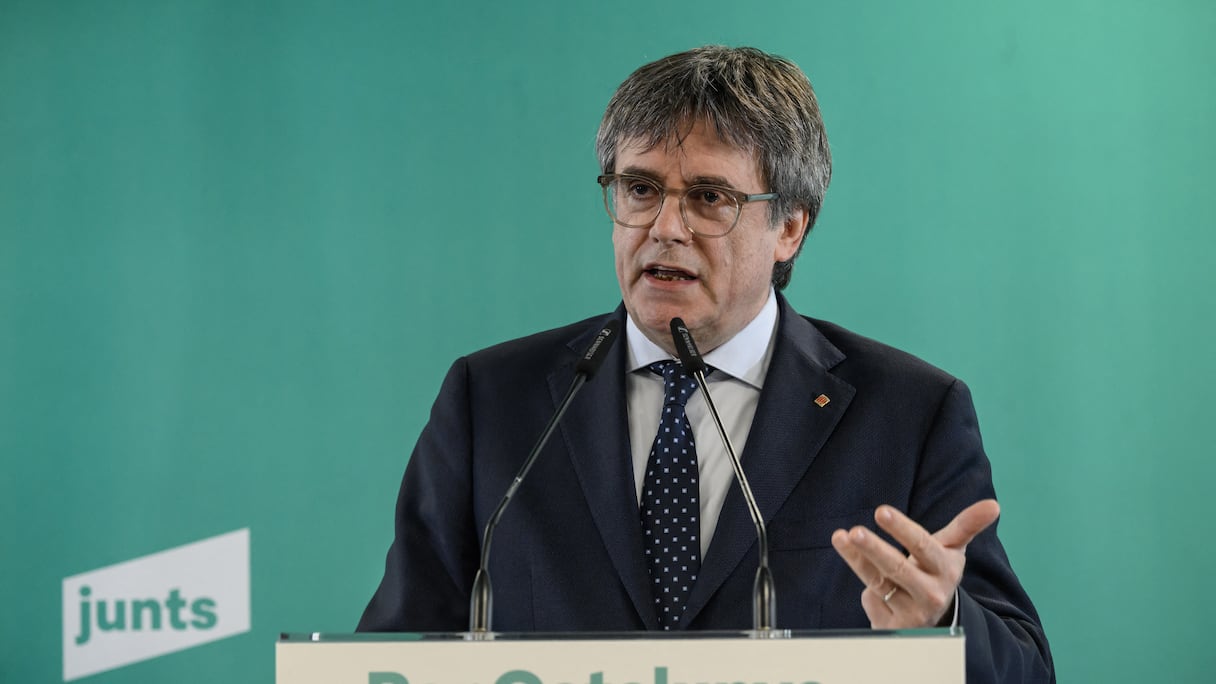
“What sense does it make for a European Union country to have two colonies or two cities inside Morocco?” Carles Puigdemont, former president of the Generalitat of Catalonia and leader of Junts, asked in an interview with British newspaper The Times from his residence in Waterloo. “From the Moroccan point of view, this is obviously a wound,” he added.
While acknowledging that “the population of Ceuta feels deeply Spanish,” Puigdemont argued that this position would carry greater legitimacy if it were put to a vote. “Wouldn’t their position be more legitimate if they held a referendum on self-determination?” he asked.
The Catalan leader immediately drew a parallel with Catalonia. “Spain will not allow it because it fears that we would also demand a referendum,” he said.
Puigdemont is far from being a marginal figure in Spanish politics. Junts’ support is crucial to the continuation of the legislature, and the party is part of the majority that enabled Pedro Sánchez to secure his investiture.
By describing Ceuta and Melilla as “colonies,” placing them “inside Morocco” and calling for a referendum, Puigdemont has created an uncomfortable issue for a government that repeatedly maintains that Spanish sovereignty over the two cities is not open to discussion.
From the European Parliament to Spain’s political debate
Puigdemont’s comments came only days after the status of Ceuta entered the debate in the European Parliament. During a session held on September 16, Italian MEP Ilaria Salis, a member of The Left group, said that “Ceuta is not Spain” and that “Ceuta is not Europe.”
Salis described the city as a remnant of European colonialism in Africa and accused part of the right wing of exploiting the migration situation to fuel nationalist and anti-migrant propaganda. “Someone had to say it in a parliamentary debate that still seemed to be taking place in the middle of the colonial era,” she later wrote, reaffirming her position.
Questions over the status of the two cities had already emerged in Spanish political debate several weeks earlier. On August 31, Esquerra Republicana de Catalunya President Oriol Junqueras described Ceuta and Melilla as a “geographical and historical anomaly.” “How many countries have enclaves and cities on another continent?” he asked in an interview with Catalunya Ràdio.
During the same interview, Junqueras called on the Spanish government to control its borders and questioned whether the large-scale entry recorded in Ceuta could have taken place without the knowledge of the Moroccan authorities. He did not, however, call for the transfer of the territory or for a referendum on the sovereignty of the two cities.
Spanish government rejects any discussion over sovereignty
Puigdemont’s proposal runs counter to the position maintained by successive Spanish governments, which consider Ceuta and Melilla integral parts of Spain and rule out any negotiations over their sovereignty.
Spain’s Foreign Ministry reaffirmed in August that the two cities form part of the country’s territorial integrity and the European Union’s external border. Defense Minister Margarita Robles said at the time that they were “deeply Spanish” and that “no one touches them.”
Since its independence, Morocco has claimed the two cities and rejected the comparison made by Spain between their situation and that of Gibraltar. Ceuta and Melilla, however, do not appear on the United Nations list of Non-Self-Governing Territories awaiting decolonization.
The Catalan referendum in the background
The issue of Ceuta and Melilla accounts for only part of the lengthy interview Puigdemont gave to The Times, which mainly focused on his political and legal future and the possibility of his return to Catalonia.
The former Catalan president once again defended the unilateral referendum held on October 1, 2017, and said he had no regrets over the decisions taken at the time. “I regret nothing. I am proud of what the Catalan people achieved. We defeated Spain democratically,” he said.
Puigdemont described the vote as an advance for the independence movement. “There was a referendum. We won it, we organized it and, despite the police violence, we held it. It will remain in history because we took several steps forward on the road to independence,” he said.
He also said that when he promoted the referendum, he was prepared to remain away from Catalonia indefinitely. “I did not know how long my exile would last, but I was prepared to spend my whole life there. And if I have to spend my whole life there, I am ready,” he concluded.
